Part Three: Kick-Ass Granny

The morning of Day Three is like hitting the replay button. It’s comfortable and familiar with no surprises. I slept fairly well before and after some distressed wild thing shrieked in agony for about an hour in the night but I don’t mention it. Nobody else will have heard it, and if they did, they won’t say so.

I’m invited to a wedding reception today. Gede, the sweet, sensitive jokester who works in the house next to mine, is thrilled. His girlfriend of several years is finally pregnant. Children are important, if not essential to the culture here and often a wedding is forthcoming only when the woman’s fertility is a proven fact.

I’ve been told the reception will be in the morning, but a message from Gede to Ketut let’s him know not to bring me before 1 p.m. The couple is still having their makeup and costumes done. I find a straw broom and sweep the baked earthen yard halfheartedly, kicking up clouds of dust. I recharge my camera and delete several dozen photos to make room for a few wedding shots. I walk to the side of the cliff and gaze at Mt. Abang in the distance. Then, when I’ve exhausted all my options, I twiddle my thumbs.

“Maybe relax, you go in room, relax.”

“Okay? I won’t disturb anybody?”

“No. It’s okay.”

I stretch out and allow my body to melt into the bed. When I wake up and look at the clock, two hours have passed and it’s time to go. Today the temple clothes aren’t a requirement and I’m grateful to be able to grip the bike between my thighs for the plunging drops and zig-zaggy turns. My sparkly sandals are the only dressed-up thing about me, but I’ve learned that as the token foreigner I’m going to look unusual no matter what I wear.

Upon arrival we’re told that Gede and Ary are still inside. We’re offered Coke, Sprite, and sweets. Ketut sits with the men. I chat with the women and Gede’s father who is a round, jovial gentleman and has the same sense of humor as his son. We’re having a fine conversation when right in the middle of a sentence, he jumps up, pulls back a blue curtain that I hadn’t noticed before, and says, “Eat! Please! Eat!”

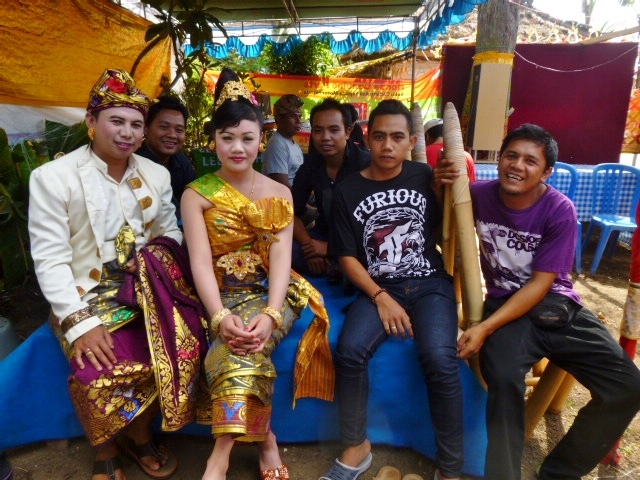
The row of chafing dishes lined up on the buffet table is impressive and as our host uncovers each one, spicy aromas fill the tent. I heap my plate and every bite is more delicious than the one before. As I’m shoveling the last morsel of banana tree trunk into my mouth, there’s a ripple of excitement from outside. The bride and groom have arrived.

P1080105I take a volley of photos, then Gede joins the men and Ary and I join the women. She asks me about weddings in America. Does the bride have her makeup done? Does she wear traditional clothes? I reassure her that many brides hire a person to do their hair, makeup, and nails and that for traditional weddings, the bride wears all white. She thinks an all-white dress sounds boring. I start to argue then glance again at her elaborate costume and say no more.
P1080108

After a dignified length of time I thank the parents, say goodby to Gede and Ary, and let Ketut know I’m ready to point my nose toward home. We pull out of the gate and bump along for about a half mile when Ketut says, “Want to see my grandmother? She 150 years old.”

“One-hundred fifty? Are you sure?”

“Oh ya. Very old.”

I’m at that point where the horse can smell the barn. I just want to be home! But I’ve learned that when Ketut throws out an off-handed suggestion, I’m a hundred times the fool if I don’t jump at it. In a few more yards he hangs a hard left and revs the gas for a vertical climb. We’re now on a dirt trail about the width of the bike tire.

“Where does she live?”

“On mountain. No more house, only her house.”

“She’s 150 years old and she lives in a house alone on the mountain?”

“My grandfather also.”

“Your grandfather is still alive?”

“Oh ya, very strong, still in garden, feed cow, good body.”

I marvel silently at this information while trying to ignore the fact that all signs of civilization have disappeared and we’re still going straight up. With a lurch, the bike swerves right and a cluster of concrete block buildings lays dead ahead. Ketut kills the motor and I swing my leg over for the dismount. It feels like we’ve warped into a different universe surrounded by a vacuum of silence.

I follow Ketut through a gateway into an immaculate courtyard. The black dirt is smooth and hard as concrete without a tree or shrub or blade of grass and there isn’t a soul in sight.

“Maybe in garden,” Ketut says.

We walk around the corner of a building and a broad, parched meadow spreads before us. Several yards away a stooped figure rises to look at the intruders. Communication passes between Ketut and his grandfather.

“She not here,” he says after the exchange. “She cut grass for cow.”

“Well she couldn’t have gone far. Let’s go find her.”

We set out along the treeline bordering the meadow. Within a few minutes we’re passing mounds of fresh-cut grass. Another figure comes into view, swinging a curved knife that mows down the long green blades with stunning efficiency. She sees us and stands, erect and alert. I don’t know what I expect a 150 year old woman to look like, but I flash on a memory of a proud buck, frozen in a meadow, watching me. She’s elongated. Her thin, bony body and face seem stretched out rather than the slumped and shrunken form so common to the elderly.

I smile. She glares and stares for a moment, then issues a command to Ketut. He jumps to attention and gathers up a pile of grass while she picks up another. I trail behind gleaning the shreds that drop from their overloaded arms. The cows are excited to see us as we dump dinner in front of their noses. Then granny disappears inside the house.

“Wait a moment,” says Ketut and we stand in the courtyard until summoned a few minutes later. There’s been a transformation. Field worker granny has donned a coral satin blouse and a fresh sarong. We’re invited in and grandpa, not to be excluded from the action, enters behind us. They sit side-by-side on the low bed and agree to a photo.

P1080116Granny still hasn’t smiled, but Ketut engages her in conversation and the more they talk the more animated she becomes. They’re speaking Balinese so I understand nothing. All at once she jumps up, bustles to the other side of the room and rummages in a cabinet. She returns holding a tablet and opens it to a page covered with what appears to be tiny circles. But the longer I look, figures emerge. The detail is dizzying.

“Spirit picture,” Ketut says. At that she moves to another corner and returns with a fabric pillow about two inches square. Once again she rattles a string of words at Ketut. “Oh, she say cut cut picture, put inside. People buy. Make good spirit come.”

“So besides the cow, she has this business?”

He turns and asks her a question. Suddenly she’s very animated, talking fast and with intense feeling.

“She say before, she fighting.”

“Fighting?”

“Ya, she study fighting.”

“You mean like martial arts? Kung fu sort of thing?”

“Ya, ya. Like kung fu.”

It takes me a minute to digest this when he turns back to her and asks her something else. As she answers, her cheeks grow pink. A youthful energy shoots through her body. Without warning, granny’s hands clench into fists. Her feet come off the ground and with lightning swiftness she kicks and punches the air.

P1080117My mouth flies open and I gasp. She doesn’t stop.

“Wow! Wow! Wow!” It’s all I can say. The woman is phenomenal. Her face glows with a beauty beyond anything I’ve seen on glamorous stars. She radiates a fierce, fabulous, power that captivates and stuns me. Long after she stops, I can’t take my eyes from her face. She fires another string of words at Ketut and he translates.

“Oh, she say study in many place and king of Bali ask her to teach all police how to fighting.”

“The king asked her to teach the police how to fight? Really!”

“Ya, but she say no. She say no good for woman to teach man how to fight.”

“Wow,” I say again for the hundredth time and then we all fall silent until granny once again breaks the spell.

“She like your sandal,” Ketut translates. I kick one off and slide it over to her.

“Ask her if it fits.”

She slides her foot into my newest, sparkly-est, sandal. It fits. Not perfectly, a half size larger would have been the best, but for all intents and purposes, it fits.

“Does she want them?” I ask as I kick off the other one. The delighted grin on her face is my answer.

P1070406

“Tell her I want her to wear them when she cuts grass for the cow.” Ketut translates and granny nods vigorously through her laughter.

“But you no shoe,” Ketut frowns. Miles and miles on the motorbike barefoot isn’t going to cut it.

“I have extra.” I pull my everyday pink rubber flip-flops out of the bag beside me. Meanwhile granny slips on the other one and she’s back in kung fu mode, her new sandals flashing with each thrust.

Twenty minutes later we’ve taken our leave.

“Did you know your grandmother was a fighter?” I’m working hard to assimilate the mind blowing encounter I’ve just had with an ancient kung fu warrior on the side of this mountain.

“No, don’t know. She don’t say before.”

I lean forward and close my eyes as the plummeting path ahead presents a perilous reality. The kung fu granny image is burned into my retinas. She moves like a twenty-year old. Her mind is clear and present.

“Are you sure your grandmother is 150?”

“Maybe 150, maybe 115. She don’t know.”

I feel the bike flatten out and open my eyes. We’ve reached the main road, safe. One hundred fifty, one hundred fifteen, what’s the difference? Kung fu fighter, spirit pictures, farm girl deluxe. Do you want to see my grandmother? More than that, Ketut, I want to BE your grandmother when I grow up.

Day Two: Marching up the mountain

I shook my head at Ketut, shot him a withering look for breaking his promise, then followed the smell of coffee. Two grandmothers in towel-wrapped heads squinted at me silhouetted in the doorway. Steam poured from a soot-blackened kettle and smoke from the wood fire clung to the low ceiling. Eyes stinging and watering, I crouched below the haze and slid onto a stool in front of the glowing warmth as a package of cookies and a cup of thick, sweet, Bali kopi was passed to me.

The grannies kept up a stream of chatter as I drifted in a dreamy, heat induced stupor. Other family members entered like shadows until the little room was full. It’s always the same, coffee and sweets as the family awakens and gathers in the kitchen. Then a big breakfast of rice, vegetables, tofu, and chicken follows the morning chores.

But on this day, after coffee all similarities ceased. The holy man appeared. Men and women arrived in temple clothes. Offerings created the day before were carried to the street and loaded into the back of a white truck. Women hiked themselves, sidesaddle, onto motorbikes that roared off in a dusty cloud.

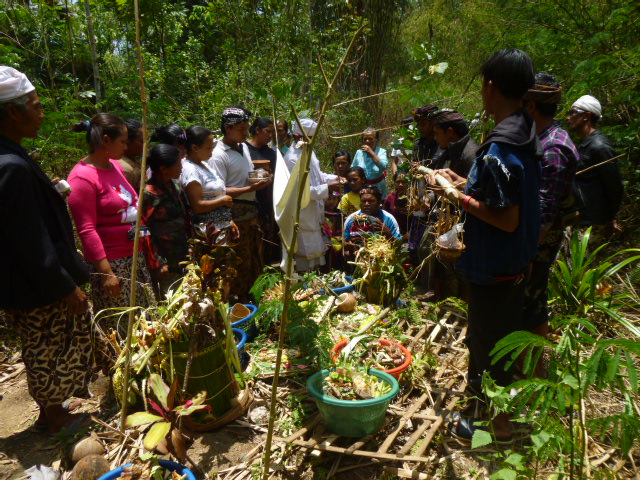
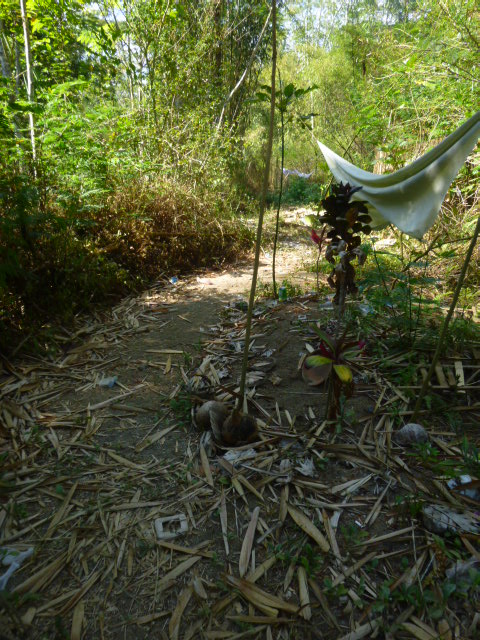
“Go to cemetery,” Ketut said, as he pulled up on his motorbike and I, too, hoisted myself to sit, lady fashion, sideways on the slippery bike saddle. If the road had been paved before, it was so eroded by water and time that it was no more. Gullies and chasms made for a rough ride. “Massage,” Ketut said as I clung and bounced.P1070952The cemetery would not have been identifiable as such had I not known. There were no neatly clipped lawns, orderly headstones, or flowers. It was a clearing on the side of a forested mountain. A white cloth suspended, hammock-like, from two bamboo poles indicated Bapak’s burial site. Silence seemed a heavy thing, weighted by solemnity and the lack of movement in the air. Someone put a drink and a little food on the grave and a lump formed in my throat.

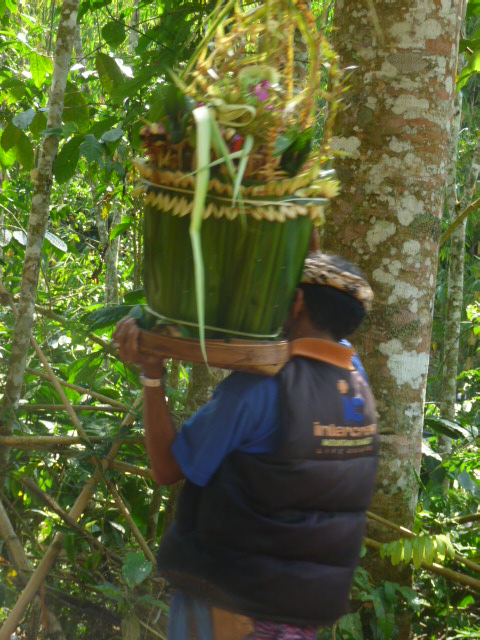
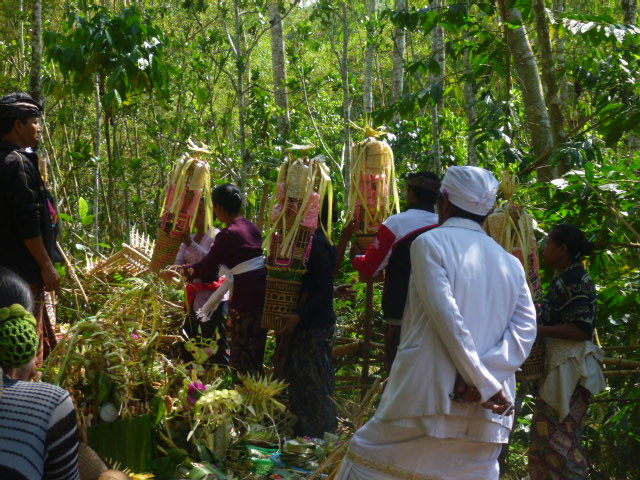
Commotion behind me signaled that the offerings and the white truck had arrived. Instead of coming to the grave, women, balancing the precious cargo on their heads, and men carrying the larger baskets, were marching single file up the mountainside.

P1070970

I thought I had seen all of the exquisite creations, but I watched the stream of elaborate baskets and trays go by noticing many for the first time.

P1070979

After the ceremony the fabrics in this offering were distributed among an eager group of women.

P1070985I picked my way, with help, up the sandy slope sliding two steps back for every one step forward. How do they do it with baskets on their heads?

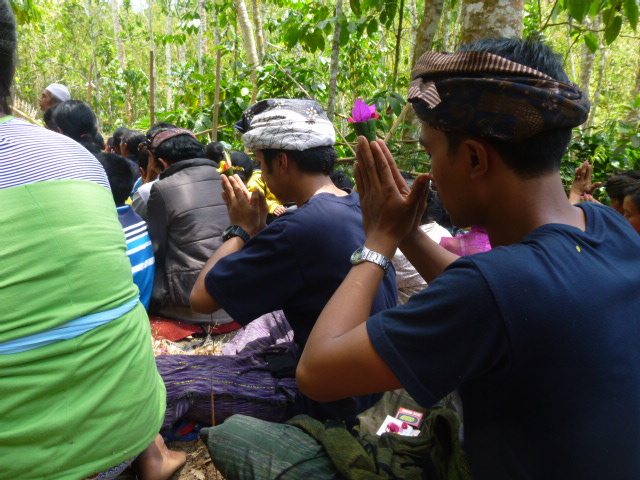
P1070986The bearers waited at the top until the priest showed each one where that kind of offering should be situated. P1070992 The bounty was piled high in front of the seated crowd when the line of gifts coming up the incline finally stopped. After arranging them in the correct ritual order, the busyness ceased and a hush fell over the crowd. Silence. There were no birds singing, not a breath of wind rustled the trees. Then a low, melodious chant, soft at first, but building in volume and strength, flowed from the women. Moments later the priest joined them, his voice a raspy, hypnotic tone accompanied by his ever clanging bell. P1070966 Prayers commenced, a well-orchestrated sequence that changes very little no matter what is being celebrated. Rich with symbolism, it’s the one time during a ceremony when people stop chit-chatting, instant messaging or gaming on their smartphones, and give the officiant their full attention. P1080006Lost in the beauty of nature, the warmth of the people, the intimacy of this eons old practice, I felt very close to Bapak. At that moment a wind swished the leaves of the trees overhead and brushed a swath of air across my hot, moist face. “Goodby, Bapak,” I whispered and a rogue tear slid down my cheek. The crash of gamelan answered me, resounding through the trees from somewhere below shifting the energy into a rousing farewell to his spirit.

“You have photo of gamelan?” Ketut asked.

“Not yet.”

“Now is good time.” Grateful for a chance to stretch my legs and relieve my buttocks after hours on the ground, I stood and headed toward the path, half skidding, half running down the mountain.

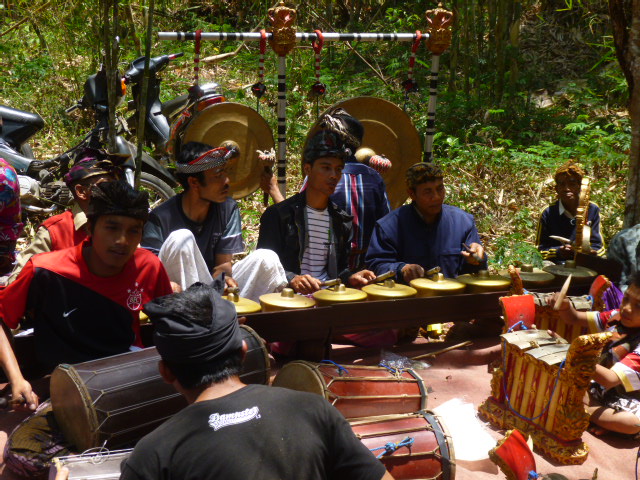
The gamelan orchestra was spread out in the shade focused and intent upon the difficult rhythms they were creating.

“Ketut are there are special songs for different ceremonies?”

“Different gamelan group, one for temple called Gong Gede, one for when people die called Angklung. Angklung song sad, Gong Gede song happy.”

P1080008 I listened but to my Western ear, gamelan can never sound sad. Perhaps the beat was a little slower, the pounding a little less intense, but even funeral gamelan has a vital energy that stirs and enlivens my senses.

The ceremony on the mountaintop was over and the offerings were making their way back down the slope to Bapak’s grave. I watched as the pile became a mound and family members gathered on the northeast end of the site, the direction of his head.

“Ya, when in ground same as for sleeping,” Ketut told me in answer to yet another of my endless questions. The Balinese sleep with their heads in the direction of holy, Mt. Agung.

P1080037When the last basket was settled in place, the men erected a bamboo fence around the grave. I learned later that this is a ritual performed only for the body of a minor holy man called a Dulu in Ketut’s village. His father was a Dulu and he, Ketut, will eventually also have that designation. Every question I ask, and every answer I receive prompts about fifty thousand more questions. But the language limitations are still so great that I don’t ask them. I just wonder, and marvel at the endless layers of significance that exist in every aspect of the life of the Balinese Hindu.

P1080063Once the cage was in place and Ketut had circled it distributing small packets of satays along the exterior perimeter, “So all spirits can have party,” he said, the family received one more round of blessings and started home.

I lingered, taking time to say goodby. Here was a man I had met only two years ago. Our ability to communicate was limited to Ketut’s willingness to translate which was limited even farther by Ketut’s very basic English language skills. But Bapak persisted with questions about America, about my family, about the solar system, seasons, and the cost of a house or a plane ticket to the U.S. He was soft spoken. His sons have the same gentle quality of voice. But intelligence burned from his eyes and the intensity with which he listened made my breath catch in my throat. As I stood there, emotion rolled over me moving from gratitude, to loss, to love, and back to gratitude.

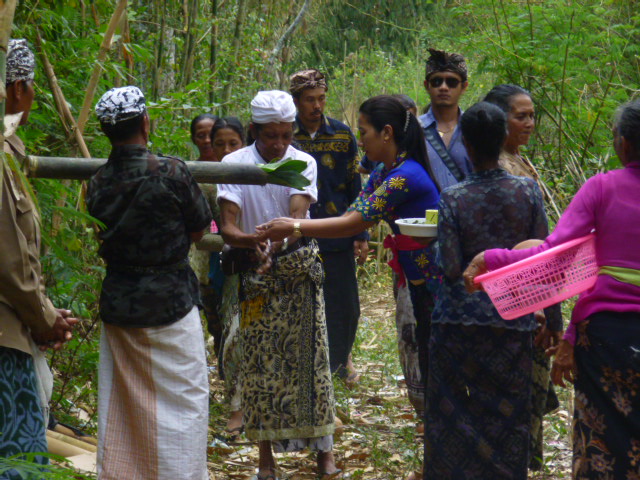
At last I turned away and hurried to catch up with the crowd. I saw what looked like another family ritual and turned to go around so as not to disturb, but was waved back. When I got closer I understood. I needed purification after being in the company of the dead. A long bamboo tube with leaves tucked into its mouth tipped over my hands and cool, clean water trickled out. I rubbed my palms together and was told to take some of a green mixture of finely chopped leaves and continue to scrub.

P1080066Thus cleansed, I found Ketut and the motorbike and we headed back to the house. People were lined up opposite the gateway to Ketut’s family compound when we arrived. I hopped off and went to join those waiting and once again, hands beckoned me to come to the gate. I couldn’t make out what to do but I knew something was required. There was a person standing on one side with a dish of salt. There were hot coals burning in the center, and another person stood on the opposite side with a bucket and ladle. Behind this setup was a holy man seated on the ground deep in prayer.

P1080070Watch and learn, Sherry, I told myself as a woman in blue carrying a child dipped her hands into the salt, scrubbed them and flicked the remains over the fire, then proceeded to the man with the buckets who sloshed water over her feet.

P1080073Once the feet were doused a dribble was poured into her hands which she drank. Only then did she proceed past the holy man and enter the compound. At the first opportunity I quizzed Ketut. What happened at the cemetery and again at the house?

“Water at cemetery make ok  go home so spirit don’t follow. Leaf same. When home salt make dark spirit go into fire. Must wash feet so land from cemetery don’t go in house. Drink water a little take out spirit. Holy man sit in middle make no spirit come in.”

“Right. Of course. Thank you. Glad we cleared that up!”

Once the family had all proceeded through the gate, the rest followed. In the back of the property, yet another priest, seated with more offerings, prayed and blessed the family home while the women once again filled the long tables with bowls upon bowls of food and the blue laundry basket overflowing with rice.

P1080078Faces were showing signs of wear and as soon as their plates were emptied, a weary group straggled through the gate toward home.

P1080081The men began deconstructing the tarp shelters and for all intents and purposes, it appeared that the big day was coming to an end.

P1080080I’d been close to nine hours in my corset and sarong. Up the road about a half mile is the house of another friend and I’d promised her I’d stop in after the ceremony. I longed to shed the constraints of my restrictive clothing and have a few laughs with her.

“Ketut, maybe I can go to Nyoman’s house now? Finished, ya?”

“Oh, not yet temple. Want go temple?” I couldn’t believe what I was hearing.

“There’s more?”

“Ya, in temple.”

“Of course I want to go.”

And of course I did. There wasn’t one moment of this fascinating day I wanted to miss. The rigorous activities required of the living to appease the spirit of the dead mystified me. Back on the motorbike and up the steep hill to the top we zoomed to the location of the temple. A handful of people were sitting just inside on the steps and they flagged me over to join them. Then we waited. And waited. And waited.

“You want to walk? Take more photos?” someone said. So I walked and snapped a few more pictures. Slanting rays cast long shadows when by some mysterious clock it was time. We were a small group, five priests, a few elder men, several women, and a child. I sat with them and observed. When it finally began it was brief and I assumed, which I should never do, that this final temple ceremony ensured that the village was also purified and safe from unruly roaming spirits. (I asked Ketut before writing this. Nope! That particular ritual had made it possible for the family to once again go to the temple. When a relative dies the rest of the family cannot enter the temple until either the cremation or this special ceremony is held.)

P1080090By now my energy gauge was hovering around empty. We returned to the compound and as I walked back to the room to finally free myself from my ceremonial outfit, I passed this little fellow, down for the count.

P1080079 Alone at last, I unzipped the corset, untied and unwound the sarong, and let my stomach fall out into happy freedom. My lungs sucked in deep breaths of air. What a day you’ve had, Bapak. What an incredible day.

Next

PART THREE: Kick Ass Granny

Part One: Death isn’t the end

Six months ago, in a hardware store in Denpasar, Ketut answered a phone call. He moved to a quiet area behind metal shelving to talk. It was a light-hearted outing but the man who emerged after the call walked as though wounded and his face, attempting a smile, masked pain.

“Ketut, what’s wrong? What happened?” He didn’t speak right away. Maybe he was still grappling with disbelief. But when he was able to answer it was a message that sent my heart plummeting to my feet.

“My father die.”

———-

Extended family performed the necessary procedures on the body, washing, wrapping, blessing, keeping watch, and burying. But other ceremonies in the village took precedence so the funeral for Bapak had to wait. In Abang Songan there is a mass cremation every five years. Very few families can afford the expense of an individual cremation, so the body is buried and later exhumed for burning with the rest.

P1070891That poses a bit of a problem. The spirit must have a proper sendoff. Nobody wants the spirit of the deceased hanging around for long because it requires tending. Since his passing, Bapak Ketut has been fed every time the family is fed. When gifts are received, he is given a portion. Ancestral spirits are honored and kept happy because it is believed that an angry spirit will wreak havoc. Even with all possible care taken, every stubbed toe and skinned knee in the ensuing months will be attributed to a dissatisfied soul.

October 30th was the day ascertained by the holy man to be auspicious for the releasing of Bapak’s spirit. I was invited to attend. Ketut went home days before to help prepare. There were shelters to be erected, platforms and blankets and tarps to be borrowed, chickens killed, fish caught, vegetables collected. The guests would bring rice, coffee, and sugar as part of their contribution.

Ketut’s older brother, Nengah, came at 7 am the morning before the ceremony to pick me up. When we arrived in the village an hour and a half later, an army of people were already at work.

There’s one job that I know how to do. Only one. Without that job I am destined to wander aimlessly with my camera for hours, long past the battery’s capability for more photos.

I peel onions.

But the kitchen had gone missing.

“Di mana dapur?” I asked the first woman I saw. She motioned in a direction back where I’d come from, then took my arm steering me around a corner, then around another, along a narrow alley between a tarp shelter and a house, over a stoop and behind another house. There they were, the piles of vegetable, the steaming woks and kettles, whole chickens flattened as though they’d met with a steamroller, and the Ibus, chattering and working as smoothly and effortlessly as a new Mercedes Benz.

I greeted them and was invited to sit.

“Thank you,” I said, “But first, where are the onions?” My question was followed by a shotgun volley of words in Balinese, a language I will never understand, and then laughter. A blue plastic laundry basket was hoisted off a shelf and the contents poured into a pan. “Knife?” I asked. A sabre of fearsome proportions came my direction. “Small please?” More laughter but a smaller knife was produced. For the next few hours I peeled onions, made jokes in my broken Indonesian, and functioned as a member of the kitchen crew.

P1070877

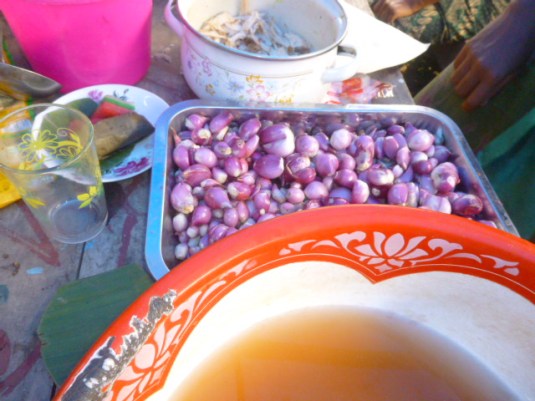
Bali onions are tiny, about the size of a large clove of garlic. and red. One pan full was the sum of my whole morning’s work.

P1070869

For about twenty minutes these two industrious young ladies helped me peel.

P1070856

In another area women assembled hundreds of offerings.

P1070945

Some of the designs for this particular ceremony were elaborate and unusual.

P1070894

Ketut told me that this vertical basket contained sixty different kinds of leaves. “All the leaf from my house to the river,” he said. It also held sixty eggs, and sixty garlic cloves, sixty onions, in essence, the fruits of the land. To my question, “Why?” there was the usual answer…

“I don’t know.”

P1070857 In another area the men chopped fish and chicken, bones and all, into a meaty pulp. They mixed each of them with pulverized coconut, onions, garlic, and chillies, then smooshed the mixtures onto bamboo sticks. The sticks had been carved the day before.

Coffee and sweets were served when the workers arrived and again later in the morning. At 11:00 am the blue laundry basket appeared, this time heaped full with steaming rice. Dishes of vegetables and tofu, satays, bean soup, potato soup, deep fried fish, and chicken with spicy sambal (the Balinese version of salsa) created a feast for the eyes and the palate. After eating the men smoked and the women chattered, then it was back to work. Mid-afternoon the young girls of the family in tightly wrapped sarongs, once again brought out trays of coffee and sweets. At 4 pm the buffet reappeared. When the last satay stick was licked clean, people drifted to motorbikes or started the walk home. Easily fifty people were fed twice on this day as they had been for several days prior.

But as the sun set and evening chill settled over the mountain there were still a dozen or so extra bodies hanging out. Ketut and his wife insisted that I take their room with the double bed, television, and privacy.

“Where will you sleep?”

“All sleep outside, many many.”

“All these people are spending the night here?”

“Ya, all. You want shower?”

“But where is everybody going to sleep?”

“Ya, here.” A sweep of Ketut’s arm indicated the platforms that earlier held the offering makings.

“Outside? Really?”

“Ya.”

“Ketut, it’s cold!”

“Oh no, many people, very warm. Ya, you take shower now.” As if on cue, his brother appeared carrying a bucket with a small faucet attached.

“Hot,” he said.

I dutifully followed him to the bathroom where he showed me how to operate the faucet then left. The hot water felt wonderful. I dabbed at my face, neck, and did the best I could without soap, washcloth or towel, and the pail was still 3/4 full when I finished. But fresh guilt assaulted me.

“I don’t want your wife and baby sleeping outside when I have a warm room. That’s not okay.”

“Ya, later they sleep inside.”

“With me?”

“Ya, later.”

“Promise?”

“Ya.”

Somewhat mollified I kicked off my sandals at the door and went in. The bed seemed wide enough to sleep crosswise so I stretched out at the foot leaving plenty of room for Komang and the baby. Remembering a previous experience with nocturnal visitors, I left the light on hoping to discourage unwanted guests.

At 5 am I awoke to barking dogs and cock-a-doodle-doing roosters, alone. Still fully clothed, I ran a comb through my hair, pulled on a sweater, and poked my nose outside. A row of mummies, sausaged into a variety of blankets, stirred ever so slightly. Ketut’s head popped out. My glare was answered with his happy grin that spoke, I won! louder than words.

Next

Day Two: March up the mountain

The Bali Blue Bed

Indonesians make amazing beds. Historically they used them for sleeping, but Westerners have adopted these exquisite creations to serve as sofas where several people can curl up and have a cozy conversation.
 *

For months, Ketut has been hauling me to and fro through surrounding villages stopping at every shop with a daybed for sale. I’ve seen them all, from heart-stopping gorgeous ones to those with manure and pig-smell hanging about them. Even though the choices were endless to the point of customizing something to my specifications, I was ambivalent.

 *
Then last week at Ketut’s home in Kintamani, I toured the family compound and caught up on the latest happenings. As we passed through the wood shop, a flash of blue in the corner caught my eye. It was heaped full of stumps and chunks awaiting the skillful knives that would reveal the images within. Upon closer inspection, my eyes nearly popped their sockets. It was a DAYBED, carved in the old style and painted Bali blue. In disbelief I turned to my host.
*
“Ketuuuuut…what’s this?”
*
“Oh, old bed. My father make.”
*
“Your father made this?”
*
“Ya, very old.”
*
“Ketut, this is a daybed.”
*
“Ya.”
*
“Remember, you have been taking me all over Bali looking at daybeds.”
*
“Ya.”
*
“You didn’t tell me about THIS daybed!”
*
“Oh no. Very old. I forget.”
*
I took a few deep cleansing breaths and studied the lines, the detail, and checked the sturdiness. It appeared to be strong and fully intact.
*
“You like?” he asked.
*
“Ketut, it’s amazing! It is exactly what I’ve been looking for. And your father made it! Do you know how special this is to me because your father made it? Do you think your mother would sell it?”
*
I was speaking too fast about abstract feelings, most of which, I knew, would be lost in translation. But he caught the gist of the last question.
*
“I ask,” he said.
*
He disappeared for a few minutes and returned with a tape measure. He knows the size I want and he stretched the tape for the length, width, and height calling out the numbers to me. It was perfect.
*
“Will your mother sell it?”
*
“Ya, you can have. Very old, nobody want.”
*
“Ketut, I need a daybed. I am going to buy one somewhere but this one is so special and I want to pay for it. Is that okay?”
*
“Ya, up to you.”
*
I left in a state that can only be described as bliss. He said he would arrange to rent a truck and bring it to me. It arrived two nights later around 8:30 pm  with Ketut and five family members. They carried the pieces from the street along with four big new trees for my garden and a pair of giant carved mushrooms, also for my garden!
*
Over the next two days I scrubbed years of use from the frame and Ketut sanded and applied new varnish to the side panels. Yesterday afternoon he assembled it.
P1070823
 Ketut in assembly mode.
P1070833
The beautiful Bali blue bed in all its splendor!
P1070835No mattress yet. I’ll order one made to fit. Pillows are enough for now!
 *
This daybed embraces me and it will do the same to all who join me here for future conversations. Ketut’s family is extraordinary. His father passed away six months ago. He  was a very special man, and now I have something that was not only made with his hands, but used by the family until they bought a new, modern one three years ago.
P1070832
 There are unfinished areas on the sides that were always against a wall in the room in Kintamani. As we discussed paint possibilities I mentioned the white ridged detail along the canopy.
*
“Maybe a new color there?”
 *
“Not possible,” said Ketut in the voice that means it really IS NOT POSSIBLE.
 *
“Why?”
 *
“This Barong Gigi, not possible change.”
*

“Oh, the Barong’s teeth? Really? Is that right?”

*
“Ya, long time ago all Bali house have this. Now make with machine but my father make this.”
 *
 I look at the hundreds of half-cylinder shaped wood pieces and my awe deepens. Not only do I have a family heirloom, but it is infused with the rich, protective magic of the Barong. I know the Barong. He’s the physical manifestation of the king of all protective spirits. In the ceremonial dances he’s huge with a hairy body and lion-like masked head full of large, white teeth.
P1030313
I feel myself choking up, a common occurrence in my life here. That feeling always accompanies the intense gratitude for what seems to fall effortlessly from the gods into my lap.
*
“Thank you for telling me, Ketut. I love this bed so much!”
*
“Ya.” There’s silence for a moment while he applies varnish to the bamboo slats that hold the mattress. “You have more question?” I laugh. He loves to tell me about Balinese beliefs and wants me to write a story about Bali. Maybe I will. I’ll call it The Bali Blue Bed!
*
Oh, and speaking of blue, Bali blue is a color I NEVER would have incorporated into my decor. So bold, so very very BLUE! Now I’m rethinking my whole design scheme to highlight that color. It gives my heart a joyful bounce every time I look at it.
*
On all those daybed outings I told myself, I’ll know it when I see it. There were many stunning options, ornate and delicately carved, but my mind never said, Yes! This is it! until the woodshed. I’ve learned this about myself: I need to wait with decisions until my heart leaps out and grabs onto something. Until then it’s just stuff. But after the heart takes hold it becomes a treasured part of me, its presence an intrinsic piece of my happiness.

Sexy men in sarongs

I’ve heard it said that Asian men are androgynous. Statistically they’re smaller in stature than men in the West. Most have less body hair and finer features. I’ve been around Japanese men, a few Koreans, and now hosts of Indonesians. To my aesthetic, there’s nothing sexier than a man in a sarong. Androgynous or not, they are magnificent!

P1070751My friend, Dewa I, (the hottie in the photo) invited me to his village months ago for a special ceremony. I have no idea how special until Ketut and I are about a mile from the town and we’re stopped by a Pecalang, the local security guard.

“Sorry, no vehicles past this point, special ceremony.”

“Yes, we know. We’ve been invited.”

The guard peers at me. I’m in full temple garb and I’m sure he’s wondering how I fit into this picture.

P1070729As authentic as it looks, I’m not passing muster.

“Sorry. Road closed.”

Ketut rattles off a few sentences in Balinese, slides his phone out of his pocket, and calls Dewa. The next thing I know we’re waved through. Even in Bali…especially in Bali…it’s not what you know, it’s who.

In a mile or so we come to the village. Another Pecalang motions us off the road into a parking area. We leave the bike and are ushered to a roofed platform where three more guards confer about what to do with this smiling American and her Balinese escort. They’re holding two-way radios and a flurry of crackling messages commences. “Parking lot to temple, we have an unidentified foreign female demanding entrance…!”

Five minutes, ten minutes. Ketut arranges himself on the platform with a cigarette. One of the men notices the sun beating on my fair-haired head and invites me to sit in the shade. Fifteen minutes, twenty, then Ketut stands, ambles to the edge of the platform and says, “Dewa’s wife coming.”

We’re saved!

P1070754She’s like a vision walking toward us. We exchange happy hugs and she leads us to their home up the street past throngs of villagers awaiting the next event in the temple. The houses are nestled, tight-packed up the mountainside. We follow a narrow, walled path, ascend a staircase, and we’re there.

Coffee appears and a bowl of snacks as Nyoman apologizes. They’re all very busy today and because it’s an important ceremony and we are outsiders, we’re not allowed into the temple. But we can watch the processions and dancing that will happen in the street.

I laugh and tell her it’s fine, but my private thought is that Dewa didn’t remember, or perhaps didn’t think of it when he invited me. It’s the women who know the rules, the ins and outs of the ceremonies. But I’m delighted just to be here, to see their village and be a guest in their home.

Everyone’s jabbering at once when a shout from below brings me to the wall. I peer over and there’s Dewa II,  holding a plate of food and grinning up at me. I can hardly believe he’s the same guy who scared the stuffing out of me when we first met because he never smiled. He’s just finished a Baris performance and is grabbing a bite before it’s show-time again.

P1070747As he gobbles his lunch he tells me that he has six performances today and the next one is in a few minutes.

“Can I watch?”

“Yes.” When he leaves the girls grab my hands and we zig-zag through the crowds. They park me in the shade above the area where the dancers will appear, and then it begins. (Click here: Baris Dance.) Now the smiling face is set in a mask of concentration as he executes the complex footwork of this dance of the warriors.

P1070764The dancers form lines on either side of the women and priests who are exiting the temple after making offerings and prayers. When the ceremony draws to an end the girls are agitated. Their English is confined to, “What is your name, my name is…!” and they don’t comprehend my brand of Indonesian. But with enough repetition and gestures I’m made to understand that they have to go somewhere to do something and I should wait here. They race away. In a matter of moments it becomes clear. They are the next performance! This close-up of Dewa II’s daughter shows her with the same fierce intensity of concentration as her father in the photo above.

P1070782The girls finish and I’m collected and returned to the house where more coffee and a tour of the rest of the family compound awaits. Ketut is particularly interested as we meander past the residences of the brothers and uncles, to see the livestock. There are cows, pigs, piglets, chickens, fighting cocks, and ducks. One porker named ‘cow’ because of her immense size, lumbers to her feet and sticks her snout toward the camera for a close-up.
P1070797There’s one spotty milk chocolate runt in the pen of piglets. I feel an instant kinship with the tiny character because he looks so out of place with his pinky-grey companions. I name him Coklat (c is always the ch sound in the Indonesian language, and Cok is the name attached to the royalty in Ubud.) My companions find this hilarious.

P1070794The afternoon wanes into evening and the gamelan orchestra is still pounding a frenzy of sound when we take our leave. Nyoman bustles to the kitchen and returns with a bag stuffed with mangoes, oranges, pears, snakefruit and sweets to send home with me. We walk down the hill together, her arm around my waist, mine around hers. Then it’s back in the saddle for the long ride home.

P1070808

We pass rice terraces and fresh paddies just sprouting. “Nice area,” says Ketut.

“Yes, beautiful.”

“Good people,” he adds, and I couldn’t agree more.


No, you don’t understand…

Stretch reality, expand it until it becomes unreal, a thing so far removed from the familiar that words of explanation cease to exist.

I awaken at 6:00 a.m. to the hollow wooden echo of the kul kul and a chorus of roosters. Morning. The fingers of the great coconut palm brush my window, whish, whish, and clouds in the east blush golden. My feet meet the silky chill of the tiled floor. Curls of sweet cempaka incense from morning offerings tells me that Pasek has already appeased the gods on my behalf. I pad to the bathroom and assault my face with cold water.

Yoga pants and sports bra await. Yawning, I slip into clothes and push the wall of sliding doors aside. A rush of morning air carries the scent of onions and garlic frying and the gossipy blither of sparrows busy vying for best nesting rights under the eaves. With a practiced flick of the wrist, my mat unfurls and I step into place for morning sun salutes. Today I do the sequences quickly, pushing myself to wake up.

Forty minutes later, muscles warmed and mind clear, I open the front door. Sitting in bags, striped black and white and one shocking pink, are papaya, salak, jackfruit, sprouts, spinach, cozy brown eggs from chickens that have never known captivity, and sweet kue. I didn’t order kue, but periodically the irresistible, fattening delicacies appear. Mmmm yum! Shallots and garlic round out today’s picks. Ketut asked for my shopping list last night so he could visit the Ibus’ produce trucks before sunrise.

The teakettle whistles. Scalding water with one part Nescafe and one part Torajan coffee, mixed well and allowed to settle, brings me fully into the day. I answer e-mails then pick up writing where I abandoned it the night before. Half-way through morning Ketut appears to cook rice, vegetables, and tofu for the noon meal. Before he begins, one-quarter of the papaya is sliced into a bowl with a spritz of fresh squeezed lime juice. Breakfast is served.

“Have program?” he asks while he chops and minces.

“How about flower shopping? Go to Mas?”

“What you want?

“Short flowers, red, yellow, for the garden.”

“Maybe grass?”

“Grass?”

“Ya. Two meters make many many.” It’s clear to me that I have a fuzzy idea of what I want but Ketut has the master plan. I don’t pursue with questions.

At noon we set off by motorbike to the nurseries in the next village. The woodworker shop where I left a sketch and a request for a quote is on our way. We swerve in and stop so I can check to see if there’s a price assigned to my drawing.

“Bapak belum,” says the little moonface in pigtails. (Daddy not yet.) The shy older girl says nothing and both turn back to the cartoon characters shouting at each other on the rabbit-eared t.v. We press on.

Another mile down the road lush, well-ordered gardens appear on the right. “Grass here,” Ketut says. In the States I’ve seen turf rolled into neat bundles and delivered by truck to create instant lawn. Of course that’s what I expect. Dumbfounded I watch as the stooped Balinese man marks off two meters of ground cover and skims it from the earth into a pink plastic bag in exchange for 50,000 rph. ($4.75 U.S.) An hour later we’re on our way back to Ubud. On the bike seat between us is the bulging bag of sprouting earthen knobs, and atop that, the yellow and red blooms of ten plants bob gaily like the flowers on a clown’s hat. For a split-second I imagine us tooling down Nicollet Ave. in Minneapolis. A Neil Diamond song runs through my head,

It’s Love, Brother Love, say
Brother Love’s Traveling Salvation Show
Pack up the babies and grab the old ladies
And ev’ryone goes, ’cause everyone knows
Brother Love’s show…!

Why that song?

Back at home Ketut serves up lunch then heads to the garden. I resume writing. The sounds of drumming and male voices in a staccato kecak chant jolt me from my altered author state. Gede and Kadek, the staff from Rumah Jepun next door, and Alit from Rumah Kita on the other side of me, are helping Ketut prepare the ground for grass. Ketut scrapes and chops at the hard-baked earth and shovels it into buckets.

P1070473The three volunteers relocate the contents. On the return they pound a wild beat on their empty bucket drums and fill the afternoon with the syncopated chak-chak…chak-chak-chak… that they’ve heard since before they could walk. Primal energies churn through my nervous system. There is something deep in my cells that knows the language of drumming, knows that understanding its message meant survival. I close my eyes as the force of their sound vibrates through me.

P1070478

The performance is by them and for them, but I’m the lucky bystander and when the camera appears smiles beam upward.

Last night this same group gathered around my table to play Uno.  We’re vastly different in age, cultural background, education, and life experience but at the core, our hearts desire the same things, community, acceptance, laughter, love.

P1070490

As the sun and heat intensify, Ketut lays down the clods, pressing them into moist, loosened earth. Now I understand his cryptic, two meters make many many. He’s already planted about four meters and that pink plastic is still half full! I hurry downstairs and slip into my garden flip-flops . It isn’t until I’m eye level with the artful ‘ruin’ in the far corner of the plot that I notice the cheerful yellows and reds embedded in their new home. I had imagined stewing, contemplating, The yellow here? No, over there? No…. But I’ve been spared the indecision and it’s perfect.

P1070481

“Wow Ketut! I love it! Amazing job!” He knows he’s good, but you can never give a Leo too much praise. He poses for the camera looking like something from The National Geographic in the rolled up ‘PINK brand’ sweat pants that some guest discarded, with his t-shirt swathed around his head.

“Facebook?” he asks.

“Absolutely! Okay?”

“Ya, okay!” His grin spreads wider.

P1070482

My phone tings and there’s a text from Nina. Join me for a cocktail? I leave the garden and go around the corner to her kitchen. She dusts off the tiny blue stool that we both know is my spot. I sit, sipping a Mandarin orange juice shot through with mango vodka and marvel at the way she can talk, gesture, drink, and cook all in the same breath. We remark again at the fate that made us neighbors and agree that our friendship is a happy accident. We share the knowledge that people who haven’t experienced this kind of life cannot possibly understand its rich rewards.

At dusk I toddle home and hear the trickle of the water hose as Ketut gives the new plantings their kiss goodnight. An hour later he appears, showered and fresh. “Want fish?” he asks as he scans the contents of the refrigerator.

“Yes! Great!”

We feast on Lake Batur bounty smothered in Balinese sambal, and a savory mix of sautéed veggies over rice. At eight he closes the sliding doors and heads down the hallway. “Want door lock?” he says as he lets himself out.

“Please. And thank you for everything.”

“Ya. Good night. See you tomorrow.”

It’s a snippet, a typical day in a life that I could never have imagined for myself. Ketut is staff. Every foreign resident in Bali must employ at least one Balinese person. He has his own bedroom and bath on site. He shops for me, cleans, gardens, cooks, and carries me on the back of his bike wherever I need to go. He’s up at 5:30 a.m., to the market by 6:00, and sometimes he’s still hauling me to and from engagements at midnight. He manages my life so it’s a seamless, effortless, joyous event. But he’s also my friend.

How did this happen?


The Big Fat Full Moon

What’s more romantic than moonlight?

My father proposed to my mother on a bridge with the reflection of the moon on the Mississippi River below. She loves to tell the story, how she didn’t answer right away so he took her by the shoulders, peered into her eyes, gave her a little shake and said, “Say yes.” She did, of course.

But I haven’t had any proposals recently, and tonight is Purnama, the ceremony that celebrates the full moon.  Here’s the culprit, just an hour ago, smiling down on my balcony.

P1070350I have no curtains, shades, blinds, or draperies of any kind on any windows. I love light, most light, that is. Moonlight is different. It’s blue. Blue light is not my favorite, neither the eerie illumination from the moon, nor the cold neon glow from the cool color light bulb I bought by mistake. And when it should be dark outside but my house is bathed in that phosphorescent sheen, I don’t sleep. When I don’t sleep, I do other things, like think.

So while I was not sleeping last night as the moon approached full, I contemplated the Hindu calendar that pays homage to the lunar cycles. Purnama is the full moon ceremony, Tilem celebrates the dark moon, and they alternate every fifteen days.

All Balinese ceremonies, celebrations, and rituals have a meaning and a specific purpose. I’ve seen the women walking to temple with offerings on their heads around 8 p.m. on the moon nights. But I never thought to ask why.

So after Ketut finishes arranging a potted bougainvillea at the bottom of my stairway, I snag him. “Tell me about Purnama and Tilem. What are the meanings of those ceremonies?” Sometimes I ask him questions pertaining to rituals and he’ll think for a minute, make a sheepish little laugh and say, “What it means? I don’t know.” This time he explains in some detail and I come away understanding that this ceremony, like many, ensures the balance of opposites, light and dark, life and death, good and bad, happy and sad. If a person is experiencing sadness now, he is told not to worry because soon he will be happy. And if happy, don’t get too excited because it will change. He ends by saying, “Always like this,” and I don’t know if he’s insinuating that from the beginning of time this is the way it’s been done or if every fifteen days it’s always the same. It’s because of the possibility of various interpretations that I decide to check the internet. Google agrees with Ketut but goes on to elaborate.

P1070343Balinese people believe that at the height of the full moon and the peak of dark moon, clusters of galaxies emit a certain energy that affects the lives of living creatures on earth. Therefore, the people of Bali begged (pray) that the energy provided will be positive energy for life.

When you consider that the 2,740,300 Hindus on Bali, are all taking offerings, going to temple, and praying in the blue moonlight tonight, that’s a lot of concentrated focus on a very small island. No wonder the energy here feels different. Where else on earth is it prayed in from the galaxies?!


Travel Guide Barbie

Few things are more terrifying than a trip to the hair salon. I can say with absolute honesty that I’ve never walked out of an appointment satisfied. I’m always convinced I could have done it better myself. (Overly confident? Narcissist? Confirmed do-it-yourselfer! Yes!) So for the past several years I’ve applied Nice-n-Easy #108 Natural Reddish Blond every couple of months with deeply satisfying results.

Fast forward…Bali.

I’ve been here for two years. When friends or family ask, “Can I bring you anything from the States?” I’ve begged them to load up on as much #108 as they can comfortably stow in their already overcommitted luggage. In exchange I play tour guide, help them find drivers and navigate the unwieldy currency exchanges. To date, my sassy hair has gotten by on the good graces of visitors. Then that thoughtless company discontinued #108. Trying creatively to meet my needs the last shipment via Jan’s suitcase held various alternatives. Bless her for trying.

Those events propelled me into panic. I’m not about to give up my vivacious strawberry blond-ness without a fight.

I began my search locally and realized in short order that a natural red-blond hair color could not be found in this village. Ubud is a thriving tourist center that caters to Asian women who all have dark hair. The products I found were in shades of mahogany, burgundy, pinky-purple, and brass.

I was three months into my last color job. Desperate, I got a lift with a friend to the upscale Mal Galeria in Denpasar, an hour’s drive from Ubud, and began the inquiry. Matahari had hair dye but nothing permissible. The apologetic clerk suggested Hypermart. The name, at least, sounded promising. Reality was a bit something else. Picture Walmart times ten and you’re close. The battalion of check-out counters with lines stretching to oblivion made me re-think going natural. As I did a No way! about-face my eyes caught sight of a small pharmacy tucked into a niche on the left. It’s worth a try, my ever optimistic self said.

I asked in pidgin Indonesian if they had hair color while pointing to my head. After a quick stop at shampoo and a few more meager attempts to communicate, I was led to the back of the shop. There, in a cluster of the usual sultry mahoganies and sables, I saw an incongruous label sporting a cartoonish red-head with enormous eyes. Her hair, Sweet Apricot, was the right color.

schwarzkopf-fresh-light-hair-color-sweet-apricot-L_p0018326099I blinked several times and she was still there. May I look? I said. The name on the box was in English but everything else was undecipherable. Is it for children? I asked. The question seemed reasonable enough to me. The imp on the box was a cartoon after all! What guru of marketing would put a video game type character on a box targeting…Asian teens and young adults? Didn’t they invent the gaming phenomenon? Of course! Brilliant!

The clerks were discussing me, looking at the box, then pointing to my head. This good for you, the older one said.

Now there was no way out. The 95,000 rph price tag translated to about $9 U.S. Shelling out a fist full of 10,000 rph notes I thanked the smiling clerks, tucked my tail, and left.

The box lay hidden in a drawer until last night. A glance in the mirror at my two-tone hairline, dishwater meets redhead, sent me digging under a bag of cotton balls, bandaids, and miscellaneous other supplies. I pulled out Sweet Apricot and was appalled anew by the image. It’ll be okay, I said, Relax! You can do this!

I opened the package and organized the contents in an array before me. The design of the applicator bottle seemed to have significantly superior engineering to the single aperture squeeze thing I was accustomed to. The hermetically sealed packet of plastic gloves weren’t the whisper thin, wrist length throw-aways that Miss Clairol sees fit to supply. They stretched all the way to my elbow and were textured for a non-slip-grip. Sweet Apricot was dead serious about protecting the delicate hands of it’s users.

A quick Google Translate provided instructions that sounded familiar. It’s just hair. As I thought it, I wondered how many times I had breathed out those same three words prior to a disaster of epic proportions.

I’d stalled long enough. With the picture directions spread out on the countertop, I noticed a punch-out circle in the box just the size of the applicator bottle. I was instructed to remove the circle, secure the bottle in the opening for stability, then pour in the color cream, cover securely, and scramble. (Google translate isn’t perfect.) I did as I was told.

You don’t need a blow-by-blow, but the experience was shocking. Once again my sub-grade expectations put me to shame. The solution didn’t singe the nostrils like the Nice-n-Easy brand. It smelled good. The comb-like applicator was 100 times better than the Clairol product and delivered the color cream in an even, perfect flow through its teeth. The goo stayed in my hair and didn’t dribble down the back of my neck or under my chin. Of course all that would be moot depending upon the final outcome.

When I finished, Ubud was experiencing one of its humid, evening rain showers so I knew my hair wouldn’t dry until morning. Final judgment would have to wait.

As the sound of roosters and a chorus of frogs heralded sunrise I stumbled to the bathroom mirror. Spikes of shiny plastic Barbie-doll-ish hair sprouted in all directions. But the color wasn’t a normal Barbie color. It was more like Roller Blade Barbie or Mud Wrestler Barbie. I found myself once again squinting and rubbing my eyes. Maybe after a cup of coffee…?

P1070235After coffee I loved it! No more imports of inferior products from America. No more impositions on the good will and big hearts of Bali bound travelers. I’ve found my color at last, Sweet Apricot!

When I skyped with daughter, Joy, this morning she thought for a minute then christened me, Travel Guide Barbie and I’m okay with that. I’ll still do the tours, arrange drivers, and help with currency exchanges. And I’ll do it with gratitude for my friends who are planning future trips to Bali, because I’ve yet to find a workable alternative to CoverGirl #210 Perfect Point Plus Espresso eyeliner pencil!


When you just keep falling in love

For someone who’s sworn off men, I’m not doing too well. I’m alone, that isn’t the issue. But my defenses have been shot to shreds in the loveliest possible ways and I find myself falling in love a little bit every day.

First there’s Ketut. I’ve written thousands of words about Ketut, glowing, gushing words. When I first came to Bali he was my room staff. I remember when he met me at 3 a.m. as I disembarked from a taxi after a trip of thirty-six hours from the States. “You Zely?” he asked, then hoisted my brick-heavy suitcase on his shoulders and told me to follow him. The next morning, there he was again. “Breakfast?” he said. “Kopi? What you want?”

P1030558

Ketut with baby daughter Nengah

I remember my thoughts. A man? Why? Couldn’t I have a sweet girl cleaning my room and bringing my breakfast? Drat! I don’t want to put up with man-energy. But I didn’t understand then that the Balinese man isn’t like the men I’d known in the West. Ketut filled my room with flowers, daily. He anticipated me, knew when I would be hungry and showed up with treats. Knew when I wanted company and hung around to chat. Knew, even more importantly, when I wanted to be alone, and left me alone. His intuition was far more highly developed than mine, and I’ve come to realize that’s true of Balinese people in general. (But I won’t go into details here! Another time.) In short, Ketut healed my heart.

Enter, Gede! He’s another member of the staff in the neighborhood where I live. Gede is a clown, a twenty-one-year-old little boy who loves to laugh and make others laugh too. One day he gave me a lift on his motorbike and told me he wanted to bring me a kebaya. That’s the beautiful, traditional blouse that women wear to ceremonies here. It seemed far too generous a gift for someone who doesn’t even employ him, but the next time he went to his home in Kintamani, he came back with not one, but three stunning kebayas for me. They all fit like they had been custom tailored for my body. I fell in love with Gede long before the kebayas, but I fell a little bit deeper that day.

P1030524

Gede…always the trickster!

The Tukangs working on my house, we’ll call them Dewa One, Dewa Two, and Pak Mandi, all have a slice of my heart. Dewa One scared the bejeezus out of me when I first met him. He had an angry man look, his hair was wild and his body was as tight as a coiled spring. He snapped orders at his crew and I steered clear. But his work was immaculate and one day I drilled up the nerve to tell him how happy I was with his skillful precision. He smiled. No, you don’t understand. He SMILED! There isn’t a more beautiful face on earth than the smiling face of Dewa One. My heart became gooey. Now I find every possible opportunity to praise him and he graces me with that gorgeous grin every time. I love Dewa One.

workers that took down the yoga deck

Dewa One…you’ll have to trust me about the smile!

The most outrageous of my loves is Pasek. He’s blatant, calls me his second wife, makes highly suggestive comments and enjoys watching me bristle. I’ve met his first wife and I adore her but I wouldn’t want to be her. Her hubby’s a handful. But do I love him? Oh yeah. Pasek is the one I call when my electricity goes out, when my faucet leaks, when I need food from the market, or when I want to know about Balinese culture. His harmless joking has become just another part of life here. And he, too, anticipates me and shows up just when I am about to dial his number.

Bali - Pasek's Family (26)

Pasek and his wife, Nyoman

But it doesn’t end there. I’m in love with my tailor, with the taxi drivers, with the man who sells tickets on the street, and the shop keeper at the corner convenience store. I’m in love with my neighbor’s husband, and pretty much every Balinese man I know. Do I use the word too loosely? I don’t think so. The men in Bali are kind to me. I’m susceptible to that. In the West kindness has become a lost art. We have bumper-stickers to remind us to be kind. But here it’s a fact of life, so I just keep falling in love.

P1060558

The neighbor’s husband! (Don’t worry, Nina…you have zero competition here!)


My Village, My Tribe


P1010125

I woke up the other morning to emailed photos of the annual Family Picnic. It’s an institution, an every year reunion of all living members of my father’s large family of origin. There were twelve children who had children who in turn had children, and those children are currently having more children.  So they gather, those who aren’t feuding or living far away, at the home place, to eat, reminisce, play softball, and marvel at how they all look the same, never change, don’t age, and isn’t cousin Charley’s little girl a handful!

I puzzled over the photo for a long time and then took a walk. My injured foot felt ready at last.

The past six weeks I’ve been immobilized due to an injury. During that time I became aware of a different world. On the best days it was vacant, void of feeling, a long tunnel of boredom. On the worst days a sodden blanket descended over everything and the atmosphere darkened with anxiety, foreboding, and fear. It was a place empty of gratitude. In my small room, day after day, foot propped on pillows, construction noise hammering around me, there were times when I sank into that other world.

But today marked the end of solitary confinement. I set out under paintbrush blue skies washed with sunlight and expectation. The taxi drivers in the street welcomed me back. Where had I gone? Had I been in America? I met an Australian friend for lunch and mailed a letter at the post office. Out of nowhere gratitude spilled over me. In gratitude anything is possible. The air sizzles with potential. People smile and instant bonds form. It’s a world of generosity and heart wholeness.

At the end of my outing, giddy and joyful I approached home. The shaggy grass in the yard had been trimmed by my neighbor. I drew closer and saw Ketut’s head in the kitchen window. I could hear Lake Batur fish sizzling in the pan. “How did you know I’d come home now and be starving?” His uncanny intuition is unnerving. “Did you read my mind?” I’ve accused him of that before.

“You long walk, maybe hungry,” he said as he piled mounds of stir-fried vegetables, steamed rice with chunks of sweet potato, and the crisp body of a whole fish on a plate and handed it to me.

“Yes,” I thought, “A very long walk, right out of one world into another.” I had created them both by what I allowed my mind to dwell upon. Ketut is always kind and thoughtful. The sun in Bali is always shining. I have no more or no less money today that I did yesterday. But for six weeks my stony little heart lacked gratitude.

Bali - Ketut's Family (4)

And then it hit me. What seemed odd about that picture was that all those people have white skin. Of course they do. They’re Norwegian with a smattering of other European genes. My family here is Indonesian, mostly brown, and sometimes I forget that I’m not.

But it isn’t skin color that makes a village, or shared history that creates a tribe. It’s the condition of the heart, the bonds of love and service, the willingness to be vulnerable and accessible to one another. That can happen anywhere.

And gratitude is the gate between worlds.

Previous Older Entries Next Newer Entries