The Village That Time Forgot – Making Kue – Scritch-Scratch

Morning in the mountains comes early. Abang Songan awakens its people by alarm at 6 a.m.

WeeaaaahhhhWeeaaaahhhhWeeaaahhhh it screams. School children roll out of bed, babies cry, dogs bark, and cooking fires are stoked. The kitchen is the hub of the world. It’s no different here. A stone fireplace with two holes in the top where the pots sit to cook holds a smoking blaze that is fed continually throughout the day. P1060187Someone outside the bedroom door summons Wayan. Without a word, she gathers her blanket and slips out. I linger a few more minutes under my cozy covers, then reach for clothing. Everyone else sleeps fully dressed. I peer around the room looking for signs of my nocturnal visitor. None are evident, not even telltale droppings.

I wipe my face with the still wet cloth and pull out a mirror to inspect the damages of my eventful night. Hmmm. Puffy eye-bags. I grab the fleece jacket and step outside. The mixture of woodsmoke and mountain air smells like fall in Minnesota, but all similarity ends there.
P1060182

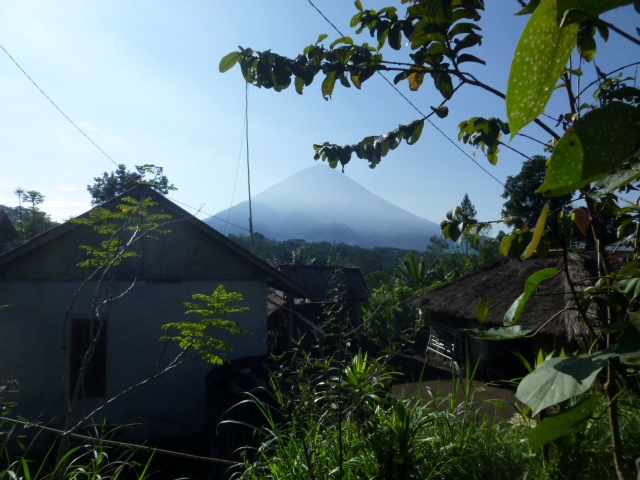
I pause to soak in the hazy purple of Mt. Abang silhouetted against the awakening sky. Majesty. The word springs to my lips and I breathe it out like a prayer. Majesty. But the urgency in my bladder cuts short my meditation. The bathroom is unoccupied. I wonder if I’m the only one who uses it. At least twenty family members live in this compound with only one bathroom yet I never see anyone else head that direction. But muddy footprints on the tile floor assure me that others also heed the morning call of nature.

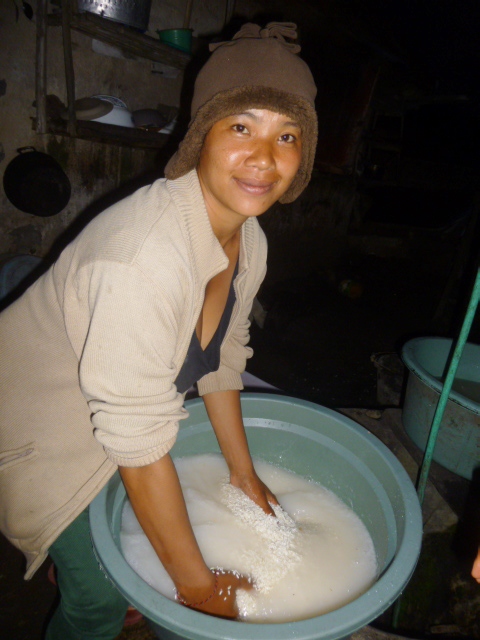
Voices emanate from the kitchen building and I cross the sun-baked earthen yard and stoop through the doorway. Grandpa is seated on a low stool by the fire, warming his arthritic legs. Grandma, her head in a towel turban, pours rice into massive plastic tubs. I don’t know how I understand what she’s telling me because Grandma speaks only Balinese and I know only a smattering of Indonesian. But it’s clear to me that one tub holds regular rice and the contents of the other is glutinous rice.

P1060245

As soon as my sleepy face appears, a staccato chorus of voices issues commands. A sister-in-law is shooed off a stool and Grandpa commandeers it. He sets it beside him, close to the fire, and motions me to sit. Grandma bustles and a steaming glass of white coffee with a plate of sweets is offered. It is implicitly understood by everyone here that I am the queen of everything. Heaven and the gods forbid if anything I want should go unattended. I’m always seated first in the best spot. I am fed before anyone else, even the holy man who usually reigns supreme, with portions sufficient to satisfy an entire family for a week.

I eat and converse with Grandpa who, in spite of his age, speaks Indonesian. Most of the elders in this community never attended school and the younger ones learn the language but don’t have occasion to use it unless they leave the village.

English is required for work in the tourist industry. The teens are taught basic grammar by Indonesian teachers. Wayan shows me her workbook from English class. The author is not a native English speaker. I can barely understand it. “What’s the point?” I murmur out loud.

“What?” asks Wayan.

“Nothing,” I say, then add, “Difficult?”

“Yes,” she nods. I would imagine so.

The fire melts me and smoke stings my eyes. Two wives sit in front of huge baskets of garlic and onions, one peels, the other smashes. It’s something I know how to do.

P1060198

I stand up and tell Grandpa I’m too hot. I move toward the vegetables. The women scramble to rearrange themselves and they clear a spot for me to sit on a higher bench. I shake my head and thank them as I pick up a bud of garlic and begin to lower myself to the floor. Everyone speaks at once. Loosely translated I’m sure they’re saying, “Oh my god! She’s going to sit on the floor! Somebody get that stool under her lily white bum immediately! Do you think she can peel an onion? OH MY GOD!!!” A stool slides under my backside before it reaches the ground. An extra knife appears for me. For the next few hours I’m just a woman peeling onions, or so I’d like to think. I can only stand the boredom of being queen for so long.

The women are rescued from my help when Ketut’s brother sticks his head in and says he’ll take me to the machine. How can I resist such an offer? I bid my co-workers farewell, the queen has been summoned elsewhere.

It’s a quick walk to another uncle’s home. As we pass through a gateway steps lead down the mountainside. Sheets of plywood hold confections that are drying in the sun.

In Ubud where many Balinese women work outside the home, the delicacies needed for offerings are purchased at the market. There simply isn’t time to make them. But that’s not the case in Abang Songan. These women may spend part of their days cutting the long bladed grasses to feed the livestock, pick beans or uproot potatoes, and cook everything from scratch, but they still work hundreds of hours making the various kinds of kue that especially please the unseen deities.

The thrum of a motor comes from one of the buildings. I’m invited inside to see the machine. And what a multipurpose contraption it is!

The large silver box in the forefront houses sharp blades that turn coconut flesh into dust. The far end has a funnel where rice is dumped and comes out the bottom transformed into flour. The middle chute is for grinding coffee beans into the powder that makes the thick, black, Bali kopi. Uncle dumps several cups of rice into the far chute. The operation takes mere seconds and the flour is ready.

The coconut dust is returned to Grandma’s kitchen where moisture is squeezed out, handful by handful.
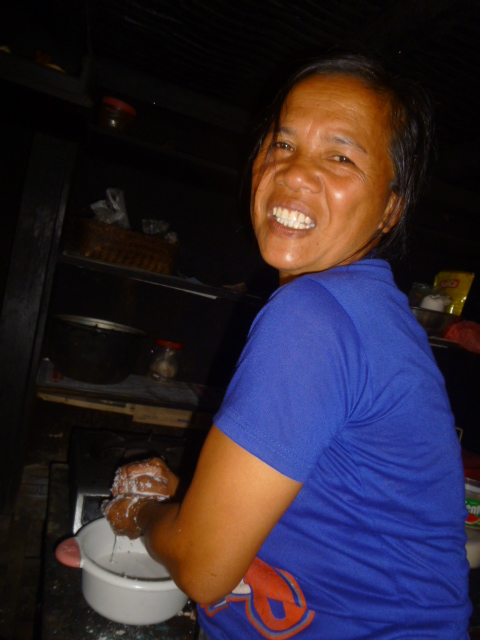
P1060193

I can’t believe it’s still morning. There’s a bamboo structure going up in the space between houses and the men have strung a blue plastic tarp over the top.

Low tables appear out of nowhere and are placed in the shelter. Around noon, men with knives assemble. Woodchips fly as they carve the hundreds of sticks needed for chicken and fish satays. One uncle is a renowned singer. He serenades with Balinese songs while the men whittle away.

Meanwhile, the coconut sans it’s milk, and the rice flour, have been pummeled with a heavy mallet in a stone bowl until the remaining moisture in the coconut melds with the flour and a fine textured substance forms. The dough-like mixture is rolled into logs and sliced into round chunks with a string. Each round is placed inside a banana leaf collar that was made earlier for this purpose. Then the contents is maneuvered by hand until it perfectly fills the collar. The same process is used to make caramel colored kue by adding palm sugar to the already tasty mix.

At another table, rice, coconut, and sugar, are being blended with coloring for a rainbow-like kue. First the white mixture is spread in the bottom of a round pie-plate followed by two colored layers.

Ibu lowers the finished product into one of the steaming kettles and covers it. One hour later it’s removed, sliced diagonally into striped pieces, and wrapped in cellophane. This presents another opportunity for me to assist. Only the most basic, mindless activities are available to me.  Everything else requires a skillset that I don’t possess…may never possess. I’m quite sure you have to be born with it.

Just when I think I’ve seen it all, that no way could there be another kue process today, I stick my head back into the kitchen. There’s Komang slicing banana leaves into small squares. Her mother and sister-in-law are shaping balls of sweet rice with shredded carrot mixed in and wrapping them in the leaf squares. They’re secured with a needle sharp sliver of bamboo. These will also be steamed to perfection and served to the workers and guests who will descend on this compound tomorrow.

And where are the children during this process? There are two under the age of two, one five year old, one six year old who is my favorite. He has Downs Syndrome. And there are two more who attend grade school. Wayan, my fourteen-year-old roommate, is only here to help out with the ceremony. Usually she lives with her mother three miles away.

The children, even the youngest ones, rarely cry. Sometimes they ride in a scarf sling across the chest of a family member. But most often they entertain themselves outside, with a ball, a tricycle, or a training bike. Oh, and the fingernails! Probably something left over from Nyepi, the night of the ghouls. These are the only toys unless they’re lucky enough to snag a smart phone from Bapak! They know how to manipulate the games and music, a feat that, once again, is far beyond me.

This fascinating day seemed endless before breakfast. As the sun sets I think longingly, with a little apprehension, about bed. I wonder if the mystery guest will return. Maybe it was a one night stand. I can only hope. But any thoughts of an early lights out is short-lived. “Go to…what word?” Ketut says, expecting me to somehow read his mind and fill in the blanks.

“Where?” I ask.

“Play play,” he says. “Need money a little.”

All I can do is repeat, “Play play?” with a question mark.

“Ya, you go,” he says.

I stuff some rupiah in my pocket and Wayan grabs my arm. We join the family heading out the gate and down the road. Then it gets trippy. Really trippy! In the distance I can see what looks like…it couldn’t be…
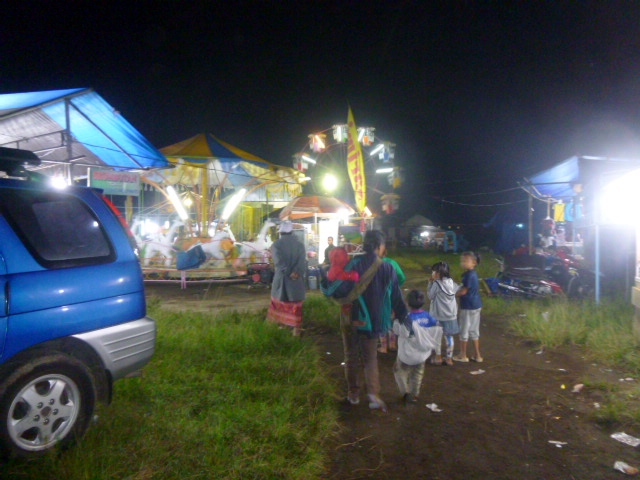
P1060262…a fair?

There’s a merry-go-round and all the horses are white. Solid white. There’s a tent full of balls and bouncing children. There are food vendors, a ring toss and various other opportunities to try to hit items with green tennis balls. But the crowning glory, chugging and belching diesel fumes, is the ferris wheel. In America where there are regulatory laws, safety standards, certain expectations of mechanical proficiency even at the County Fair level, I’m still wary of the ferris wheel. It’s enchanting from a distance but as we approach I get a severe case of the willies. P1060263It’s held together with screwed on pieces of wood and lengths of chain. Wayan, still gripping my arm, hauls me to the entrance. There’s no line and only a handful of the little gondola cars, swinging and wobbling around and around, are occupied. “Saya takut!” I shout over the din of the engine. I’M SCARED!

“Sama Saya!” she yells back, SO AM I. But it appears that sheer terror isn’t enough to get me out of this one. Two more members of the family crowd behind us and I pay the 20,000 rupiah, about $1.75 U.S., for four riders. P1060267Wayan and I step through a creaky door into our chariot. I flash a quick photo of Wayan’s serene face as the car shudders, groans, and begins its ascent. How did I get myself into this? It’s my last thought before our rickety bucket sways to a stop at the very top.
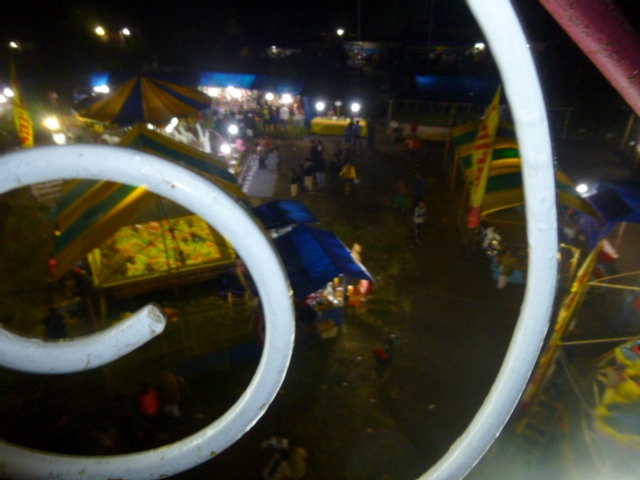
P1060265

I have a handy trick when things in life get too difficult. I take a short vacation from my body. It often feels a little like this as we hover in that swaying cab high above the twinkling darkness. Typically I love a bird’s eye view, a lofty perch. But this is a nightmare! Wayan and I get my money’s worth. We circle for thirty minutes or more. Are they doing it for the benefit of the only foreigner ever to set foot in their precious ferris wheel? Who knows? But I kiss the feet of the tattooed goth who finally frees me from my horrible cage!

P1060268Oh what a night. On legs more than a little shaky, I allow myself to be led to another ride where we wait a small eternity for the children to finish their turn. It has almost stopped when a group of giggling youth bound up to Wayan. She shrieks, hugs her friends, then turns to me, “Maaf,” she says, SORRY, and departs with cheerier company.

P1060272

It takes so little to make these children happy. One ride on the green caterpillar and they’re ready to go home. One ride on the nasty wheel and I’m also ready. I join them for the trek back along the rutted road in the dark. Someone switches on a phone light for me. It seems I am not endowed with telepathic night vision like my Balinese friends.

My room awaits. I thank my guides for getting me home and the gods that I survived the ferris wheel. There’s no pretense of a bedtime wash-up tonight. I pull on my night shirt and leggings, peel back the blanket, and sink my weary bones into the mattress remembering as I do, the light switch 7.5 feet away. In a replay of the pevious night, I lunge, hit the switch, and fall back onto my pillow. Ahhhh. At last. I begin to drift. Scritch-scratch…

COMING…DAY THREE: The great chicken massacre etc. etc.

Night Visitor

“Will your mother show me how to make this?” It is an innocent request. I love the coconut and rice flour kue, especially when it’s crispy fried. I’ve never seen it anywhere else in Bali.

“You come for six month ceremony. My mother show you,” Ketut says.

A child has four important birthday ceremonies, one each year for the first four years. The Balinese calendar has six months of thirty-five days each. It’s time for Ketut’s baby to celebrate her second six month birthday.

Ketut says that he’ll be leaving for his village, in five days. “We come back in morning after ceremony,” he tells me.

I know it will involve spending the night in his family compound. But just to make sure we’re on the same page, always a good idea here, I beckon Ketut to the calendar, “Show me,” I say.

He points out the dates, “Go to village here, come back here.”

“That’s three nights Ketut, yes?” my stomach is doing little flips.

“Ya, it’s okay,” he says.

Ya it’s okay with whom, I wonder. With him? With his mother? With me?

Ketut’s village, Abang Songan, is off the grid. Literally. There is no internet period, full stop, forget about it. There’s also no running water unless you count the hose hanging from the outdoor cistern. The bathroom’s only fixture is squat style, with the dip and pour bucket beside it. But the door locks from the inside so the things a strange white lady has to do to make that facility work for her are done in complete privacy. And in case there’s any doubt in anyone’s mind, don’t forget to BYO TP.

I pack light. We’re going by motorbike and I’ll need a few changes of clothes, my computer for downloading the pictures I plan to take, and gifts for the family. By the time they’re assembled the three stuffed bags are all squished between my stomach and Ketut’s back. We head out of Ubud.

The family greets us when we arrive. I’m ushered into the room that Ketut and his wife and baby share with a bed, a TV, and a wardrobe.

P1060166

Presents, boxed and wrapped, are unheard of but Nengah is undaunted. She rips into her gifts like a pro. Traditionally, the Balinese don’t celebrate birthdays with the exception of these first four ceremonies.

P1060165

Komang disappears for a minute and returns with food for me, a huge bowl of rice, soto ayam which is chicken soup made with lemongrass, lime leaves, and garlic, and wrapped sweets. I plough through the delicious flavors until I’m stuffed. Then they bring coffee and more treats. This is to be the theme for the duration of my stay. It is as though there is an unspoken code: When you don’t know what to do with her, feed her!

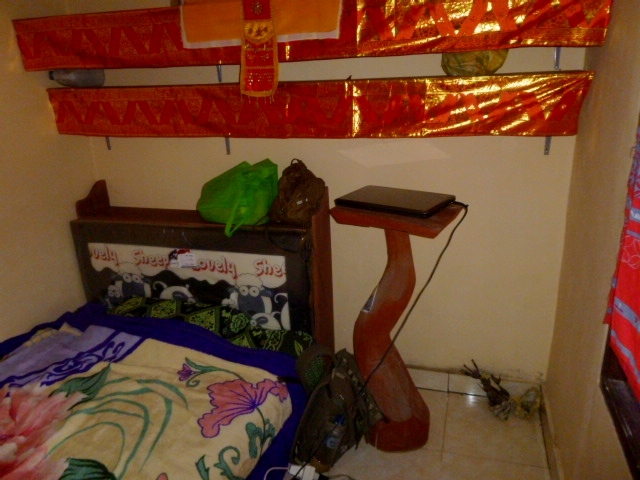
Two new rooms have been added to the family compound. One is a house for the sacred writings (lontar) and the kris (sword). The other is for me. I’m ushered into a 8 x 8 foot space with a bed and a whimsical side table for my computer. I take note of the writing on the headboard: Lovely Sheep, Lovely Sheep! An offering has been placed in the corner.

P1060364

I leave my bags and join the family outside. They’re sitting beside a pile of husked coconuts, talking and laughing as they cut off the brown leaving only milky white meat. This, I am told, is the first step in the lengthy kue process.

P1060158

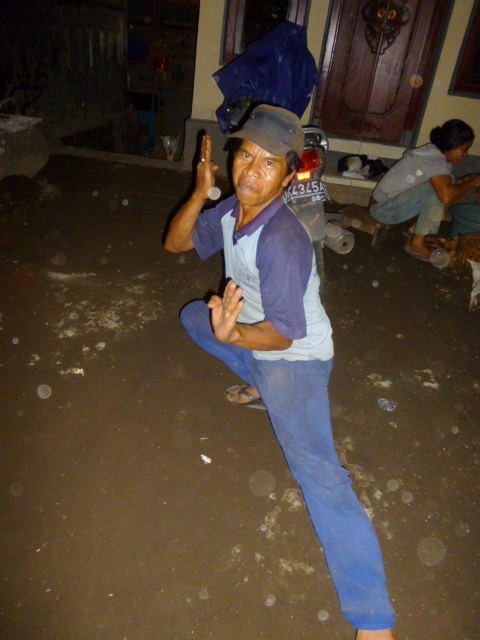
By now my camera is a familiar friend and an uncle hams it up for me.

P1060160

The coconuts, peeled and ready, are turned over to Komang. She fills the plastic basin with water and rinses off fingerprints and remnants of fiber. Coconuts are plentiful in Bali but they don’t grow at this altitude. These have been purchased from the local market.

P1060163

Rinsed and clean, they’re set aside to await the next steps in the process. I can’t stifle a huge yawn and I’m hustled off to my room for the night.

Alone at last, I pull out a bottle of drinking water, wet the washcloth and dab a corner of it on the bar of soap I’ve brought with me. The coolness feels good as I swab the shine off my face. With another damp corner I wipe off the soap. A little toothpaste on my electric toothbrush and my mouth is as fresh as my face. I swallow since there’s nowhere to spit. My filthy feet aren’t going anywhere near that pristine, white washcloth! I swing them onto the bed, tuck the fleece blanket around me and realize the light switch is 7.5 feet away.

I lunge toward it and flick it off. In the dark I rustle around with the plastic mattress cover crackling beneath me until I find just the right position. Deep breath, sigh. I try not to think about how much I’d like to pee. Then I hear something. It’s a scritch-scratching somewhere over my head. The sound stops. I relax and begin to drift off. Out of nowhere a rather small, lightweight beast runs across my blanketed legs. My right knee flexes and I haul off with a mighty kick. I expect to hear a thud as a furry body hits the wall. Nothing. I think about the light switch 7.5 feet away. Nah. I don’t really want to know the damages, and if I don’t see anything maybe there is nothing really there. I’m drifting again, my arm flung over my forehead, almost asleep. This time the wee beastie uses my arm as a bridge. I don’t scream, but I do grab the edge of the blanket and throw it over my head.

Around ten p.m. the door opens and the light goes on. It’s Wayan, Komang’s fourteen year old sister, looking for a place to sleep. She throws her blanket on the ceramic tile and pulls it around her. “Wait, Wayan! You can’t sleep on the floor. I’ll move over…”

“No,” she says. “I stay here.”

I argue but she’s adamant, telling me she moves a lot and doesn’t sleep well. She falls promptly to snoring while I lay suffocating with my head stuffed under the blanket against further invasion. Wayan sleeps like a rock. I know this because every dog within ten miles barks all night, non-stop, and I hear them. There is, however, no more scratching. It becomes essential to breathe and I eventually uncover my head.

Next post: Day Two in Abang Songan

Sanity is Green

I didn’t sleep well last night. There was one mosquito…. But it wasn’t just the annoying buzz around my ears. I was waiting for another sound that didn’t come until after sunrise, after I’d shampooed, showered, and dressed, after I’d had coffee and my morning bowl of fresh papaya. I was waiting for voices, the workers who would come en mass today to pour my first floor terrace. I didn’t know how many to expect. Pasek said “Many.” How many is many? He didn’t know. But he brought extra glasses, more Bali coffee and sugar, and  watermelon and kue from the market. Pouring a floor is a big, big deal here in Bali. So I was on high alert knowing that the whole thing has to be finished the same day it starts and knowing also that they would begin early and stay as late as necessary. I was a little apprehensive in an excited sort of way.

P1060120Yesterday morning the floor looked like this.

P1060125

By the end of the day there were identical boxes perched on 2 x 4s at either end of the structure.

P1060131

And at 8:00 this morning…!

A crew of ten workers arrive. They come in the back of a pickup truck from a village in the district of Bangli. A breakfast of rice and vegetables, sometimes chicken, is packed early when food is made for the whole family. They unpack it and laugh and joke over their morning meal. I bring out the plates of kue, Balinese cakes, and Ketut heats the water for coffee. They love to joke with me and I know just enough Indonesian now to be dangerous. I’m not always certain what I’ve said or what I may have agreed to. They’re a raunchy bunch!

P1060132

The big guns arrive. Pasek, the project manager is in the forefront and Dewa, the contractor, is next to him. They’re here to make sure everything gets off to a good start. Sudi, my neighbor, is the third in the line-up, and Ketut in red takes it all in. By 8:45 the place is like an anthill. Everyone moves at once and knows what to do. Water flows into the big square boxes. Bags of cement come in carried atop the women’s heads. Stones are dumped in with the concrete mix. Scraping and mixing and commotion ramp up to full volume.

By 9:00 a.m. I’m in search of sanity. Which, as it turns out, is green.

Lucky for me, my friend wants me to go with her to Denpasar today to buy fabric. So at 9 a.m. Sudi and Ketut pull up on their motorbikes and we escape.

P1060142

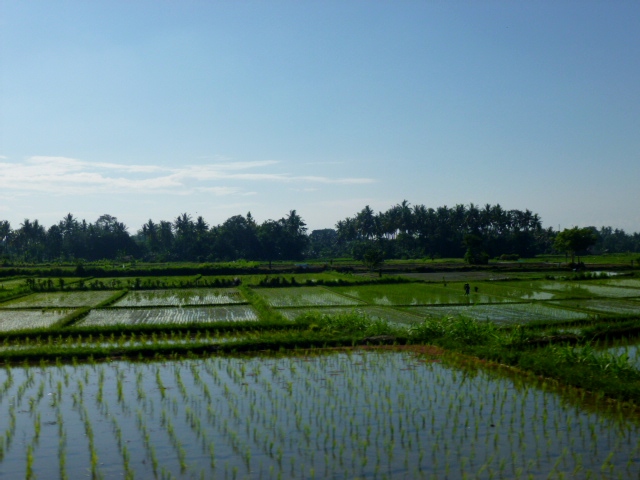
Flooded paddies with new plantings reflect the sky

P1060148

Older growth yields layers and layers of green

P1060145

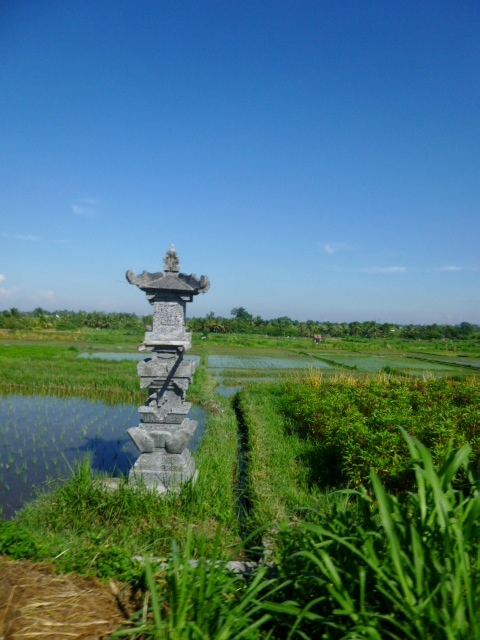
A small temple posts watch

For miles we roll through serenity. My nerves calm. My mind clears. We pass a small temple at the edge of a paddy and I remember that on the other side of the world today is Easter Sunday. It doesn’t take much, I realize, to ground me, to restore balance in my mind. Sanity is green, just a few miles of small road through acres of natural beauty.

P1060150

 Tonight my new floor looks like this.

The concrete is poured. The thunderous piles of black cloud that surrounded Ubud all afternoon didn’t leak a drop. The work was uninterrupted. All that remains of my diligent crew are these soggy gloves, hanging on the skeleton of a pillar to dry. Until tomorrow, that is. P1060151

A Strange Diagnosis

Ketut’s father is sick. The Balian, a traditional Balinese healer, is consulted. “How is Bapak?” I ask him the next day.

“Same-same,” is his reply. But there’s more to the tale and once again I listen in amazement to the complex interrelation of medicine, magic, and mystery that surrounds the lives of the Balinese. This is the story as told to me by Ketut.

One of his father’s ancestors a long time ago was a Balian and he had a book that had been passed down in the family for seven generations. The book (lontar) contained the collected wisdom of the healing arts, required rituals, recipes for medicinal cures, instructions for auspicious marriages, and all that the community needed to know to thrive. But it also contained the opposite, an operations manual for black magic.

When that Balian died, no one replaced him. The book that had been cared for, consulted, honored with offerings and placed in a special position of prestige, was ignored. It was kept in a cabinet in the father’s sleeping room.

“The Balian say book angry,” Ketut tells me. “My father sick because book want house.” I pepper Ketut with questions and learn that construction on a house for the book is underway. I’m trying to wrap my head around this but the concept is elusive.

A few days later I ask Ketut how construction is coming. “Not yet finish,” he says. I get the same answer as weeks go by. I’m picturing one of the small tower-like structures that I’ve seen in temples all over Bali. That, I assume, would be a fitting house for a book. But why is it taking so long?

The day comes when the new house is finished. “Is the book already inside?” I ask.

“Oh no.” Ketut answers many of my questions this way. “Not yet good days,” he says. “Manku make ceremony when good days.”  So this is a bigger deal than I thought. I should have known. The book can’t be moved until the holy man finds an auspicious day. Then the priest will be hired to come and officiate. Mountains of flowers, fruits, cakes, and chickens will be purchased or cooked and prepared as offerings.

“I want to come to the book ceremony,” I tell him. He says of course and he’ll let me know. Weeks pass. “Book ceremony soon?” I ask.

“Not yet, maybe three month.”

“Three more months?” I’m shocked. His father hasn’t gotten better. But this is Bali and the mills of the gods grind slowly.

As mid-April approaches I’m told that the day has been decided. It will be on Purnama Kedasa, the full moon celebration April 14th, an auspicious day indeed.

The long-awaited morning dawns bright and clear. Outfitted in temple clothes, my neighbor Julie and my visiting friend from America, Jan and I are ferried up the mountain to Ketut’s village in a decrepit mini-van. As we chug and cough along Pasek, who is with us, gets a text from Ketut. The priest hasn’t yet arrived. Pasek invites us to his house to wait.

P1060073

We’re greeted by Nyoman, Pasek’s wife

Jan is beautiful in her lacey kebaya and sarong

Jan is beautiful in her lacey kebaya and sarong

Nyoman cooked this amazing spread for usIt’s always the same with Ketut’s and Pasek’s families. We are plied with food and drink. When asked if they will be eating too it’s either, “Already,” or “Later.”

Not many foreigners come to this remote, mountain village so we are studied with wide-eyed wonder by the small children. The adult women wrap us in warm hugs. The adult men smile and shake hands or hang back. Teens whisper and giggle.

Waiting outside the temple for Pasek's father to bless us

After the feast we wander to the temple where a rug is spread outside. We squat or crouch in our tight sarongs awaiting the blessing.

It’s mid-afternoon and we’re still with Pasek’s family.  Ketut comes to find us. The priest has not yet arrived but Ketut is ready to take his turn with us. “Want to see book?” he asks. Of course we do! We all pile back into the rusty bucket. This time our route can barely be called a road. The jouncing and jiggling are fierce and I’m surprised my dinner behaves as well as it does. I’m worried about Jan. Her stomach was a little unsettled earlier. But she says she’s fine. It’s a miracle.

Ketut and Pasek's cousing with rice basket cookers on their headsFrom Pasek’s house we move to the home of another relative. A tour of the premises brings us to the outdoor kitchen where Ketut and our driver model the woven cones that are used to steam rice over boiling water.

P1060091

Stealing honey

Moving from one mischief to the next, these two decide to pry open the bee house and check for honey. The bees they’re disturbing look like overgrown fruit flies. We’re told they don’t bite, but they swarm around Ketut’s head as he violates their stash.

P1060092

He extracts some of the honeycomb and a little nectar for us to taste. The comb is dark brown and the honey has a tart vinegar-y flavor. It isn’t an instant hit.

Ketut’s father with the ancient books (lontar)

Ketut’s father appears and greets us. He is much better. He leads us to a room with a cabinet and takes a seat on a raised platform. This is the room where the lontar is stored. A footed offering plate holds several of the volumes. With utmost care he opens one of them and shows us the script that was cut into the palm leaves hundreds of years ago. Very few people can read the old Balinese writing. The modern alphabet is completely different.

P1060083We lean in close and Bapak says it’s okay to take photos. The inscription is faint but legible. There are dozens of the bound packets of hardened palm leaves. Ketut tells us that the leaf is dried, then soaked in hot water, then dried again and it becomes hard. The writing is done by carving each letter with a knife.

But there are new developments. The book no longer wants to be in the new house. The ancestral weapons, the kris, must go there first. Later if the book wants to be with the kris, it will tell the priest. But for now, the book stays where ‘she’ is and the swords will take up residence in the new house. How was this communicated? “The Mangku he know,” Ketut tells me later.

P1060102

This is the new book house. Ketut stands in the doorway and Komang, his wife and a niece look on. I’m shocked to see a real house with two rooms. All this for a book and a couple of swords?

Ketut’s family gathers round while we wait for the priest. More food is brought along with thick, sweet, Bali coffee.

Ketut has heard from the priest. Many blessings are scheduled for the full moon and he’s much in demand. It may be hours before he arrives, “Or maybe tomorrow,” Ketut says.

The sun set a while ago. We still have an hour-and-a-half ride down the mountain before sleep. With the timing of the ceremony uncertain, and the adventures of the day already enough to fill us to capacity, we opt to take our leave. As we bump along the ridge, the lights of the villages lining the shores of Lake Batur shimmer through a gauzy mist of cloud far below.

The island of Bali is another world. But the places we’ve been today could be another galaxy so far removed are they from what we might consider normal. And yet it works here. It fits. And I doubt that I will ever outgrow the amazement and wonder at the vast differences that feel so familiar.


News Flash…There Will Be Silence!

Nyepi SilenceSilence is serious business in Bali. New Year’s Day falls on March 31 this year and it’s a big deal. If you’re a traveler vacationing here, you are confined to your hotel. Cable broadcasting in Indonesia is turned off. The use of electricity is discouraged. There are no vehicles allowed on the roads with the exception of emergency transport. If you venture out you run the risk of being fined by the vigilant Pecalang, local men who police the streets for offenders. And the airport is closed.

I’ve only experienced this kind of silence once before. It followed a day that will remain indelibly imprinted on my memory for the rest of my life. September 11, 2001. Air traffic over America ceased. People cowered in their homes, wondering where and when the next terror would strike.

Today, with the brilliant blue skies over Bali undisturbed by the thunder of jet engines, I remember. Nyepi is a blessing. It recreates the quiet after that devastating storm. I sit in silence and pray for the inconceivable. Peace. A planet at peace.

Nyepi, Ogoh-Ogoh and the Drone

From the magical and mythical to the horrific, New Year’s Eve in Bali is a monster mash. For weeks, men of all ages have worked feverishly in community buildings, parks, and garages. First a framework appears. It morphs into a three dimensional entity that grows limbs and a head and very possibly, pendulous breasts. With artistic flair, the specter is painted, dressed, and readied for it’s debut. These are the monsters, the ogoh-ogoh, that are paraded through the streets on the night before Nyepi, to the wild accompaniment of gamelan and tumultuous cheers.

It’s a night like none other in the world, wild, ghoulish, cacophonous, and I love it! I wondered about that as I sat at a table in Sjaki-Tari-Us around 4:30. I’d gone early to secure a ringside seat with a great view of the football field, the venue that hosts the monsters’ ball.

I had promised my friends that I’d do my best to save seats for them since it’s their first Nyepi. I hadn’t been there five minutes when an aggressive gent in a blue plaid shirt laid claim to one of the empty chairs. “My friend is coming,” I said, smiling in a you’ll-get-your-hands-off-that-chair-if-you-know-what’s-good-for-you kind of way. The chair stayed, the man went away.

P1050963I slipped into a day-dreamy haze as the loudspeaker pumped reggae music through the soft hum of voices. The bright colors, the warmth, the familiarity of this town that has become my home, settled around me with a sweetness that brought a lump to my throat.

As I wallowed in the gratitude of those feelings, a different sound needled into my consciousness.

What was it, electrical wires buzzing? It had that high-pitched whine that pierces through everything else and puts your teeth on edge. It sounded foreign, it didn’t belong. Then I saw it hovering over the football field like an alien spaceship, lights flashing, propellers whirring. My friends had arrived. “What in the…what’s that?” I had spotted it first.

P1050977P1050976

They craned their necks to see what I was looking at. “It’s a drone!” Nancy said. We watched it hover, then dart to another part of the field, hover, then dart again. “It’s taking pictures.”

For a nanosecond I felt dizzy. The harsh invasion of space technology colliding with the ancient practice of Nyepi sent shock waves through my system.  An image of Balinese women, carrying buckets of sand, or concrete blocks on their heads, came to mind. Even though that stretches my definition of reality, it’s easier to accept here than a buzzing, flashing, hovering UAV (unmanned aerial vehicle).

I pulled my eyes away from the intruder and back to the teaming crowds. Then it hit me. That’s why I love it here. Bali is a study in contrasts. It has tranquil rice fields and chaotic traffic, reverent prayer and raucous cockfights, Kuta Beach and Kintamani. But tonight, on the eve of Nyepi, it has ogoh-ogoh’s and a drone.

Best Margaritas in Bali

I don’t have many rules about food here, but there’s one that I swear by. In Indonesia, eat Indonesian food. The same goes for France, Italy, Greece, Scandinavia, and so forth. First of all, why wouldn’t you? It’s part of the experience. Second, it’s the best way I know to avoid disappointment. When, for instance, you’re in Bali and the menu says, Chicken Gordon Bloo, here’s my advice. If it isn’t spelled right, how can you even remotely expect that it will taste right?

P1050951But tonight I broke my own rule. I met Sharon, who has been visiting in Bali for two months and admitted that she is getting a little tired of Asian food, at Taco Casa. As the name implies, Mexican food is served there. They have not a single Indonesian dish, well, I take that back. I saw black rice pudding on the dessert menu. That’s undeniably Indonesian. But dessert aside, the fare is Mexican, the kind of Mexican that we in America know and love, sour cream, black olives, and fat, juicy, jalepenos!

P1050945

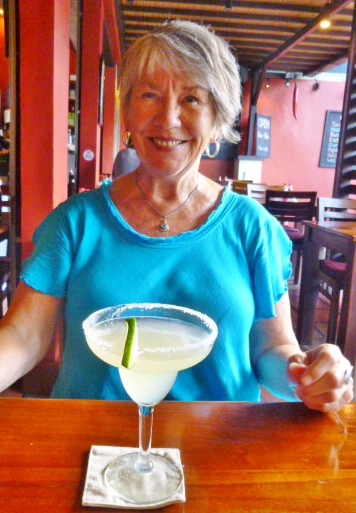
P1050948Not only does Taco Casa advertise great Mexican food, but Nina next door, my oracle on all things Bali, assured me that they have the best margaritas on the island. Sharon liked the sounds of that. “Let’s go!”

Four in the afternoon is a little early for dinner, but it’s perfect for a drink. Oh my! Nina was right! There’s nothing like a cool beverage in a salt rimmed glass on a hot Bali afternoon to make you feel so, so happy.

P1050954But our appetites kicked in as we watched plate after delicious plate of real-looking Mexican food float past and get delivered elsewhere. Nachos Supreme, we decided, was the combination of crunchy and spice that we were looking for.

I didn’t realize until I put the first bite in my mouth, how much I like the flavors of Mexico! Eating rice and veggies in some form or another every day, day after day, is fine. I’m okay with that. But mama mia! Did those nachos taste almighty wonderful!

Next time you’re in Ubud and you have a hankering for Mexican, or a margarita, stop at Taco Casa. It’s across from Mama Mia’s Pizza, another great alternative to Indonesian. Rules are made to be broken!


You a little fat

IMG_8200

It’s 6 p.m.

Wayan Sie, the only masseuse in the world that I allow anywhere near me, arrives and I strip, stretching out on my stomach on the bed. The aroma of nutmeg scented oil swirls in the room. She strokes my back with long, sweeping movements, ahhh. Muscles let go. I melt. “That feels so good, Wayan,” I croon happily.

“Ya, Sherry,” she replies. She’s quiet for a moment then says, “You a little fat, ya?”

Wayans hands have been all over my body. Many times. If anyone could detect a few extra pounds, she could. Damn Balinese honesty! “Am I?” I ask.

“Ya, it’s good,” she says.

I meditate on that for the remaining 70 minutes that she kneads, pokes, pummels, and prods me. First I think about the comment another friend made just a month ago. “You’re scrawny,” she said. Okay, who do I believe? No contest. Wayan knows. Then I think about my body. It’s become muscular with all the yoga and walking. It’s that new muscle, I tell myself, as if Wayan doesn’t know the difference between fat and muscle. Right. I wonder why I haven’t noticed. My clothes aren’t any tighter. Of course the loose fitting garb I wear here wouldn’t be tight if I gained 200 pounds.

Wayan finishes. I thank her and she leaves to cook dinner for her husband and son.

Fat. I don’t relate to fat. I’m not fat. I’ve never been fat, well, aside from pudginess prior to puberty, but that doesn’t count. Why am I obsessing about this?

In the U.S. we wouldn’t dream of telling someone what we think when it concerns negative body image. Bali is a different story. In this culture you say it like it is, whether you’ve gained weight, grown a zit the size of a grapefruit, gotten a bad haircut…the Balinese notice and comment. It can be a bit off-putting at first, as is their propensity to want to know your business.

“Where you go?”

“What you buy?”

“How much you pay?

Then I remember. The last massage Wayan gave me was on the heels of a ten day siege of Bali Belly. I had done nothing but puke and poop. There wasn’t much left of me. By comparison I am now, indeed, ‘a little fat’. Okay. I can live with that.

Black Magic

People in the West don’t pay much attention to the dark forces. Paranoia around all things paranormal runs rampant unless of course it’s vampires, or child wizards wreaking havoc with broomsticks. Those have become acceptable, even desirable in recent literature and film. In fact tales of bloodsucking teens has become a money-making machine. We can’t get enough.

In Bali the dark forces are acknowledged and maintaining balance between the negative and positive energies is a daily practice. Credence is given to blessings but perhaps even more attention is afforded the dark arts. Someone’s father is sick. A skin rash appears. A house burns down. Crops fail. Black magic, they whisper. It’s as though no other possibility exists.

When illness or tragedy strikes, a balian is consulted. There are two types of balian according to Ubud Now and Then.

Balian Ketut Arsana of Bodyworks Center in Ubud Photo credits Namaste Festival

Balian Ketut Arsana of Bodyworks Center in Ubud
Photo credits Namaste Festival

The first, known as the ‘balian taksu’, is a kind of shaman or trance medium: he goes into a trance to communicate with the spirit world, and frequently chases away unwanted influences in this way. The second, the ‘balian usada’, refers to sacred medical manuscripts, and uses massage techniques and traditional medicines made from plants and animals. He also works with a spiritual approach, drawing on intuition, visions, mantras and prayer to aid the healing process.

The article goes on to say that a visit to a balian requires sensitivity and openness to the Balinese beliefs about the spirit world and the power of the invisible. It may require a dramatic leap of faith to accept a prescribed remedy which can be unorthodox. Yet many visitors to Bali have found themselves cured by a local medicine man when no Western doctor was able to help.

Some of us can be quite comfortable with intuitive types. Their subtle seeing of things unseen, or knowing without being told, is acceptable and we seek them out for guidance. But Bali takes it a step beyond.

Sanghyang is the Balinese sacred trance. It’s a phenomenon that raised the hairs on the back of my neck when I first witnessed it. Spirit possession wasn’t an everyday occurrence in my upbringing and I was unprepared for the raw power unleashed during a Sanghyang ritual.

But for the Balinese, trance is an essential element of their belief system. Skye Laphroaig, in an article for the Bali Advertiser, says that Sanghyang is a sacred state in which hyangs (deities) or helpful spirits temporarily inhabit the bodies of willing participants. The purpose of sanghyang is to cleanse people and places of evil influences to restore spiritual balance.

An example of a Sanghyang is the spectacular fire dance. A man in trance holding a hobby horse walks back and forth through burning coconut husks in his bare feet. Again and again he circles through the fire until he is pulled to the ground by two attendants.  A priest appears and sprinkles him with holy water. The man remains immobile in an altered state for some time.

Kecak Fire and Trance Dance

Kecak Fire and Trance Dance

These productions may appear to be for tourists, but I have attended elaborate performances where I was the only non-native person there. The Balinese do this for the Balinese. They do it to maintain harmony on their beautiful island. The spiritual realm is as real and present for them as the natural and they travel fluidly between the two. They accept without question the presence of the unseen, the dark forces and the light. Their offerings, prayers, and rituals are designed to appease both.

The Balinese year ends with the granddaddy of all spirit-balancing rituals, Nyepi. This year Nyepi falls on March 31. Nyepi Eve is a ghoulish extravaganza of ogoh-ogoh monsters paraded through the streets accompanied by pounding gamelan and overwhelming chaos. The negative deities are chased away or driven crazy by the pandemonium. Then the island shuts down. The airport is closed as are all the businesses. People do not go out of their homes. The streets are empty with the exception of the Pecalang who enforce the day of silence and impose fines on offenders.

Ogoh-ogoh

Ogoh-ogoh

In the West the healing arts have become the healing sciences. Science, we believe, can fix people, animals, vegetation, rivers, and every ailing thing. Bit by bit, a more holistic mindset is allowing natural remedies to be reintroduced, suspiciously, into the mainstream. But other than prayer chains, dialed into service for an extra measure of divine intervention, the vast resources of the metaphysical realm remain untapped.

We scoff at the mystical beliefs of the uneducated. We pass judgment on primitive practices and superstitions. We’re so wise. But what if that’s the missing piece? What if it takes science, and nature, and the realm of the unseen working together, to accomplish mighty feats? What if….

Building a House in Bali – big stones arrive

We had polished off a killer meal of Lake Batur fish and copious amounts of Bintang. We’d solved half the world’s problems and discussed the other half ad nauseum. The mosquito coil lay in ashes on the floor, spent. The guests had gone home and I was reaching to turn off the garden lights when a bush rustled. Bushes rustle all the time, but after dark I notice. My eyes scanned the shadows while my mind ticked off possibilities: herons, squirrels, monkeys…Ketut. “Ya, stones come tomorrow,” he said, stepping into the light.

“What time?” I knew it would be early, I just wanted to know how early.

“Oh, maybe tweluv.” In Ketut speak, the number twelve has two syllables, twel uv.

“You mean midnight?” I’m still grappling with Bali time.

“Ya, in the street, many-many.”

He made the announcement and left. Pasek appeared moments later. “Ya, stones come tomorrow,” he said.

“What time?” Didn’t I just have this conversation?!

“In the street now, maybe five bring inside.”

“Five in the morning?”

“Ya.”

I didn’t sleep much knowing my stones had been dumped in the busy Monkey Forest Road and would sit there until the women came in the early morning hours to haul them to the house. I pictured small stones. I know that sand has to come, and metal, and bags of concrete. Small stones were also on the list of materials.

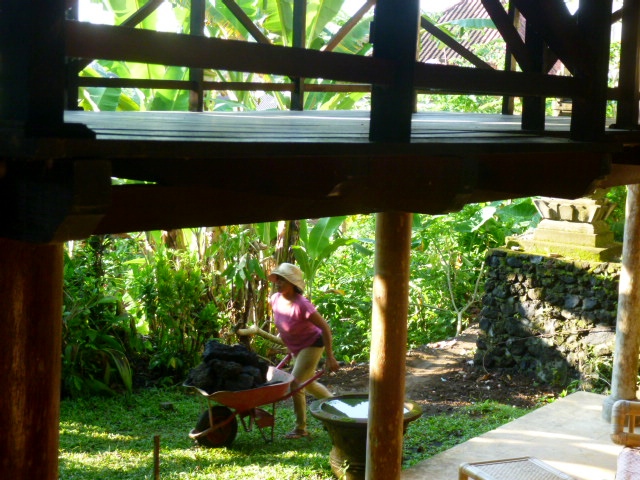
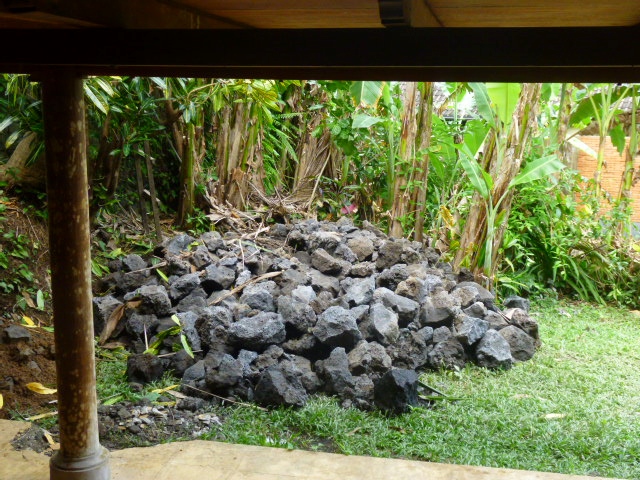
P1050897At 5:30 I heard voices whispering in the garden. My windows don’t have glass. There’s a bamboo blind between me and the forces of nature. At 5:48 there was a bit of shoveling and scraping. I got up. I had just spread out the yoga mat on the bedroom floor when, at 6:09, an avalanche of volcanic boulders crashed to earth.

Through the window, women pushing pinkish wheelbarrows piled high with rock streamed past me. The boulders rolling out of the barrows created a thunderous roar. Ketut strolled up and I said, “Why big stones? I thought little stones.”

“Oh, first big stones. Make strong.” He disappeared into the kitchen to make coffee for the workers. When he emerged with glasses of the thick, black drink, I joined the women for their breakfast break. The savory scent of chicken and chilis emerged from their brown paper wraps. The smallest one of the group had a bag of kue, the Balinese sweet treats that I love. She offered them to me. I chose a browned ball. Coconut, palm sugar, and sweet potato lay hidden in the center of the cake-like confection. “Mmmmm!” I said as I bit into its moist sweetness. A beatific smile beamed from her weathered face.

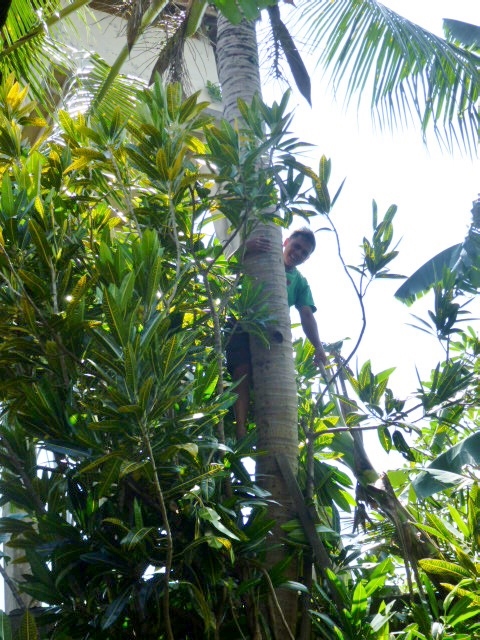
Their rest was brief. As they retrieved their wheelbarrows, Ketut, ever mindful, scaled the palm that towered over the dump site for the rocks. His machete sliced off six coconuts and a couple of enormous branches. Being clobbered by a coconut isn’t a happy ending. One of them split when it hit the rocks. Next thing I knew, a glass of young coconut water appeared in front of me. Delicious!


Mid-afternoon the task was done.
P1050907My first materials have made their appearance. “Sand tomorrow,” Ketut said.

“What ti…” I began, then realized…it doesn’t matter.

Previous Older Entries Next Newer Entries