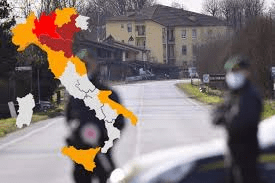
The coronavirus in Italy had a 25% surge in the past 24 hours. The Local it (Italy’s news in English) reports there are now 520 confirmed cases and the infestation has spread to the south with the area of Puglia reporting one and Sicily with three.
According to Sergio Matalucci out of Milan, eleven towns have been quarantined. Schools, universities, cinemas, clubs, and museums are closed. Events have been cancelled. Supermarket shelves stand empty as people panic-buy groceries, unsure of what’s ahead.
He goes on to write that grocery owners say they don’t lack stock in their warehouses. They just need to get it to the stores more quickly – a timing issue, not a supply issue. That’s good news.
It was slim pickings in my fridge. I climbed to Tutto per Tutti market this morning and found that even here in sleepy Praiano, in an area in the south of Italy as yet unaffected, shelves had empty spaces that hadn’t been there on prior visits.
Nicola, my host, told me people who had booked his rental properties for March have cancelled. He’s concerned for himself and his town. The economy of Praiano hinges extensively on tourism. Economic consequences are being experienced worldwide. Some types of businesses will profit. Many more will not.
So what’s actually happening? How much of the reporting can be trusted?
We’ve been bombarded for several years now by cries of ‘fake news’ from the very top of the power pyramid in the United States. Media giants have the ability to sway the thoughts and actions of the entire world population by choosing what to allow on their channels or what to suppress. I highly doubt, highly highly doubt if they even know if their sources are valid.
As I read article after article, these are the thoughts uppermost in my mind. Frankly, I don’t think we have any idea what’s really happening. We have limitless quantities of information at our fingertips. We can click ourselves down rabbit-holes and wind up light-years from where we began. But we have absolutely no way of knowing truth from lies.
Yet I’m addicted to that stream of information. Some part of me still trusts, or desperately wants to.
So I’ll keep reading the news. I’ll take precautions. According to the WHO more than 80 percent of patients infected with the virus have a mild reaction to the disease and recover. I’m here in Praiano until March 6th. Nobody can predict what will happen in the coming eight days but if planes are still flying, and I’m still healthy, I’ll leave Italy from Naples on that day and head back home to Bali.
Meanwhile, I’m grateful that the sun still rises. The sea is still blue. And this town of ancient stairways and kindness is mine to explore.
I haven’t mustered the courage to ask if I can photograph either of the brothers who run Centro Market. The surliest one was there when I stopped by, complete with stocking cap, muffler, and a week or two of stubble.
I wasted no time. “Pane duro?” I asked. He cocked his head toward me and frowned. I tried again. “Pane biscottato – duro?”
His face lit up and he grabbed two bags from the shelf behind him. Then lo and behold – he spoke English!
“This,” he said, pointing to one of the bags. “This you cannot bite.” He made chomping motions with his mouth shaking his head in an emphatic no. He pushed the other bag toward me. “This one is soft.”
“Grazie,” I said. “I want the hard one.”
He looked dubious. “First put in water for one minute. Then you can eat,” he said. I nodded. I’d already learned that trick at the winery after trying to bite into one of those rocks.
I looked up what the words meant in the circle at the top: Old and modernized bakery from 1890 LOVE IT!
I checked ‘hard bread’ off my list. “Do you have coffee?”
I was ushered to the other side of the long counter and he explained which ones required a machine and which ones just need hot water.
Coffee, done. “And limoncello?”
He pointed. There were twelve varieties of that liqueur in his tiny market. I browsed waiting for a sign to determine which to choose. One toward the far end caught my eye. “What’s this?” I pointed.
He came to my side and picked up the bottle. “Yes, this with crema. Crema and limone mix.”
I love Baileys Irish Cream. I’ve never had a liqueur with cream other than that. Cream with lemon would either be divine or disgusting.
“Ok. That one, per favore.” I’m really trying hard to use my eight words of Italian whenever I can.
I was excited walking home with the large bag of rock-solid bread hitting my back as I bumped down the steps. In my mind I imagined the process: chop the tomatoes, slice the onion, fill the colorful ceramic bowl with water and soak my pane duro to just the right consistency. Saliva filled my mouth.
Once home, groceries unpacked, I Googled ‘Italian winter salad tomato and hard bread’ and up popped images for Panzanella. So that was the name of the concoction that had thrilled me. Panzanella.
I read through several recipes and found the simplest one. A lengthy description warned me that after assembling Panzanella, it needs to rest up to four hours at room temperate for the bread to absorb the juices and flavors to mingle.
If I started now it would be ready for an early dinner.
Embracing my new love for all things food, I began.
First, tomatoes and onion. Normally I’m not a raw onion fan. But I have to say, in this mix the onion is perfect. Even if you don’t like raw onion, try it just once to make sure you don’t miss something quite magical.
Aren’t they gorgeous? These chunks could be used as cannon balls they’re that hard.
Here we go. While the pane duro soaked I mixed an olive oil, white wine, salt, and pepper dressing then added it to the tomato-onion mixture.
I checked the bread. It had maintained its shape and appeared ready. I took it out of the water and broke it into large pieces.
Then cut it into smaller chunks.
Regular bread would have been a gooey mess, but not this robust loaf. I added the bite-sized pieces to the waiting salad and gently mixed.
Oh, you’re beautiful! Your aromas – heavenly! And now? I have to wait…??
Patiently…?
In the meantime maybe I could test the Crema di Limone…what a good idea!
Whoa! Liquid lemon meringue pie! No, I’m serious. That’s exactly what it tastes like: creamy-tart yet sweet. And 20% alcohol by volume? Whoops! This needs to wait. It’ll be dessert. What else shall I do to distract myself?
I could write a blog post…
Which I did. And now my friends, Panzanella is ready! On a whim I added the last ball of buffalo mozzarella and here it is, the finished product.
Mmmmmm – oh yeah, that’s what I’m talkin’ about. Now if you’ll excuse me…it’s dinner time!
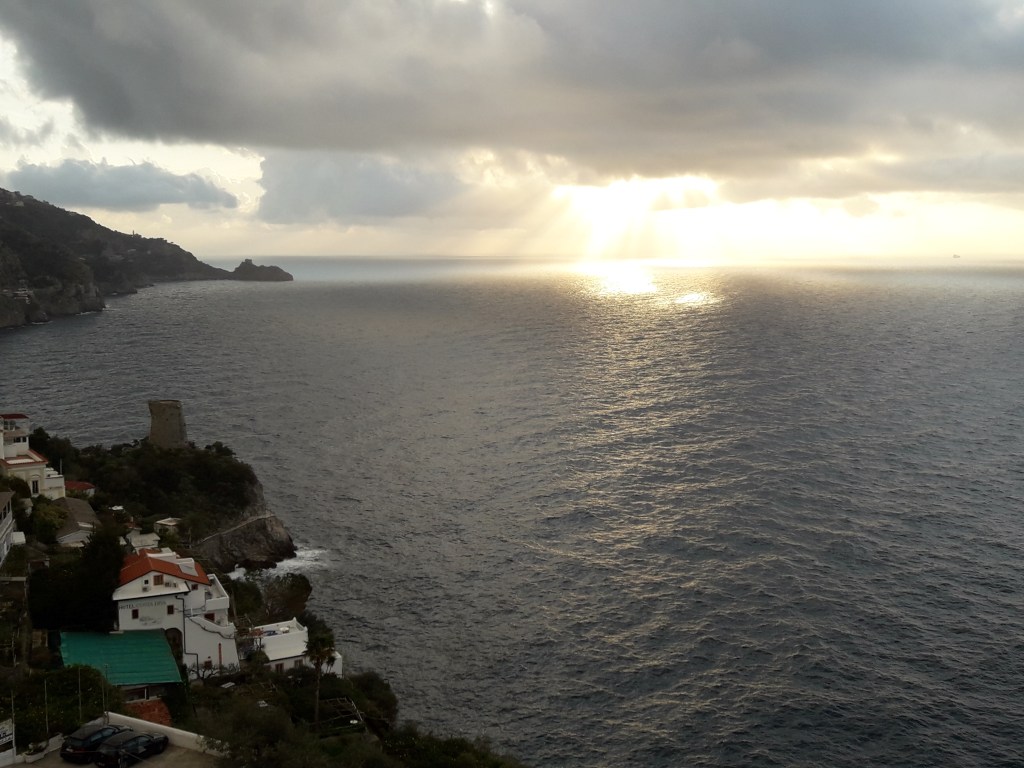
Overcast skies obscured the hoped-for pinks and corals this morning. An hour after sunrise light shone through a few cloud-holes casting dazzling pools on the sea.
I pulled on my ‘outside’ clothes – I have wooly leggings and a sweater for inside and black jeans with a couple of layers under my sweater for outside. Plus a jacket and scarf. I could have left the rest at home – so far. You never know when Cinderella might get an invitation to the ball!
There’s a marked difference in Via Roma during the week – no traffic. On my long Sunday walk, motorcycles, buses, and cars whizzed past. Today they’re all back at work and I have the luxury of the open road virtually to myself.
I stopped to admire several houses I’ve passed before but never really looked at.
This sweet casa has a real driveway winding down to it. A luxury.
This one has steps up from the street but note the tuck-under garage. Maybe there’s an elevator inside – or maybe not.
This might be old. If so, it’s been renovated and beautifully maintained.
And just look at this driveway! It feels fairytale-ish. Like any moment I will see Goldilocks, or Hansel and Gretel skipping along holding hands.
Like the road, Che Bontà was all mine. I thought I wanted pizza. Then I remembered Blackbeach, my favorite Italian restaurant in Ubud. They make melt-in-your-mouth panini. It’s all I ever order there. I had to know if the real thing, made in Italy, would measure up.
While I waited for my order, I chatted with Claudio who, bless his handsome heart, speaks English.
“Claudio, I want to buy the hard bread. The really hard bread. What is the name?”
“Yes, you must ask for pane biscottato.” I repeated the words, perhaps not very well since he added, “Or you can just say pane duro, that means hard bread.” I added it to my shopping list that consisted of coffee and limoncello – staples.
After not much time at all, out came panini and Claudio! What’s not to love? As he set the fragrant plate in front of me I asked him, “Che Bontà, Claudio…what does the name mean?”
The smile grew bigger, “It means, how tasty,” he said.
You have no idea how badly I wanted to comment on that. But I bit my tongue and smiled back. “Grazie,” I said.
Crispy-fried focaccia, melty mozzarella, mushrooms, tomatoes, the flavors melded in my mouth and went straight to my heart. How tasty indeed. I weighed the evidence, did Blackbeach or Che Bontà have the better panini sandwich? I think it’s a tie. I’m going to have to go back for another round.
I could only eat half. The rest is in the fridge for later tonight when the nibble bug bites.
The bill was eleven euros. Claudio showed it to me and said, “But for you, ten.”
“It says eleven,” I replied, confused.
“Yes, but for you, signora, ten.”
How tasty!
Need I mention, Claudio got a handsome tip? Then I was off to Centro Market to try out my new Italian words.
Speaking of which – would you like to see the inside of my Praiano life – where I get to be when I ‘stay home’?
One of the dear people who reads my articles commented early on how it was fun to see inside the house. In the Domestic Goddess post there were snippets of appliances and a drying rack set up in my bedroom. I can do better than that.
Welcome to La Scaletta – come along…
First of all, a disclaimer. The decor does not reflect my aesthetic. Felicia, whom I love, who gave me the cooking class and put me in a food coma, owns this home. It has her flavor everywhere which makes it even more special to me.
No need to take you up the 112 steps to the front door – we’ve been there done that. Nicola hauled my suitcase all the way up and unlocked the door when I first arrived, February 3, 2020. It seems like yesterday.
I feel like my house is high above the water, and it is. But it’s only about 1/10 of the way up the mountain. There are dozens and dozens of houses higher than this. The lovely home just above me has an orchard of lemon trees. I’m a bit enamored of the cliff-dwelling life!
I’ll begin the tour with the journaling corner I’ve set up in the master bedroom. I sit with the blanket over my legs, sipping coffee and jumping up every other minute to open the French doors and shoot the sunrise. I may be here for an hour, maybe two every morning depending upon what comes up as I write. Everything I need is here, the pens, the tablet, the woven hotpad for the coffee cup, earbuds in case a daughter calls…and the view.
Here’s the rest of the master bedroom.The handstitched quilt with tiny pink rosebuds? Purple roses on the sheets repeated in the pillow cases? It’s like a hug from grandma. I pull the covers up to my chin and sleep like a princess.
There’s a tiny second bedroom with twin beds, a chest of drawers, and a closet. It’s excess space. I leave the door closed.
The bathroom is efficient laid out with a toilet, bidet, sink, and shower. I don’t understand the bidet. Someone please explain that useless piece of porcelain. I’ve purposely left it out of the photos. It’s beside the commode.
Master bedroom, spare bedroom, and bath are off this gracefully arched hallway. All the doors are solid wood.
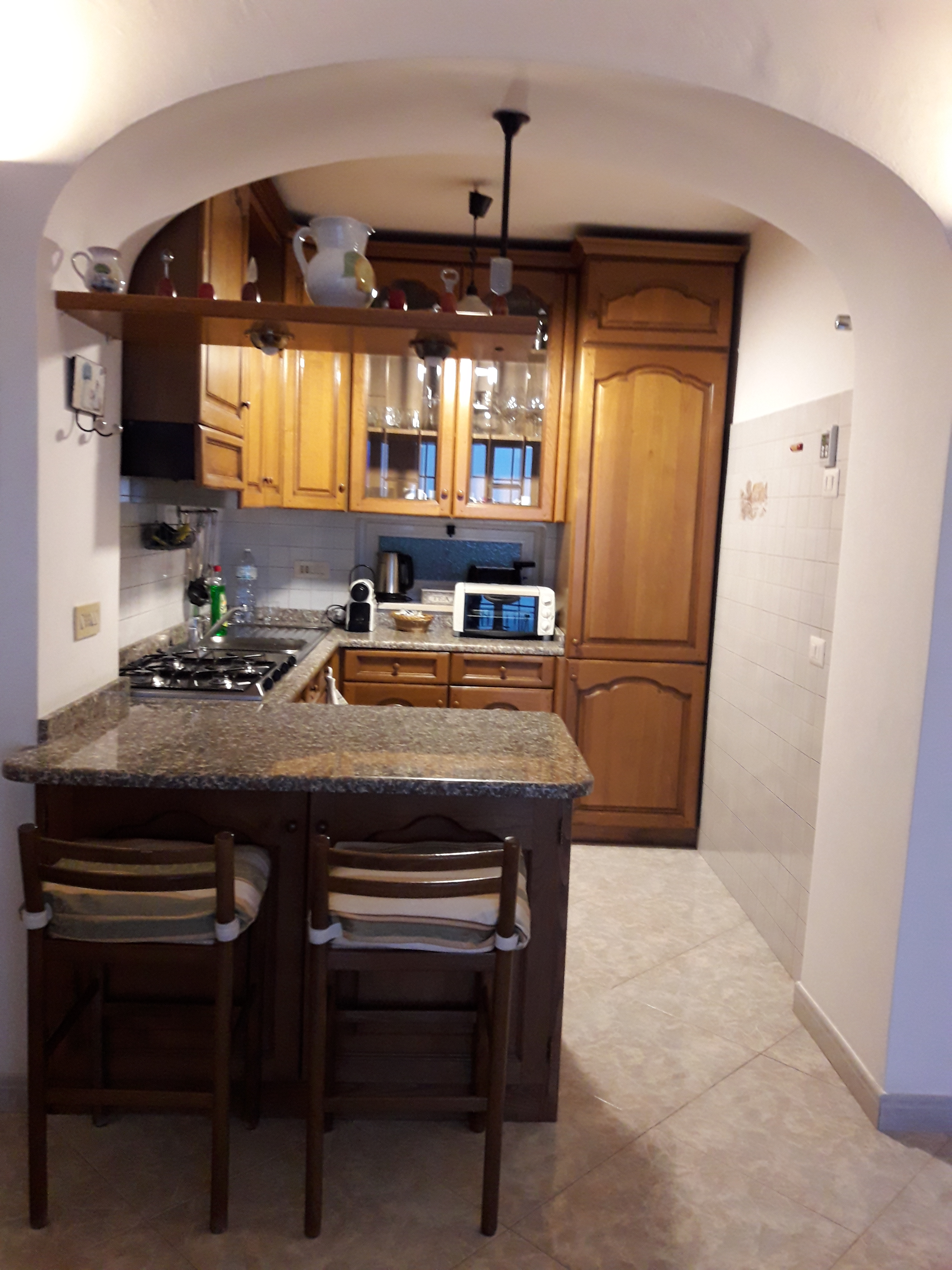
The open plan living room, kitchen, and dining area utilize the space economically and the French doors that open onto the terrace and the sea make the room feel limitless.
The lace doily? Tchotchke on the shelves? Pink damask draperies? Ladderback chairs? Ummm…no. But here in Praiano, in this house? Yes.
I’m curious. Does IKEA sell complete sets of art, plus matching sofa slipcover, plus pillows that perfectly, I mean PERFECTLY pick up every color in the art? I noticed the cookware is from IKEA – that made me slightly suspicious. It’s just too, too, too…coordinated! I do love the red sofa though.
Glassware, glass shelving, tiny figurines like the ones my mother collected that I had to dust individually every Saturday…uh-huh. Not me.
But oh! The terrace! The coup de coeur. It stretches across the entire front of the house and it couldn’t have a more splendid view. I watch ships and sailboats. I can monitor the traffic on the Via Roma. (There is none.) I can see Sandulli’s tower and Angela’s shop. And did I mention the sunrise?
One end of the terrace has two loungers like this. A majolica dining table with lemons and oranges – what could be more Italian – and wrought iron chairs anchors the other end.
I give myself credit for getting up and out of this cozy place to explore. I could be very very comfortable with my books, my writing papers, the sun on the terrace, the view…
And the wine. Here’s the one I picked up yesterday. A crisp pinot grigio that I’ll be pairing with caprese salad and farmer’s bread in about two seconds.
I hope you enjoyed the tour. I’ll tell you about farmer’s bread another day!
Today I unlocked the blue gate and headed west on Via Roma, past Angela’s shop and Sandulli’s tower. Past Via Miglina – the farthest point I’ve been on foot in this direction – and kept going.
When Nicola took me to the winery I’d cranked my neck back and forth ooooing and ahhhhing as one magnificent scene after another sped by too fast.
So I set out today with no other purpose than to photograph this stretch of the coast for as far as I could walk and still walk back.
The road hugs the cliffs. I never lost sight of the sea…except in the tunnels…
There isn’t much of a margin for error. I hugged the side and flattened myself against the wall if two cars tried to pass next to me.
I’d just cleared one tunnel and could see the next across a ‘sunken’ village. It isn’t really sunken – just another fisherman’s inlet.
I marvel at the engineering of these soaring bridges.
Can you see them – Roman soldiers crossing on horseback, armor flashing in the sun, banners waving, lances piercing the sky?
That’s a strange-looking rock formation…from a distance (above) and up close (below).
So much of the architecture seems free-form, whimsical almost. It has to be to cling to the irregular edges of rock cliffs.
A plunge to turquoise waters far, far below.
I love the stucco and I love the stone! I love the cliffs and I love the sea!
Still not crazy about tunnels…but I’m getting better!
During the 10th-11th centuries, Praiano was the summer residence of the doges of the Duchy of Amalfi. I have to believe that some of these grand structures were once royal homes.
Italy has fjords. Who knew? This one is called Fiordo di Furore (Fjord of Fury) and it doesn’t look anything like the fjords I sailed on in Norway. But according to the Oxford Dictionary definition: a long, narrow, deep inlet of the sea between high cliffs, it fits.
A stoplight! I just happened to arrive as all the testosterone you could wish for came roaring to a stop to wait for the green light!
There are two types of towers built on outcroppings of rock along the coast. The round ones came first. They were strictly watchtowers. If danger was approaching by sea a huge fire was lit so the people of the town could assemble, or run, or whatever they needed to do back then.
The square towers, like this one, came later. They housed artillery actually used to shoot at enemy invaders.
Notice the church sitting high on the ridge.
I’d reached the Grotta Dello Smeraldo, the Emerald Grotto.
Across the street from the steps leading down – which I’ll save for another day – was a ceramics showroom. This is a far different quality product than I’ve seen in the little souvenir shops. I drooled for a while. It’s probably a good thing the shop was closed.
Did I mention everything was closed? Sunday morning, of course. Although knowing what I know now I expect maybe they’re all closed Monday through Saturday, too! Many of these places won’t see the light of day until April or May when tourists again begin to flock to the beaches.
I checked the clock and the map. It had taken me 1.5 hours to walk 2.25 miles stopping every other step to take a picture. Hopefully I’d get home in half the time. I was getting hungry.
Plus, my ballet flats do great in town on the steps, but this highway hiking – I should have worn the New Balance shoes I brought along for just this purpose. What was I thinking?
Actually, I know exactly what I was thinking. These are cuter. Oh, Sherry!
As I started back I realized the road sloped very gently downward. I’d been walking uphill the entire way and hadn’t realized it.
The water was on my left for the return and I saw things I’d missed going the opposite direction.
All along the coastal road outcroppings of rock like this one, hang over the highway. An elaborate net system is used to hold them in place. Nicola told me rock slides still happen and when they do, the road may be impassable for days.
Arches. They’re everywhere in Italy, and here’s why. From study.com: The Roman arch was the foundation of Rome’s architectural mastery and massive expanse of building projects across the ancient world. It allowed the Romans to make bigger buildings, longer roads, and better aqueducts. The Roman arch is the ancestor of modern architecture.
Now this…this must have been a royal residence at some time. I want to believe it!
Only one more tunnel after this one. That’s Praiano in the distance.
And on the other side of the tunnel, Paulo Sandulli’s tower. I’m almost home!
I read the news every day so I know in some ways this exquisite experience is a make-believe bubble. Yet I’m grateful, so grateful to be here. To see the beauty and share it. To feel the utter joy of being alive. I don’t want to send more doom and gloom into the ether. There’s an overabundance of that already. I believe we need to do our part to alleviate suffering wherever we can. But still we must celebrate what can be celebrated and not feel guilty about doing so.
As though to put an exclamation point on a perfect day, the leftovers of sunset on the other side of the mountain hung for a few breathless moments in the eastern sky. A benediction.
I pity night owls. Really, I do. To miss a masterpiece that lasts moments then is gone seems like a terrible waste. I think that’s why I’m obsessed with photographing the sunrise. I wake up at 5:00, make coffee, then sit, and sip, and wait. The fiery splendor this morning dazzled me.
Today is day twenty of this fabulous Italian adventure and I have a plan. A dot on the map indicates Sentiero degli Dei Praiano – Path of the Gods. I want to go to the dot. I’ve been told from that point it’s another 2000 steps up to the actual trail. Today, the dot. Tomorrow…?
I chart my course. Fortunately, even though I don’t have data here, if I add the route to my phone’s home screen and turn on location it tracks me. It’s essential in this maze of unmarked paths and stairs.
But before we get on our way, lets talk for a minute about legs. I’ve always had muscular calves, embarrassingly muscular. A gym teacher in high school told me I had legs like a Roman gladiator. Not what a pubescent teen wants to hear.
I do a lot of walking so I’ve maintained leg-strength as I’ve aged. But let me be perfectly clear about Praiano. If you have weak knees, weak hips, weak thighs, weak lungs, weak heart, or a weak mind, don’t bother. Strong calves are not enough. Good intentions are not enough. Determination will get you far, but not far enough.
My limits were tested today.
It began innocently. I took the trail I discovered the other night coming home from the bus stop. The slope upward connected to a road that took me to Tutto per Tutti market but cut off half the steps I normally climb to get there.
I passed Tutto per Tutti and took the next switchback up to La Moressa, the restaurant where I had pizza a few nights ago. There was a narrow stairway to the left. I stopped to check my location. That was it.
Up, up, up. Panting and winded, I rounded a corner. San Luca church rose high above me, white against the cloudless sky.
The next time I saw the church it was below me, its backdrop now the brilliant blue sea.
At one point I wondered, imagined, that this MUST BE the 2000 steps to the trail, and when I got to the end I would BE ON the Path of the Gods. The thought motivated me to press on.
At the top I once again checked the map. Still another vertical line to ascend.
In a few more strides I was standing at the base of a flight so long and steep I couldn’t see the top. I almost turned around. But, Sherry, I told myself, this is the last leg. At the end of this you may be on The Path. I charged onward. (Charged may be an overstatement.)
My heart pounded. My thighs burned. My calves were fine.
At the top I collapsed against the rock wall to catch my breath and saw the sign.
I moved up close and read the small print. Another 1 hour 30 minutes of steps and trails to the actual Path of the Gods.
At that point I may have taken one of the names of those gods in vain. There was nothing else there, not a vendor selling bottled water. Not a ‘last stop for coffee’ shop. Not a ‘take your instagram photo here’ posting. Nothing but rock walls and more and more and more stairs.
I photographed the sign, sucked air into my lungs, blew it out long and slow, and started down.
And down…
And down…
Finally, just ahead was the welcome entrance to Tutto per Tutti. Buongiorno said the two men who own the place. They smiled as I walked in. They know me now.
Buiongiorno. I smiled too, picked up a basket, and selected my groceries as though I’d been shopping there all my life.
Emmental Bavarese cheese, carrots, tomatoes, a red onion, bananas, apples, strawberries, canned lentils and chocolate covered orange slices.
That’s $18.20 in US dollars
Of course there were still the 228 steps down to Via Roma. And 112 steps up to my house carrying a heavier pack. After what I’d just accomplished, it felt like nothing.
I felt like I was back in Bali when I saw the terraces…almost.
We left the coast and climbed into the Lattari mountain range. It’s cold enough up here for trees to drop their leaves but warm enough for grass to stay green. Nicola had his phone tuned in to Google maps but still asked locals for directions a few times.
I’d originally thought I’d take the bus from Praiano to Tramonti and walk from the station to the winery. Had I done that, I may still have been walking. Our trail through the mountains reminded me of the last lines in a poem by Robert Frost:
Two roads diverged in a wood, and I— I took the one less traveled by, And that has made all the difference.
The story of my life.
Four people watched us expectantly as we approached the winery. It was the tour group waiting for me.
Sophia, the daughter of one of the owners of Tenuta San Francesco, was our guide. The three gentlemen were from Brazil and I was the lone American.
Sophia is a teacher. She was brilliant, speaking Spanish to the Brazilians, English to me, and Italian to anyone else. She explained we would do a tour of the vineyards then have our tasting, was that all right? We agreed, three Si(s) and a Yes.
I’d been awed by the elegant pergolas spiderwebbing the mountainsides as we’d driven through this area. I asked about them. The framework is chestnut wood, Sophia said, and workers use willow twigs to tie branches to the beams. She explained that willow is organic material and deteriorates. When that happens, it takes four months for experienced knot tiers to replace all the bindings on the vineyard’s thirty acres of vines.
We were standing under the spreading branches of a vine that was over 500 years old. Sophia told us when Vesuvius erupted in 79 AD, volcanic ash created perfect soil conditions for grapes. And when phylloxera, a type of aphid that attacks the roots of grapevines raged throughout Europe, many originals were lost.
The infestation began when plants carrying the phylloxera aphid were brought from North America in the late 1800s. What followed changed the wine industry in most of the world. Since only vines from North America were immune, in order to preserve and perpetuate the varieties of grapes throughout Europe and other countries (even Australia) original vines had to be spliced onto plants with roots imported from North America.
But because volcanic soil resists phylloxera the vines of Tenuta San Francesco were protected and survived. In a few other areas of the world where similar conditions exist, original vines remain, some over 2000 years old.
She explained that the quality of wine from the rare Tintore grape, which is the variety produced by the original vines of Tenuta, is some of the world’s finest. But the yield from old vines is not large so supply is limited. It’s considered a boutique wine.
The branches from this twisted, ancient specimen create a network overhead covering an area the size of a toddler’s playground. Gardens are planted underneath. Sophia pointed out a plot of fava beans sprouting just behind us.
The vineyard tour completed, we headed inside.
Buildings in Italy seem like they’ve existed for all time. I’ve never been comfortable around glass and steel. Give me rocks, timber, crumbling plaster and I feel at home. There’s a sense of being grounded in antiquity, a connection with the past that I felt as I walked through those doors.
“How old is this cave?” I asked as we entered.
“It has been in the family since the 1700s,” Sophia replied. Sleek steel and electronics against three hundred year old stones jarred me in an exciting way, a bit like waking up to the mechanical hum of a drone peering in my bedroom window in Bali at six a.m. (Don’t laugh, it happened!)
The winery logo was stamped on barrels lining the walls. Sophia showed us how it can be read as a T for Tenuta, and an F for Francesco. She also explained this type of cross was used by the Knights Templar. The designer added a stylized bunch of grapes at the bottom. Classy.
Information continued to flow. Whites are prepared and aged in the steel vats. Reds start there then are transferred after many months to wooden barrels where they age for two years before being bottled. Red wines, we learned, can handle the wood undertones. Whites cannot.
When we were saturated with Sophia’s knowledge to the point of overwhelm, she said, “Would you like to taste?”
She didn’t have to ask twice. We followed her into a sunlit area where our table waited.
Sophia’s mother was preparing food for us.
Gaetano Bove, the man I met in the cafe who invited me to tour his vineyard, introduced the first wine, Per Eva, which he’d named for Eva, his wife.
Sophia’s mother set plates in front of us. “Winter salad,” she said. Fresh goat cheese, warm potatoes mixed with olives and onion, and tomatoes with chucks of hearty farmer’s bread. Silken crispness of Per Eva, like spring rain, enhanced the subtle flavors of the salad and softened the onion’s sharp surprise.
Before we emptied our glasses of per Eva, Gaetano was pouring Turmiento, the winery’s organic red.
I’ve only tasted a few organic wines and wouldn’t go out of my way to find them again. Turmiento was an exception. If you know organic restaurant owners who import wine, recommend this one. It’s rich, warm, and it paired brilliantly with the dark farmer’s bread, pecorino cheese, and sliced salami that had just appeared on our table.
Gaetano radiated love for his craft. As he brought out our third wine he mentioned famous people who had visited the winery, among them Justin Timberlake and his wife, actress Jessica Biel.
Then, as our glasses swirled with liquid of the deepest, richest crimson, Signor Bove told us he’d recently gone to France to attend a meeting of top international wine makers. He’d taken E’ Iss, the red, made from the ancient pre-phylloxera vines. Each of the fifteen attendees had brought their specialties, some bottles selling wholesale for as much as 25,000 euro ($27,000 USD). They did a blind tasting, he said and shook his head. “Mine was better. And only thirty euro per bottle.”
We sipped, and sighed a collective, “Ahhhhh.” I thought Turmiento would be my favorite. It was smooth, seductive. But it turns out E’ Iss was like the difference between the boy you date on the sly and the one you bring home to meet Mom and Dad. I brought E’ Iss home.
Which, by the way, was no small feat. When the food was eaten and the wine was drunk, I said goodbyes and Gaetano drove me as far as Maori, the coastal town where he has a veterinary practice, and dropped me in the square. From there I’d catch the bus to Praiano.
Nicola had instructed me on the finer points of navigating the bus system. I had to buy a ticket before I got on, and he suspected in Maori I could only buy a ticket to Amalfi. I would need to buy another in Amalfi to get to Praiano.
I found a helpful person by this playground who pointed the direction to the Tabacci shop where I could purchase my first ticket. I set out. It only took two more queries to locate the tiny place.
Ticket in my pocket, I started back to where I’d seen people waiting in bus shelters. “Where do I catch the bus?” I asked a street vendor tending her cart. The woman took me by the arm and steered me to the side of the road and pointed.
“To Praiano?” I asked, just to make sure.
“No,” she said, and pointed to the opposite side of the street.
It was a twenty minute wait. I boarded, took a window seat, and snapped photos all the way. If you scroll through fast, you’ll get a feel for the wild twists and turns of the fabulous coastal road.
Then we were in Almalfi with another ticket I had to hunt, kill, and drag home! I asked for directions and was shown the newspaper shop across the street.
Done.
A bus with no driver idled nearby. The sign above its front window said Sorrento. I asked a man if this bus stopped in Praiano. He didn’t know. Then I heard, “Yes. To Praiano.” A face with a neatly trimmed gray beard and mustache nodded at me from the front seat. Gratefully I boarded, inserted my ticket and turned to walk toward the back. The bearded old man patted the empty spot beside him.
“I can sit here?” I asked. He nodded.
Within a few minutes the driver appeared and another gut churning ride commenced, but this time I had a seat companion. “You speak English,” I said.
He nodded. “I speak three languages, French, English, and Dutch. You know pork?” he asked.
It seemed a strange question. “You mean pig?”
“Yes, pork. In French pork say this.” A strange, pig-like grunt erupted from his mouth. “In Dutch pork say this.” The intonation was different but still unquestionably porcine. “And in English…”
To say I was happy when we reached Praiano would be an understatement. Still, I was grateful when Signor Pork reached across me to ring the bell for my stop or we would have sailed right by.
By now it was dark. I stood alone at the corner where deserted Via Umberto heads uphill and Via Roma, with more traffic, is a straight, level shot to my blue gate. I poked around in my memory trying to bring up the map of Via Umberto. Without data on my phone I couldn’t request Google’s help. Dressed all in black I’d be invisible on the busy Via Roma, narrow and without sidewalks…
I started up Via Umberto knowing with the certainty of experience that somewhere there would be a staircase going back down. After about 150 meters (apx. two city blocks) a footpath veered off to the right at a serious downhill slope. It was beautifully lighted so I took it. A few hundred yards later I knew exactly where I was. The stairs that take me from Tutto per Tutti to my house were right there.
I just want to say to senior women, men too, if you’ve ever dreamed of solo travel, if your feet sometimes itch and your eyes long to gaze on something other than your own backyard, do it now.
No matter what creams, dyes, or wrinkle retardants we use, we don’t get any younger, and time doesn’t wait.
There’s a lot going on in my head. There often is, but my thoughts are taking a detour from the usual these days. It’s little wonder. Italy isn’t Bali. Praiano isn’t Ubud. A change of scene opens up mental space to imagine.
The timing is perfect. December ends the twelve-month cycle on the Gregorian calendar but Pisces, February 20 – March 20, marks the wrap-up of the solar year. Tomorrow, 2/20/2020, the sun enters the sign of the fish to complete the last thirty days of its journey through the zodiac.
For months my friends have been muttering about feeling unfocused and edgy, as though they’re waiting for something without a clue to what that something might be.
I’ve felt the same.
Of course, turning seventy has a certain shock value. Even though I knew for 365 days that I was sixty-nine, and I’ve known for much longer than that how to count, actually becoming seventy years old surprised me. It compelled me to look back at my life and ask, “What have I accomplished?” And to look ahead and say, “What’s next?”
I’m happy with the past. That’s a good thing because it’s too late to change it and I wouldn’t if I could. It made me who I am.
But this moment in time feels pivotal, like stepping out of one reality and entering another that’s cleaner, clearer, and shorter than what’s gone before.
On my terrace, gazing at the vast horizon where water and sky collide sometimes with no line of demarcation to indicate where one begins and the other ends – breathing air salty and moist – hearing the lilt and staccato of a language I don’t understand but am growing to love – lifting my face to be kissed by the sun, it suddenly doesn’t matter that I don’t know what lies ahead.
I’m filled with a sense of release, letting go of everything I don’t want to carry with me into this new cycle that’s about to begin. It feels like a time of rest and patience. Of slowing down the outer world and focusing within. Of making new choices.
As I wrote that last line, butterflies came to life in my stomach and my arms sprouted goosebumps.
Making new choices…
Tomorrow, to give special attention to 2/20/2020, I’m choosing to accept Sig. Gaetano Bove’s invitation to visit Tunata San Francesco, the winery he co-owns with three associates.
Whether I write about the experience immediately or at some future date will depend upon how enthusiastically I taste the samples on offer.
Welcome back, Pisces, it’s been a long eleven months!
It was a three-hour meal. A three-hour, gourmet, how many courses I don’t know, Italian, homemade meal. Thank you Felicia. I love you Felicia.
I was told to come at twelve o’clock. I’d been to the house a week ago for a brief introduction but Nicola sent a picture of the doorway to ensure I would find it again.
I was certain it was somewhere on the same stairway that I travel almost every day. Ten minutes should be plenty of time to get there. I labored to the top passing many doors but not THAT door. I must have missed it…how? Impossible! Back down. Still no door. Back up to the top. Breathing hard. No internet. Cannot call for help. Panic. Maybe it wasn’t this stairway.
It wasn’t.
At 11:58 I found the right stairway. At 11:59 I found the door.
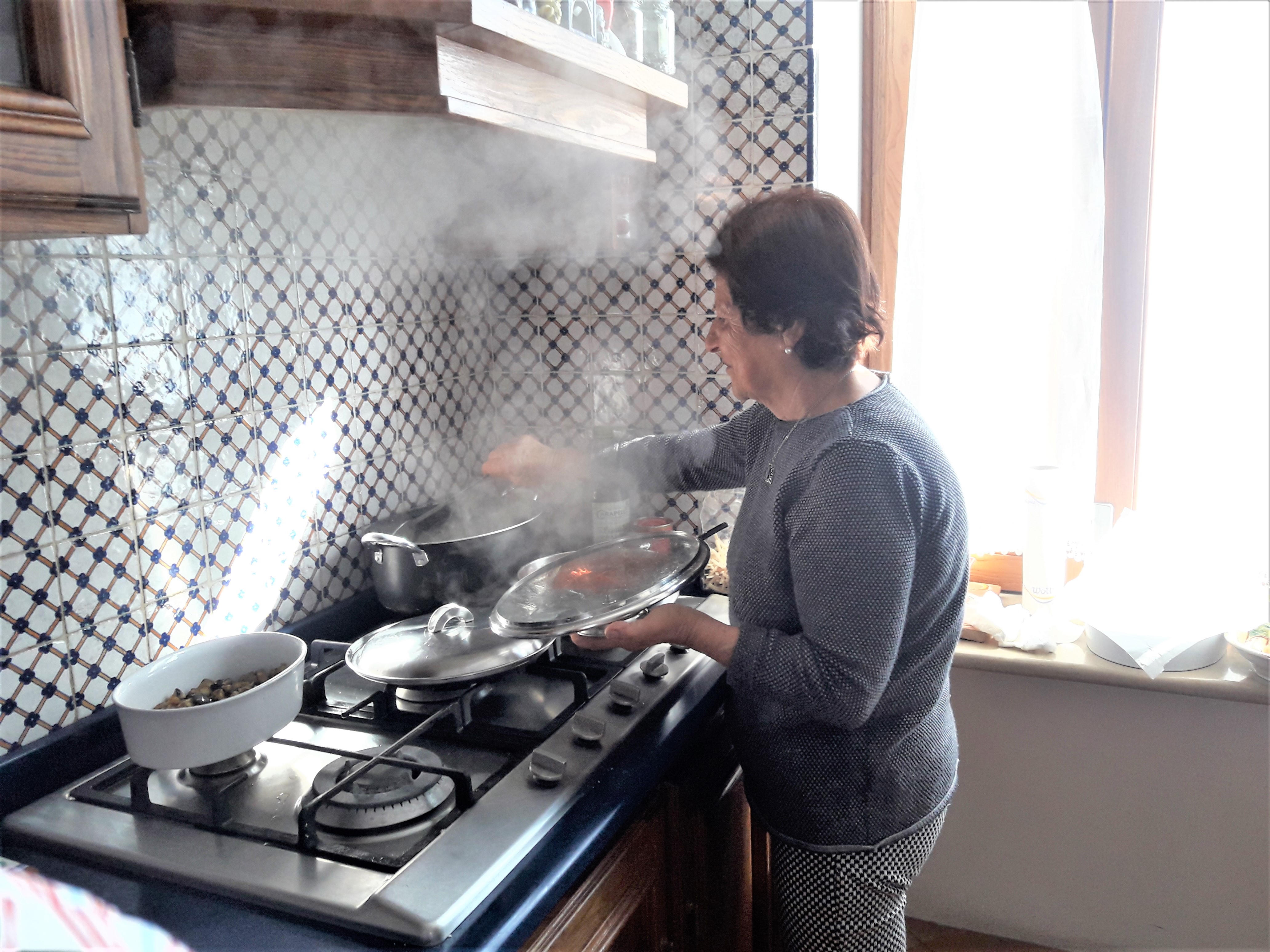
Nicola greeted me and I followed him to the kitchen where Felicia was already hard at work. Moist air, heavy with the scents of Italy, wrapped around me like a mother’s hug. Then Felicia gave me the real thing with the two-cheeks kiss that is customary here and cooking class began.
First it was totano – a variety of squid caught in the rocky depths close to the coast. Nicola explained the totano found near the shore are red, but those caught farther out to sea where the bottom is sandy are white and the flavor isn’t as good. These, he said, were red ones.
Fresh from the frying pan into the mouth. Hot and…oh, my! The flesh was delicate, so tender and sweet. “How many totano does it take to make all this?” I asked. Nicola translated my question. Felicia opened the fridge and pulled out a monster.
“Grande!” I said, backing up a few steps. They laughed.
Nicola had to run an errand. Suddenly Felicia and I were on our own to navigate the language as best we could. I connected to her internet and brought up Google Translate. I’d come prepared with a list of questions, first in English so I’d know what I was asking, then in Italian so I could practice the language.
It was great. She got every question immediately, even though I stumbled and bumbled and massacred the words. Her answers were long, emphatic, emotional – even Google couldn’t follow. Nonetheless, we managed, and had good laughs in the process.
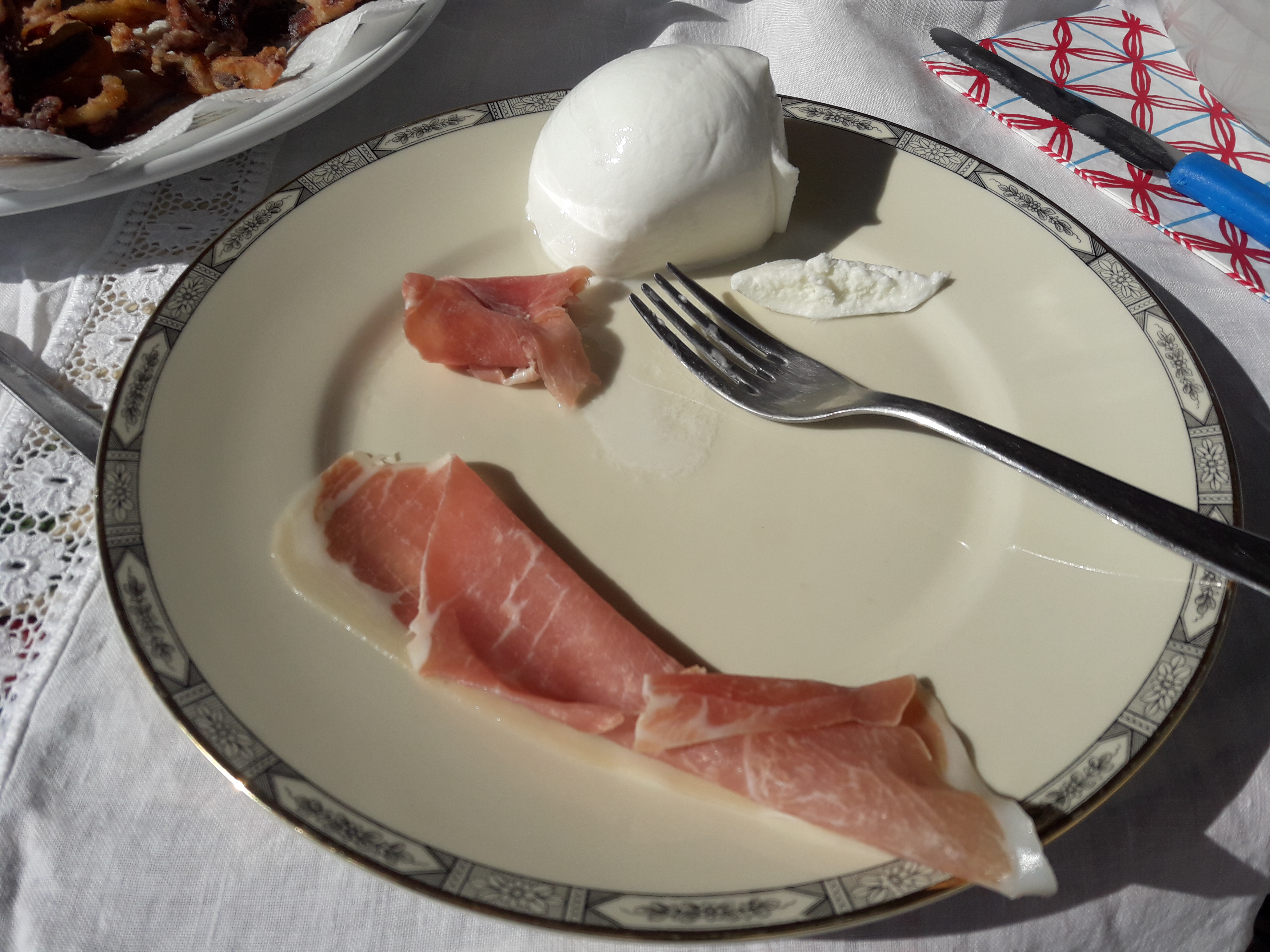
When the last tentacled leg of squid had been fried, I was moved out of the kitchen to a table on the terrace set for four and told to sit. The plate of crispy totano was set in front of me followed by a bowl of buffalo mozzarella, then salami, pepperoni, prosciutto, bread, and wine.
Mangiare, my hostess said. I started to ask if others were coming but she interrupted. Mangiare! Mangiare! and disappeared into the kitchen. Like it or not, I was to eat regardless of three empty chairs awaiting other guests.
I nibbled on a leg of squid. Love that stuff. Helped myself to one of the smaller balls of mozzarella and a strip of prosciutto savoring the contrast of the salty meat with creamy cheese. Every so often Felicia made an appearance to re-issue her command, Mangiare, mangiare!
When I couldn’t mangiare another bite, I ventured back into the kitchen.
Tomato sauce bubbled on the stove. I asked her what ingredients she’d used. Pomodoro, olio, acciuga, origano, basilico, acqua. She ticked them off on her fingers. I’ve been grocery shopping often enough now to know all of the words except acciuga. She spelled as I typed and up popped anchovies. Is that the mystery ingredient that makes Italian tomato sauce a culinary triumph?
I pointed to another pot. Melanzana, she said but this time didn’t let me Google it. She went to the refrigerator and pulled out an eggplant then motioned me to the windowsill. Mozzarella, parmigiano, and pecorino cheeses waited in majolica bowls.
Basilico, she said, laughed, and flung open the window.
Basil doesn’t get any fresher than that.
It was time for pasta. As she poured it into the kettle I asked what kind it was. Scialatielli, she said. I’d never heard of it. She showed me the label.
I decided to throw in a few more questions while the pasta cooked. “Where did you meet Rafaele,” I asked. She looked confused. I tried again. “Where did you meet your husband?” I understood the word for school in her answer and the sparkle in her eyes told me the rest.
“Did he chase you?” Oh, the laughter.
“All the way from the school to the sea,” she said, motioning the trajectory down the mountainside with a sweep of her arms.
“What did Rafaele do for work?” Again she looked confused. “Rafaele, your husband,” I said.
If I thought she’d laughed before, this time tears squirted from her eyes. I double-checked the the word for husband. It appeared correct. When she was finally able to speak, she said, “Rafaele is my brother. Gaetano is my husband.”
I was shocked to my toenails. I thought the old man sitting with his walker was her father. Come to find out, she’s seventy-nine and he’s eighty but he broke both hips this year and is housebound. She takes care of him.
“I’m sorry, Felicia. That’s hard.” She agreed.
Just then Nicola returned from his trip to Positano and joined us. Out came the pasta, biscotti, and wine. The empty chairs were filled and we had our translator back.
I’d been a wee bit skittish about the anchovies – I’m not a fan. But they did their job. The pasta was magnificent.
When I was certain I couldn’t eat another morsel, out came Felicia with an enormous bowl of fresh fruit, chiacchiere, and a pineapple upside-down cake.
The slab of cake she cut for me could have served four people. But did I eat it? You better believe I did, then drank the little cup of Neapolitano mocha espresso which guaranteed I would stay awake to finish this post even in a food coma!
What an amazing day. What special people. What spectacular food. “Now you can go home to Bali and make this dinner for all your friends,” Nicola said as I bid them farewell.
So, we’ll go no more a roving So late into the night, Though the heart be still as loving, And the moon be still as bright…
Lord Byron’s poem, sung like none other by Leonard Cohen, is probably descriptive of my feelings about roaming the ink-black stairways of Praiano after dark. Once was a scary thrill. Twice won’t be necessary. Not when there are sunrises like this, and days bathed in gold.
As luck would have it, this February has been unseasonably warm and sunny for Praiano – a walker’s dream. And I am, dear friends, a walker! Not the White Walker Game of Thrones type – just an ordinary, past-middle-age-but-still-young-at-heart woman who loves to walk. And today I’m taking you with me to the Piazza San Gennaro where I hope to see the inside of the church with the beautiful blue dome that has captivated me since I arrived.
But before I go, I want a bit of background. The Encyclopedia Britannica says: Saint Januarius, Italian San Gennaro, (died 305?, Pozzuoli, Italy; feast day September 19), bishop of Benevento and patron saint of Naples. He is believed to have been martyred during the persecution under the Roman emperor Diocletian in 305. His fame rests on the relic, allegedly his blood, which is kept in a glass vial in the Naples Cathedral. Of solid substance, it liquefies 18 times each year. While no natural explanation has been given, the phenomenon has been tested frequently and seems genuine.
Until today I didn’t know there was a saint for my birthday month. Nice. I mapped my route and was off .
The photo hasn’t been touched-up. That water is really as turquoise as it looks. But it’s a lot farther down than it appears and diving is not recommended.
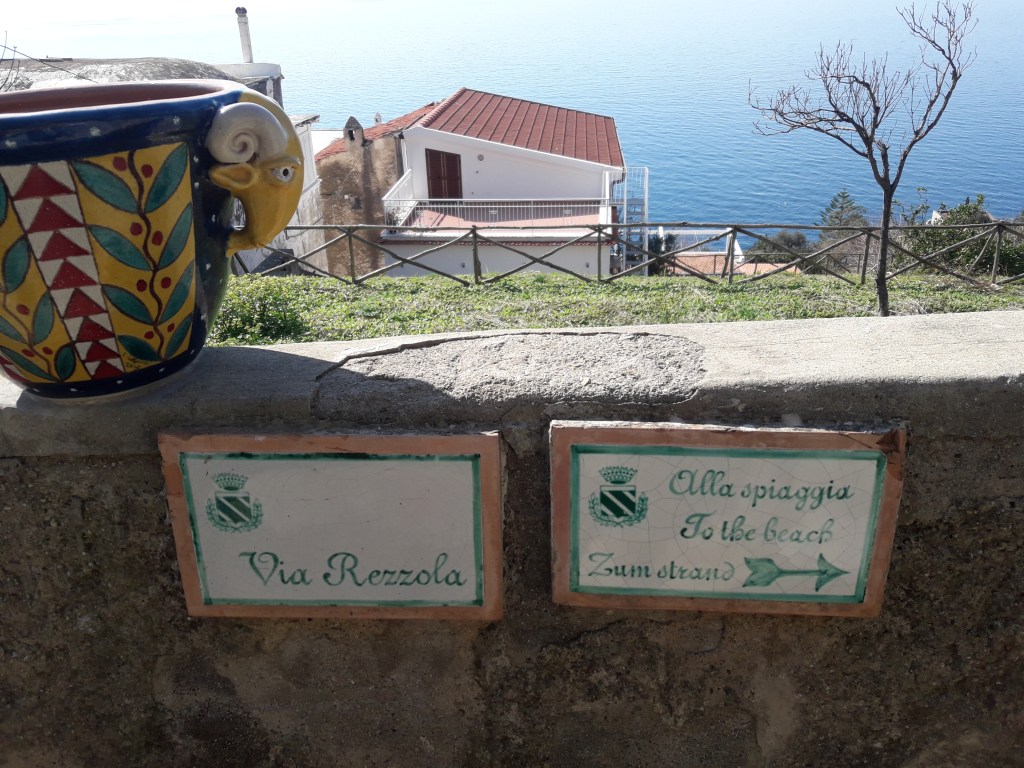
As soon as I could, I abandoned Via Roma and ducked into Via Rezzola, a series of stairs and pathways for pedestrians only. I passed one. I could tell he was a local man by the way he said Buongiorno with a nod and the curl of sound around the o-r-n followed by the slightest lift on the ‘o’ at the end. I’m becoming a connoisseur of this melodic language.
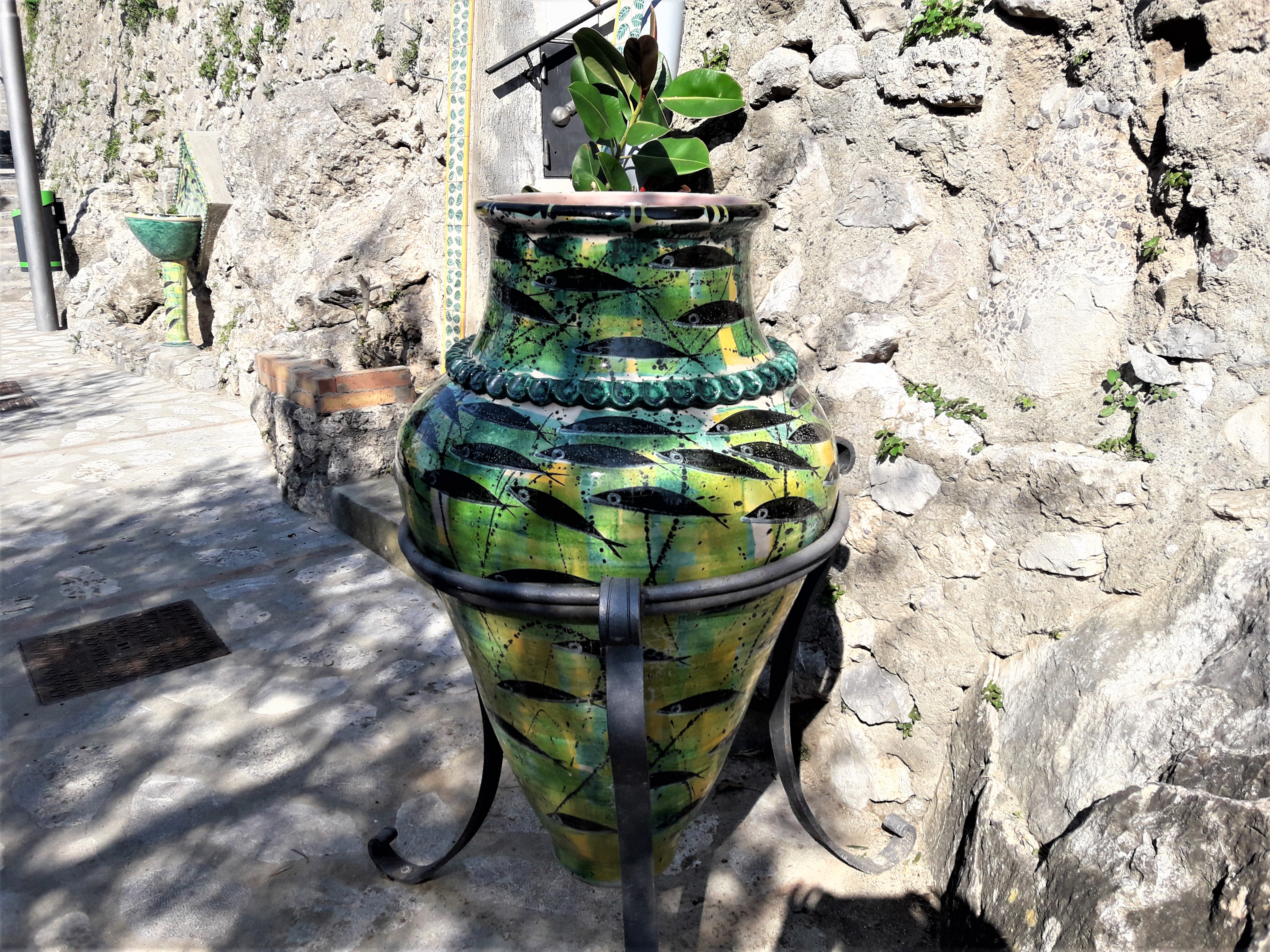
Of the paths I’ve trod so far, this one is the prettiest. Bright painted ceramic pots line the wall. I love this depiction of my sun sign, Capricorn, the sea goat.
It was unmarred tranquility until I heard something coming toward me that sounded like children beating on wooden bowls. It wasn’t children. This time I didn’t miss my opportunity.
There were four of these lovely creatures. I think they’re mules, longer manes, nicer tails, more shapely legs. They’re the only vehicles allowed – the only vehicles that can do steps without assistance. They’re the haulers, essential for any construction that happens on these cliffs.
And then I was in the Piazza. Two young boys were using the massive square as a playground. A couple sat on the side sharing a picnic.
I walked the circumference then sat in the sun, watching.
There are three entrances to the church: the doors in the middle and one on either side. Nobody was going in or out and the metal gate was closed. A woman, beautifully dressed in a fuschia coat and scarf, with a crown of white hair, walked in my direction. She smiled, “Buongiorno,” she nodded then said something that must have been wonderful if I’d been able to understand.
Mi dispiace, non parlo Italiano, I said. I’d practiced all morning to get that down. If I learn nothing else I need to at least be able to say, “I’m sorry, I don’t speak Italian.”
My new friend walked over to me and beamed. “It is beautiful day, no?” she said.
We talked.
No, you don’t understand…we TALKED. Together. Communicated. She owns the hotel by this square and interacts with guests so she speaks English.
Over the course of conversation I asked her if the church was open to visitors. She said of course, I could just walk in. It was always open. Had I not met her, I wouldn’t have gone inside.
Thank you beautiful lady in the fuschia coat.
The interior of the Church of Saint Januarius did not disappoint.
The tile work on the floor is spectacular.
There were people praying so I didn’t take pictures of the Rococo and Renaissance style art, sculptures, niches, and stations of the cross. But one stood out: a woman serving her breasts on a plate. I found a picture on the internet. The one in the church was similar to this:
I looked her up. She’s St. Agatha, patron saint of rape victims, breast cancer patients, martyrs, wet nurses, bell-founders, bakers, and (her name is) invoked against fire, earthquakes, and eruptions of Mount Etna.
Church bells pealed as I left the square.
I took the road uphill to Tutto per Tutti with a quick detour to check out Che Bonta. It was open! I spoke to Claudio, actually, Claudio spoke to me, holding his hands cupped together in front of him the way professionals in the service industry often do.
He explained it was only their second day so the menu, which was on the chalkboard in front of us, had the specials. He apologized there were only eight options. But I could also order off the regular menu which he produced for my perusal. I’m guessing there were at least another fifty possibilities there – pizza, pasta, panuozzi, antipasti, salads, and a dessert of the day. Oh, and they deliver…
Claudio, Claudio – you rock my world – you and the lady in the fuschia coat.
Tutto per Tutti was closed.
But Centro Market was open and I needed chocolate. Tomorrow at noon I will go to Felicia’s house to watch her cook. What a privilege to spend time with an Italian family. The chocolate is a hostess gift. I asked Nicola if she likes wine. “Not so much,” he said. “She’s old. But she likes chocolate.”
What does being old have to do with liking or not liking wine? I didn’t ask. I’m quite certain I’m older than she is and I have no problem with wine.
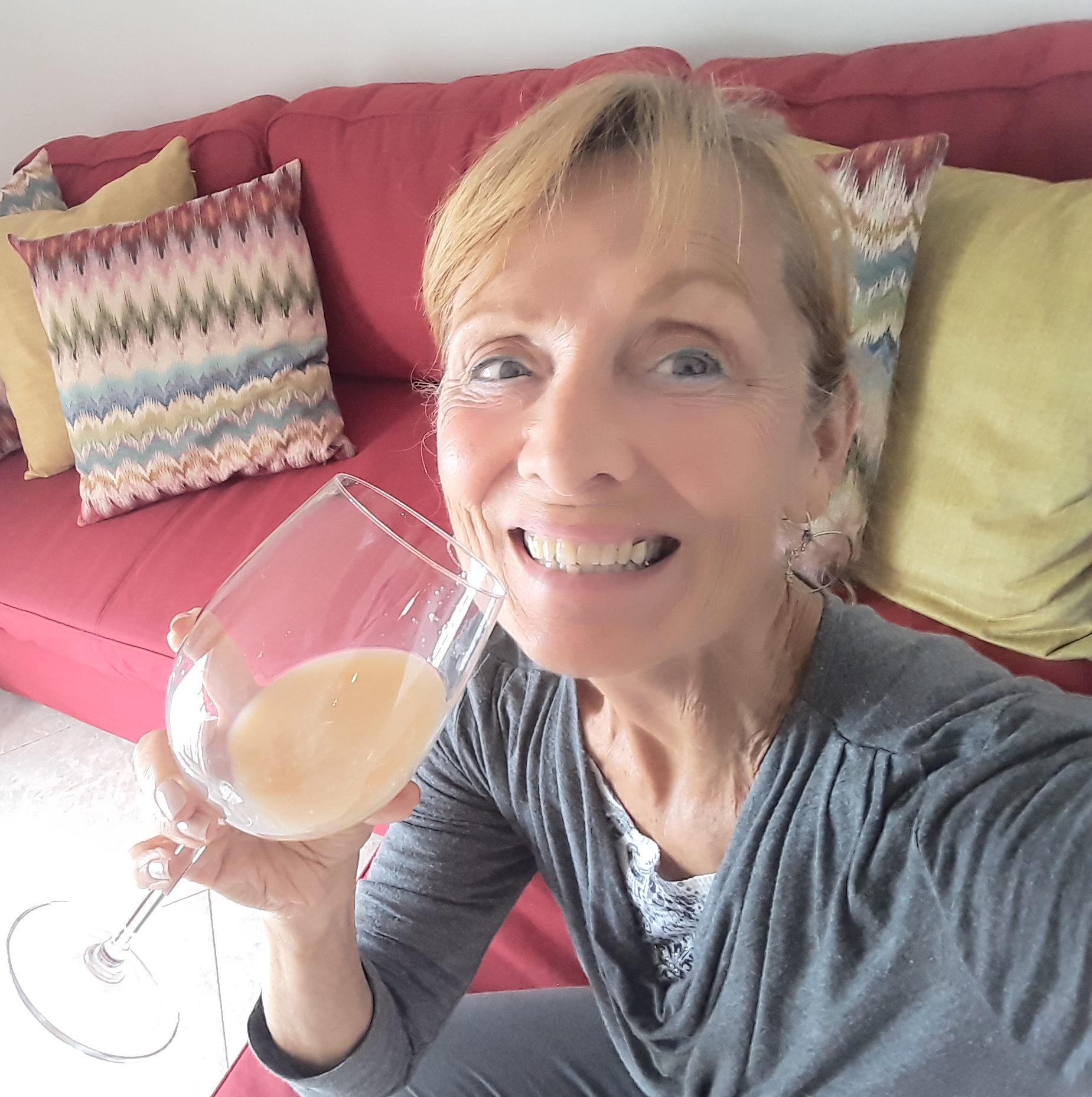
I found assorted chocolates. Here they are, wrapped and ready. That’s the Che Bonta takaway menu. And the Rosamundi is my latest wine-tasting trial. It passed – I couldn’t wait for 5:00. I think that rule is only known to Minnesotans. The rest of the world tends to pour a glass whenever they want.










![Image result for napolitano mocha espresso]](https://writingforselfdiscovery.com/wp-content/uploads/2020/02/image-2.jpeg?w=290)






 writing for self-discovery
Comments