And…The Woman In My Kitchen

I’ll get to the woman in my kitchen, but first: Galungan. There is no translation for that word. It is what it is, a sequence of days in the life of Balinese Hindus that represent weeks of preparation, the assembling of massive penjors to adorn the streets, and elaborate offerings. The belief is that the spirits of the ancestors visit their original homes during this time. Extensive offerings are made in observence of their return. Offerings are also made on the graves of family members who have died and have not yet been cremated. Business slows to a crawl, schools are closed, and the village concentrates on the events surrounding this sacred period.

Ibu informed me early that my house offerings this week would be “Mahal!” (expensive) because of Galungan. Expensive. When I quizzed her for exact numbers, the typical $3.50/week for the beautiful creations that she places around the house and yard every day would be a whopping $5.00. I happily shelled out the additional rupiah and eagerly awaited the auspicious date.

She had drawn an elaborate diagram on the tablecloth with her finger showing me exactly where each offering would be placed and how many were required at each location. How do the woman keep all the endless details of the hundreds of ceremonies tucked neatly away in their heads? I have seen Ibu studying the Balinese calendar hanging on my wall. Every Balinese home  and place of business has one. In the west, we pencil our appointments and ‘to dos’ in the blank space around the dates. Not so on the Balinese calendar. It’s filled in for you.

P1030138

Balinese Calendar for March

I’m guessing there may be some hints in the massive amounts of information contained in this document that would help jog the memory. It doesn’t help mine!

But back to Galungan…

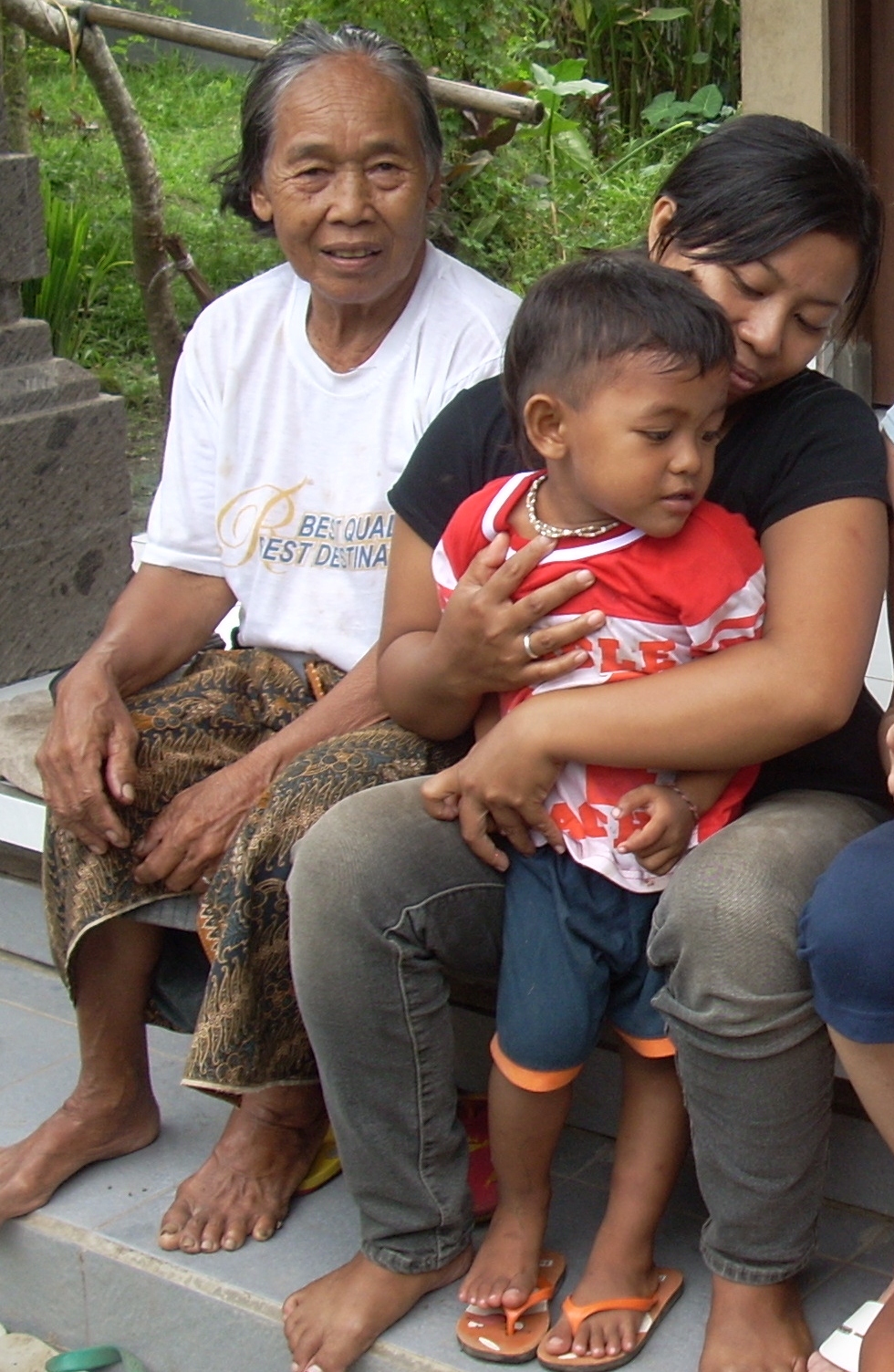
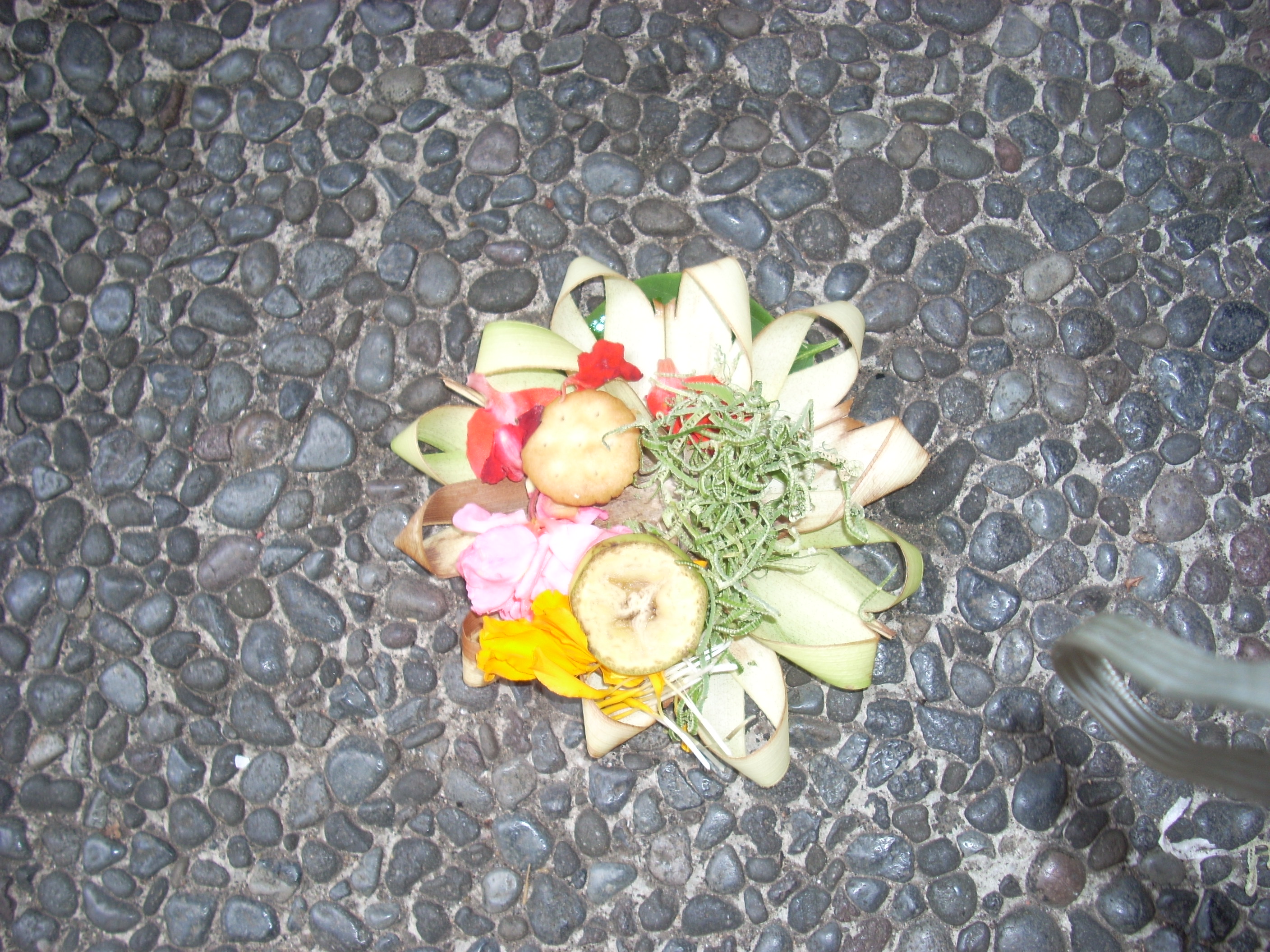
I watched as the 67 year old woman made her way along the path to my house. She was in full ceremonial dress, but her sarong was wet up to the knees. Every morning she wades the river to come here. I knew the huge, square woven basket on her head was filled with gifts for the gods. Ibu began the process of sorting and arranging the offerings. Some have fruit. Bananas are an important offering ingredient for Galungan. All have flowers. And there are celophane packages of treats, cupcakes, doughnuts, peanut chips, and little vials of…could it be…jello?! After arranging the proper items in the offering bowls and trays, Ibu began.

Ibu sprinkling holy water

She dips the flower in the holy water and sprinkles each offering

The dining table offering

The dining table offering

The top of the refigerator offering

The top of the refigerator offering

The kitchen window offering (so only good things come in)

The kitchen window offering (so only good things come in)

The stove offering

The stove offering

Ibu was in the kitchen for a long time. When she finished, that tiny space had no less that four beautiful offerings. She completed her rounds, offerings at either side of both the back and front entrances to my home, the front and back yard, the altar, until the scent of incense was sweet and thick in the humid air.

Having completed the ritual she changed into her work clothes and again disappeared into the kitchen. This time when she emerged she had a treat for me. Pisang Lawi. I had never seen this dish before but it is now my favorite treat.

Pisang lawi, banana dumplings with fresh shaved coconut and a sprinkling of sea salt. TO DIE FOR!!!

Pisang Lawi, banana dumplings with fresh shaved coconut and a sprinkling of sea salt. TO DIE FOR!!!

We sat together on the platform, each with our heaping plate and steaming cup of Bali Kopi. A friend stopped by who has been in Bali much longer than I have and Ibu rushed to prepare the treat for her, too. She had never exprienced this particular dish before and gushed her enjoyment.

I could try to suggest that I, too, cook in my kitchen, but what I do is a sorry excuse. I heat up leftovers of the fabulous meals that others have prepared for me. I tried, I really did. And I’ll try again…maybe. But with experts who can whip up such things as this in a heartbeat, without scouring the internet for recipes, translating the ingredients into Indonesian, snagging a lift on the back of a motorbike to the market, then fumbling through the unfamiliar equipment that occupies my kitchen…I ask myself, why would I?

Bali Building Codes

I have seen construction sites in Bali that make me shake my head. After working on commercial projects in the interior design industry for years, I was familiar with strictly enforced building codes.  In Bali I’ve heard of only one: nothing can be built higher than a palm tree. There are some mighty tall palm trees, but a building over 3 storeys is rare.

That leaves the playing field virtually wide open for creativity, nevermind safety or accessibility! The Balinese are artists and if they can think it, they will build it. Or if YOU can think it, they will build it. Which brings me to the subject of my latest residence.

Approach to Front Door

From the outside it looks like a normal structure with handsome brick and stonework. There’s a wide tiled terrace a step up from the yard and a garden of banana trees, coconut palms, frangipani, and thousands of unknown plant species.

Right of Entrance

Lush foliage borders the right of the entrance.  The gap between the wall and the roof allows fresh air and light into the luxurious bathroom.

Stepping through the door, however, all similarities to Western design cease. The front entrance allows a view straight through the house to the back garden, and there are no walls or windows blocking the sight. A wooden platform floats serrenely in the air above the tiled living area. The stairway access has no unsightly railings and the surround enclosing the platform has openings large enough to allow countless small children to fall through unhindered.

Platform Overlooking Garden

It is something like heaven to wake up at dawn, pull out my yoga mat, trundle up the steps, and greet the day with sun salutes while nature sings it’s lungs out around me.

Daybed on Platform

A daybed occupies one end of the floating deck and I could easily live right here. This is where I enjoy morning coffee and start my writing for the day. The view of the inside of the house from this perch reveals a sweet informality. The furnishings, although not entirely my taste, work for me. The home was built to last 25 years ago, with brick walls 10′ high, tile floors, and a ceiling that soars 20 feet.

View of House from Platform

Below the platform is an extensive terrace living area. It is open on three sides and as one friend remarked, “It looks like anyone or anything could walk right in.”

Terrace Below Platform

Indeed they could. But the bedrooms and the kitchen have locking doors, and I tend to like the security of that when I sleep! However, the bedroom window has only a decorative wooden design that would prohibit an adult from entering but it wouldn’t stop a monkey! I just lower the bamboo blinds, arrange the diaphanous mosquito netting to make a cozy tent, and sleep more soundly that I have in years.

Bed, Mosquito Netting, and Window

This house comes with staff. Ibu is a 67 year old woman who wades across the river every morning (there’s no bridge) to make breakfast, clean the house, and do whatever else I need. The first day she disappeared for about an hour. When she returned she was carrying a box of a dozen two quart bottles of drinking water on her head. I fussed at her and she left again and returned with a second big box of 12 more. I can barely slide the darn thing across the floor and she not only lifted it up to her head, she carried it all the way from the market. And she did that twice. Later, she was nonplused when she saw I had made my own coffee and she apologized profusely for not knowing I wanted it. 

It’s hard for me to let her do anything. She’s a grandmother and has worked hard all her life. But this is her livelihood. She speaks no English. I am grateful I know a little Indonesian by now, but it’s not nearly enough. Still we are making each other understood, and it is fascinating to see how much is communicated non-verbally with absolute clarity.

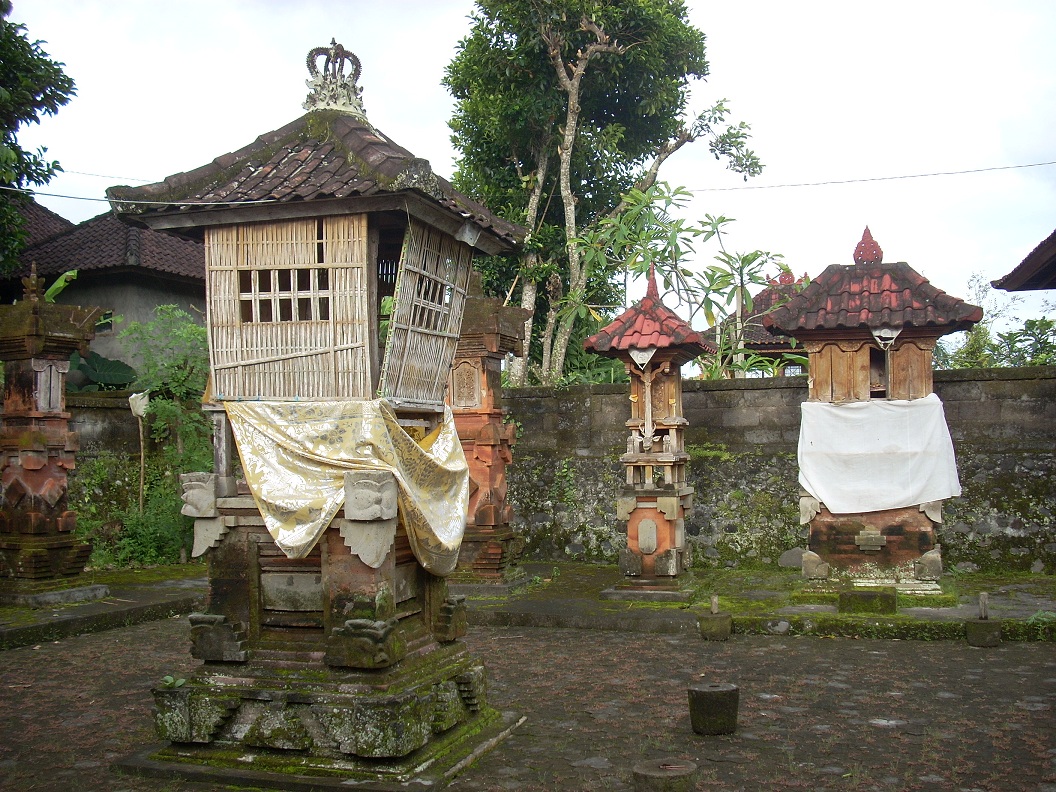
I did , however, ask one thing of her. It is something I want done that only she can do. The Balinese fill their homes and businesses with offerings daily. They spend hours making the little palm dishes that hold the bits of moss and flowers. My new home has the traditional house temple. P1020771

There are statues of Rama and Sita, Buddha, and Dewi Sri. It was a strange feeling to know, though I am not Hindu, that something needed to be done, that there was unfinished business here. So I asked Ibu if she would honor my house and make the daily prayers and offerings. The next day she arrived with no less than 15 of the little palm dishes filled with flowers. She lit sticks of incense and put on her sarong. Then she went through the rooms placing each offering where only she knows it should be placed, sprinkling holy water, and making prayers.

P1020775

There was one on either side of the entrance to the house. There were three in the front yard, one in the back. There were two in the kitchen, one on the dining table. I watched with moist eyes.

P1020770

My heart overflowed with gratitude for Ibu, and the grandmothers who know what to do. They are a dying breed. When she finished the ritual, she told me that now the house was protected. We had appeased the high gods, the low gods and the animals. We had blessed the plants and the ancestors, and brought safety to my home.

Pasek stopped by later. “How much you pay?” he asked, noticing the offerings. When I told him he quizzed me again, “How many?” Again I offered up the requested information. I’ve gotten used to the direct questions of the Balinese. If they want to know, no matter how personal, they ask. When I approached a temple a few months ago with a Balinese friend he turned to me and in all seriousness asked, “Are you menstruating?”

I don’t know if Pasek approved of the price or not. It doesn’t matter. For sixty cents a day I have the joy of watching Ibu perform a ceremony that has deep meaning for her and has its roots in the oldest belief system on earth. Even if the complexities of it are beyond my understanding, it nourishes my soul, and that’s a bargain at any price.

Happy Birthday to Me!

I don’t often post poems, but today is my birthday (it’s already January 6th in Bali) and I will do as I please!

P1020295

Kadek let me photograph her as she sprinkled holy water on the small house altar this morning. She moves gracefully, gliding like a beautiful swan. She is the inspiration for my poem.

BEAUTIFUL SWAN

In my whiteness
I watch gold-skinned women
in the temple garden.
 
One climbs
the stairs
to apologize…
 
“I make offerings
so sorry
did not see you.”
 
It is her task
to prepare
my breakfast.
 
Today she wears
a teal kebaya
with hot pink sash.
 
Tiny pearls of perspiration
glisten
on her upper lip.
 
I admire the sarong
woven in traditional
ikat style.
 
“It is made by machine
not good quality,”
she wants me to know.
 
“It’s beautiful!” I say,
and it is
because she is wearing it.
 
The color combinations
would not please
the Western aesthetic.
 
But this is Bali,
contrived fashion rules
do not apply.
 
She carries woven trays
mounded with offerings
trailing clouds of incense…
 
stopping at each altar
to sprinkle holy water
and pray.
 
Who are you,
beautiful swan?
What is your story?
 
Your knowledge is ancient
I am awed and humbled
by your mysteries.
 
Teach me, my sister,
help me understand
your incomprehensible life.


Making Peace with Good and Evil

Good and evil, yin and yang, are balanced today in the village of Bakbakan.  It isn’t easy to maintain harmony with these energies. The level of sensory intensity in the ritual prayers, dances, and offerings that are required to keep peace between the sacred and the profane is unparalleled by anything I’ve seen before.

My friend Wayan invited Nancy (who is visiting from the U.S.) and me to attend the temple ceremony as guests of her family. The village of Bakbakan is about 30 minutes from Ubud. I arranged with Pasek and Ketut for motorbike transport. After a sidesaddle ride, which Nancy accomplished with impressive decorum, we were delivered to our destination and welcomed warmly by Wayan and Komang in ceremonial dress.

A group of women had already congregated. They were stunning. They looked like brides, all in white with a colorful sash at their waists. We had a few minutes to visit and then a line started forming. The row of towering pyramids of fruit, cakes, whole baked chickens, and colorful confections were retrieved by the woman who created them and placed on their heads.

This woman’s husband helps her with her 4′ tall, over 30 pound offering.

I cannot comprehend this feat of balance and strength.  It’s a challenge for me to balance a book on my head for more than a few steps. How on earth do they do it? The stately procession was followed by the gamelan musicians. Nancy and I walked alongside the men, snapping photos as discreetly as possible.

A stunning parade, at least 50 women all in white, carried their towering offerings the 1/2 mile to the temple.

The temple complex has three areas. Those who cannot enter wait in the least sacred area outside the entrance. If a relative has died recently the family cannot enter the temple. If a woman is menstruating she must not enter. At we approached Komang politely asked if Nancy or I were menstruating. There are very few bodily functions that register as taboos in Bali. Community life is an open book. There is no embarrassment around such things. I assured him we were both well past that age. He smiled and motioned us to the holy water where we were sprinkled. Then we passed through the gate and entered a magical realm. All was in readiness for the evening festivities as we passed through this second area.

Stepping through the last gate into the most sacred portion of the temple a riot of color and commotion assailed us. The air vibrated with expectation and the hum of voices. We were urged onto a platform, a seat of honor, and woven bamboo mats were quickly spread for our delicate foreign bottoms. Nancy and I sat by Wayan while Ary slept peacefully in her arms.

Komang’s cousin, Made, appointed himself our teacher and began explaining the events that would take place. His English was excellent and I learned more about Balinese Hinduism in the 30 minutes with him than I have in 5 months of reading and asking questions. We sat and chatted while other friends and family came and went.

The gamelan began, signaling time for prayer. We sat on the ground in family groups. Each family brought, in addition to the 4’ high offering tower, a basket of flowers and incense which Komang’s mother placed in front of us. Prayers were chanted in unison as the intricate rituals were performed. I tried to chant. I’m pretty good at following along with most melodies, but this wasn’t exactly a melody. When we got to the end I recognized the words and gave it my all, Om Shanti, Shanti, Shanti, Om.

A buzz of excitement rippled through the crowd at this point and almost as a unit the we moved to the perimeter creating a center space. A cloth was spread on the ground and offerings were placed there. These were different. Some appeared to have been slightly burned. There were a couple of smaller, colorful ones but the rest were almost scary looking. Made explained that there would be a dance and prayers now to balance good and evil energies. A row of holy men in white sat behind the dark offerings. Incense was lighted that did not have the sweet fragrance we had been experiencing all night. This odor was acrid and harsh. The gamelan musicians began again. Then a grandmother appeared moving to the rhythm. Another grandmother joined her and soon a group of elder women were dancing in front of the offerings and the holy men. We had been told earlier that this would be a trance dance. It was eerie. The women appeared to be doing battle with the dark energies. I watched, mesmerized.

The solemnity of the prayers and trance dance complete, food suddenly appeared. Wayan handed us a tangerine, some beautiful little striped crackers, and a lacy confection of shredded coconut glazed with palm sugar. Yum! We ate, visited, and anticipated the beginning of the evening’s entertainment. People started moving into the performance area and Komang hustled us into position at the front. What followed were three traditional Balinese dances, each one more spectacular than the one before.

The first dance, Penyembrahma, was brilliantly colorful.

That was followed by the spectacular, twirling Bird of Paradise dance.

The costumes in deep maroon with gold were absolutely gorgeous.

Bird of Paradise was followed by a brilliantly costumed trio. I missed the name of this performance and it moved quickly so photo ops were difficult. It was hard to keep my eyes behind the camera when I really just wanted to absorb myself completely in the moment!

It was 9 p.m. by the time the dancers finished. We were told that there would be another performance starting soon, but this was a ritual dance and it would be dangerous for us to leave in the middle. It again had to do with balance of good and evil. Once we started watching we would have to stay until the end at about 2 a.m. As much as my curiosity, my heart, and my mind wanted to stay, my body was in protest. Komang graciously escorted us to the street. Pasek and Ketut had returned and were waiting for us. We exchanged sweet farewells and started home. The cool night air brushed by as we zipped through dark, quiet streets. I was overwhelmed once again with immense gratitude for the opportunity to live this kind of life, a life I have created for myself knowing what I need, what I want, and what I love. It is a life that fits me like skin.

Meet Dewa, #1 Guide, Host, and Friend

Dewa says I must bathe in the sacred waters of Tirta Empul before I leave Bali. It will purify my mind and body. So this morning at 9 o’clock sharp I do as I have been instructed, don my sarong and sash then off we go. “Why the sash?” I ask Dewa as he weaves through the maze of motorbikes in early morning traffic. My Balinese walking Wikipedia thoughtfully asks a question in return, “There is the mind, and there is the body…what is a better English word for the desire of the body?” Now it’s my turn to ask a question. “Do you mean all the desires? The desire of the body for food, for sleep, for sex?” (It’s okay. We’ve had these conversations!) “Yes, for sex,” he replies. “Well, that depends,” I say. “If desire is accompanied by caring and deep feeling it is a good word. If it is purely desire with no emotional attachment you could call it lust.” By now I think I have an idea where this is going. Dewa confirms my suspicions. “The sash is to separate the mind from the sexual desires of the body when you enter the temple,” he tells me. In this culture there’s a purpose for every item of clothing, every ritual, every ceremony.

We arrive at Tirta Empul and walk through the serenity of the the gardens.

The statue is Saraswati, a female Hindu water deity.

There isn’t really grass anywhere. It’s a tiny, round leaf plant that is used for ground cover.

And here is Dewa. Always happy, always patient. The plastic bag contains offerings for our time in the sacred waters.

Before we enter the cleansing pool, Dewa takes out the three offerings made by his mother, and lights the incense.

He places the offerings on the altar along with many others. Now it is okay to enter the water.

He says I should go first. I sit down on the edge and notice there are a great many fish that are sharing this experience with me. Some are medium, some are an edible size. I decide it isn’t much different than swimming in a Minnesota lake. As I put my feet and legs in the water I detect another similarity. It’s COLD! This is fresh spring water and as such it is deep-earth cooled. I slip into the chest high water with a little gasp. There are 12 gushing spouts and I am to bow under each one of these and make a prayer.

That’s me about half way through. By this time I’ve got it down and I’m totally into the experience.

Dewa follows. It’s quite a lengthy process, this cleansing of the body!

The second pool is for the mind. There are six spouts but you only use one. I wait patiently for the privilege of cleansing my mind.

The ritual cleansing completed, we go back to the locker room, change into dry sarongs, and depart for the next leg of the journey. Our second stop is the home of a famous batik designer. Following a narrow walkway from the street, we come to a large room. Thirteen women sit at makeshift drafting tables, each with a length of fabric and a bowl of hot wax. Using a paintbrush they painstakingly apply wax to the fabric in all the areas where the dye is not wanted. The wax is a deep amber color and the waxed pieces are beautiful before they are even dyed.

The next room holds the huge vats of dye. The fabric is soaked in the color then hung to dry.

Once dry, the pieces are moved into the next room to await wax removal. In this factory the batik is done on cotton, linen and silk. They are limited edition fabrics. Only a few of each of the designs are made. The quality is magnificent. You won’t find these in the market!

The contents of the two huge, black cauldrons in the center of the room is heated with a wood fire. The dyed material is placed in a cauldron and the wax melts leaving the raw white fabric showing through creating the design. If more pattern and color is desired the piece is returned to the wax room to have a new application placed over the dyed areas. Now when it is dipped in a different color the already treated portions will not be disturbed.

Here is a block of the amber wax. Pieces are sliced off and melted for the women to use in the fabric waxing room.

I so appreciate the opportunity to see the Balinese people doing what they have done for hundreds of years for the most part unchanged. It can be a severe shock for those of us coming from the industrialized West. Most tour guides take you to the showrooms. There you will find a few pretty vignettes where Balinese people demonstrate how jewelry is made, or batik fabrics are created. Then you are ushered into the main area with row upon row of glittering jewelry cases or racks of fabrics for sale. The average tourist doesn’t have a clue that these staged presentations are light years removed from the reality of how the products are created.

We thank the batik workers for allowing us a peek into their world then head for the ocean. The last stop today is a fishing village where we will have lunch. The roads get narrower and narrower. Dewa reminds me that this is not a place where tourists go. This is a village of Balinese fisherman and our ‘shore lunch’ will consist of today’s catch, whatever it is.

The road ends at the beach and the black volcanic sand begins.

Dewa poses beside one of the colorful fishing boats, still smiling!

Our mystery fish is being grilled over a coconut husk fire while we watch. As it sizzles, it is basted with a mixture of garlic paste mixed in coconut oil then flipped and basted again. The skin is scored with several diagonal cuts before it goes on the grill so the garlic mixture can penetrate into the meat. The end result is yet another gastronomical delight!

Here it is, grilled fish, water spinach, and rice mixed with sweet potato. Notice the candle. We had a good laugh about our candlelight lunch on the beach!

Last but not least, fish satays. These are wickedly hot little globs of fish mixed with various chilies and spices then grilled. I ate one. Dewa polished off the rest.

The shoreline gracefully curves, embracing the incoming waves. Mountains at the horizon are hazy blue.

This one almost got me!

Time to go, but as we leave we stop to watch this woman make short work of a fish. It is round and flat, I’m guessing flounder. Squatting by the side of the road she has it gutted, the fins chopped off, flesh scored and ready for the grill in a few swift flicks of that knife. Even dressing a fish, in the skillful hands of a master, is poetry!

What an amazing day. I think I have said that about every single day for the past two months. I also think, no matter how long I might stay, there would be no end to amazing days.  I love this place, my new friends here, and the ancient ways that anchor me to something more permanent than my life.

Hafiz had it right

I was searching for words this morning. I am a writer, I told myself. There are words for this. Then I asked myself, What is the ‘this’ I am trying to describe? From somewhere subconscious I recalled a poem. I did not remember the author or even the words, but I thought perhaps Rumi, or Hafiz. It took only a few moments of communing with Google to find it. Ahhh. Hafiz. Here is the poem:

I Have Learned So Much

I

Have

Learned

So much from God

That I can no longer

Call

Myself

A Christian, a Hindu, a Muslim,

a Buddhist, a Jew.

The Truth has shared so much of Itself

With me

That I can no longer call myself

A man, a woman, an angel,

Or even a pure

Soul.

Love has

Befriended Hafiz so completely

It has turned to ash

And freed

Me

Of every concept and image

my mind has ever known.


From: ‘The Gift’
Translated by Daniel Ladinsky

Isn’t it beautiful that love is the friend that freed Hafiz from every concept and image his mind had ever known? As I sat with that thought it became clear that love is the only thing that will ever free us. To love others is to accept them in all the ways they are different freeing ourselves from judgement. To love the earth is to protect and care for her freeing ourselves from the consequences of her demise. To love oneself is the ultimate freedom for out of that love comes the capacity for all other love.

The past few days my journey has been inward. The name of this village is Ubud. It means medicine. The essence of Ubud is fundamentally healing to the body, the mind, and the spirit. I have asked myself, why is this so? Is it about the thousands of offerings made daily? The scent of incense ever-present in the air? The constant rituals and ceremonies performed specifically to maintain balance in the spiritual realm? Every day hundreds of tourists parade the streets of Ubud. Every day another rice paddy is drained to make way for a new resort or villa funded by money from the West. But inside the walled compounds of Balinese family homes, life goes on as it has for two thousand years. These people have a way of accepting the new, adjusting to accommodate change, but remaining virtually unchanged themselves. They do this with a self-possessed dignity that defies explanation.

I don’t know the answer to my question. All my life I have believed that everywhere was basically the same as everywhere else. I have traveled and visited amazing countries. I have seen works of art and architecture that left me breathless. I have met wonderful people who genuinely cared for me.  Yet nowhere else has a place whispered to my heart entreating me to stay, to learn, to just be.

Invitation to a Cremation

Dewa knocks on my door at 10 a.m. “Do you want to see cremation?” he asks. “Of course!” I am instructed to be ready at 12:30. At 12:15 I’m waiting with a lovely couple from France who have also been invited. Dewa’s uncle, his mother’s brother, passed away over a week ago. The holy man has designated today as an auspicious day for cremation and there will be three of them. We are hurried into the car and make our way toward the cemetery. Suddenly Dewa says, “Get out here!” We scramble onto the street and there it is. The procession begins literally in front of me with the women and their offerings.

We are in a part of town where the tourists don’t come. The energy is much more like a wedding than a funeral. I am entranced. The bamboo platform holding the black bull is coming directly toward me.

I asked Dewa earlier if it was okay to photograph the ceremony. “Take pictures of everything. It’s okay,” he told me. So I did.

There he is. The black bull. Only holy men are cremated in a white bull. For everyone else the bull is black. When there is an intersection the bull circles three times around the intersection before going in a new direction. At one point a young man climbs on the back of the bull and the carriers make the bull buck and whirl but the rider keeps his seat.

It’s very hot and the men stop to rest while police clear the traffic in front of the procession.

They’re up again and on their way. The next to appear is an ornate, pagoda type tower. Three men cling to the sides. At this point I don’t know if the deceased is inside the bull or inside the tower or somewhere else entirely. It turns out the coffin is being transported in the tower.

As the procession continues on its way, men on the sides of the street spray water on those carrying the heavy platforms. It is a welcomed dousing on this hot hot day.

At one point the tower is too tall for the electrical wire spanning the street. The offending wire is ripped down and left hanging so the parade can pass.

Then comes the band of cymbals, gongs and drums played by young men and boys.  The percussion continues from beginning to end, rising and falling in volume and intensity. When the band finally stops they are vigorously applauded.

As the pagoda passes I notice the picture of the departed mounted on the back of the conveyance.

The bull is carefully moved to this platform and the men cut a chunk out of its back. I am transfixed by the elaborate ceremony. A white coffin is removed from the tower and a procession of women carrying offerings and men carrying the coffin circle the bull three time. The coffin is lifted and held up while the body, wrapped in white, is removed and placed in a hollowed out area in the bull.

The men around the body receive gifts and offerings from the people. They place them on the body. More and more gifts are brought. Finally the holy man sprinkles the contents of several different containers on the body and a white sheet is placed over all.

The back of the bull is once more set in place. Large bamboo logs are put under the bull and a motor pumps fuel onto the base of the pyre.

Incense is lighted and the bull begins to burn. Nobody is crying.

At this point the entire crowd moves into the street and words are spoken (in Balinese) over a battery operated megaphone. The crowd of us begins to exit the cemetery and as we pass we are sprinkled liberally with holy water. In this photo people are beginning to fill the street.

After that the crowd disperses fairly quickly. It has been an unforgettable two hours. I feel incredibly privileged to have been allowed a glimpse into this aspect of Balinese tradition that few visitors ever witness.

Dewa provides me with a map so that I can find my way to Ubud center since he has family matters to attend to. I only have to ask directions twice before I am back on familiar turf. Parched and dripping I seek refuge in Warung Laba Laba.

Here, in a shady perch above the street I sip watermelon juice (my current favorite) and order papaya chicken salad. It arrives, light and refreshing.

I opt to pass on Thousand Island Dressing…one just never knows about Thousand Island Dressing! But I can’t resist a sweet finish: one scoop of the creamiest vanilla ice cream this side of a Wisconsin dairy sitting atop one scoop of Balinese mocha.

I would return to Warung Laba Laba just for the ice cream!

Back in my room I can hardly wait to see the photos. I only wish I could include the sounds and smells that made this day one of the highlights of my life. Suksama, Dewa.Thank you.

Holy motorbikes!

As adventures go, today gets a perfect 10. It had all the required elements: suspense, terror, discovery, delight. To say that I have an uneasy relationship with motorbikes would be, well, a lie. I am white-knuckle-clench-jaw terrified of riding on any motorized vehicle with only two wheels. So when Wayan invited me to visit their home I was thrilled until she said she would pick me up on her motorbike. My big smile did an instant melt-down. “Motorbike?” I squeaked. “Yes,” she flashed her own lovely smile, “you ride on the back. I will take you.” Face it. An opportunity to visit this Balinese family in a village about 30 minutes away, to experience first-hand how these beautiful people live, just doesn’t come along every day. There was no way I was not going.

Suspense. Wayan was coming at 4:00. By 2:00 I was feeling knots in my stomach. At 3:00 my palms were sweaty. By the time I heard the sound of a motor approaching at 3:55 I was hyperventilating. Taking a deep, cleansing breath I grabbed my bag and went out to meet her. She strapped me into a helmet, popped the back foot rests down and I climbed on. My grip on her rib-cage probably permanently rearranged her vital organs. Terror!  Then off we went. Traffic on the streets in Bali is frightening enough when I’m walking on the sidewalk. But to be weaving in and out between tour buses and hundreds of other bikes similar to hers, horns blaring, without anything protecting my fragile body, put me in a catatonic state. I clung to Wayan’s tiny middle for dear life.

After a few miles we left Ubud. The air was fresh, traffic was light, and in spite of myself I began to enjoy the ride. I don’t believe I said that! But its true. Upon arrival at her home I was introduced to her husband, Komang, and their adorable son. Komang works at the reception desk of a high-end resort spa. Both Komang and Wayan speak very good English.

My tour of their home commenced. I followed Komang to the family temple area. As he explained the function of each of the structures and what they represent I was struck anew by the dailiness of their beliefs. There is no separation between the secular and the holy. They are interwoven so seamlessly that one is unrecognizable without the other.

Komang explained that each of the small buildings in the temple area has a purpose. One is for making offerings to honor the ancestors. One receives offerings for safety. Another, offerings for prosperity. One that struck me with particular impact was the edifice that represented caring about doing good work. They make offerings and prayers, daily, for caring about doing good work. With all these prayers, setting the intention for such goodness, its little wonder that Bali is a very special place.

Did I mention that I was an instant celebrity here. Upon arrival children began to gather around me. No matter what I did or said they found it hilariously funny. They have mastered the words, ‘Hello’ and ‘Bye.’ But they mostly like Hello, so every few minutes one of them would blurt out, “Hello!” and wait expectantly for my answering, “Hello!” Then they would all laugh uproariously.


The Balinese lifestyle is completely different from ours in the West in other ways too. They have a house for sleeping, a separate house for cooking, a place for the ceremonies of marriage and death, and the temple area. All of these are surrounded by a wall, maybe 8 feet high. The buildings are small by Western standards, but most of life is lived outside. And why wouldn’t it be in this climate where as the saying goes, “Even a rock, if planted, will grow.”

There is a stream that runs a little distance from the house. Earlier Wayan had pointed to it saying that this is where she does her laundry. Huh? Sometimes I have to catch myself so that my shock and disbelief don’t offend. A few moments later she added that this is also where the women bathe every morning at 6 a.m. “Men too?” I asked. “No, men go somewhere else.” As I said, much of life is lived outside.

When we returned from our walk through the neighborhood, Wayan disappeared into the kitchen building and emerged a few minutes later with a treat. It was fresh coconut milk, straight from the coconut, which was harvested from one of the three coconut palms on their property. Then Komang’s mother joined us. She takes care of their mischievous three-year-old while Wayan and Komang work six days a week.


After refreshments Wayan and Komang offered to take me to the night market. Even though it meant another motorbike ride, my curiosity triumphed and off we went. There were no tourists there tonight, and we strolled through the isles, Komang carrying his son and Wayan holding my arm. I saw many Balinese women walking arm in arm and I felt much love for this little family that has so warmly welcomed me into their lives.


There were food vendors everywhere and the knawing in my stomach reminded me that Wayan and Komang had come straight from work and were probably hungry too. Komang pointed out the various dishes naming them. “And this one is bubur ayam…” he had barely gotten the words out of his mouth and I interjected, “Oh! Can we stop and have some? I will buy your dinner. I love bubur ayam!” My gracious host and hostess agreed. Three heaping bowls of the savory dish were presented and what a delicious treat it was. Three bowls of bubur ayam and beverages set me back a whopping $2.00.

As we finished our meal the sky looked like it may be working up to another twilight downpour. We quickly returned to the motorbikes and straddling the trusty machine, I once again wrapped my arms around Wayan’s waist. Waving goodby and thanks to Komang, we set off to beat the rain. What a spectacular day. And, thanks to Wayan, I think I may have overcome a major phobia involving two-wheeled, motorized vehicles!


Hanoman Street in Ubud

I love the surprises each day brings. After another superb meal at Atman Cafe I head north on Hanoman Street.

Hanoman is one of the two main arteries running north and south through Ubud. I set off, camera in hand, to capture some images that are representative of the flavor of the village. This carved, painted door with a soaring crown and gargoyle is typical Balinese architecture. It is inserted into a high brick wall that surrounds a family compound or perhaps a temple.

There are always steps up to the doorway so you can’t quite see what’s in there. Today curiosity triumphed. I climbed the stairs and took a peek  through the partially open door. There was a large open space bordered by several buildings that I assume are dwellings. The ornate facades of these homes are protected by statues of gods or fierce creatures.

My mission for the afternoon is to visit the new CoCo Supermarket and pick up a few snacks for evening munching. I hadn’t realized until now what a snacker I am! Not having a kitchen with stocked cupboards handy is definitely a lifestyle change. I comb the gleaming isles of the large store. There are thousands of varieties of chips, cookies, and candies. My search is successful and I leave with two apples and a bag of spicy Thai peanuts. There is a somber look to the sky as I head home so I pick up the pace hoping to reach cover before a downpour.

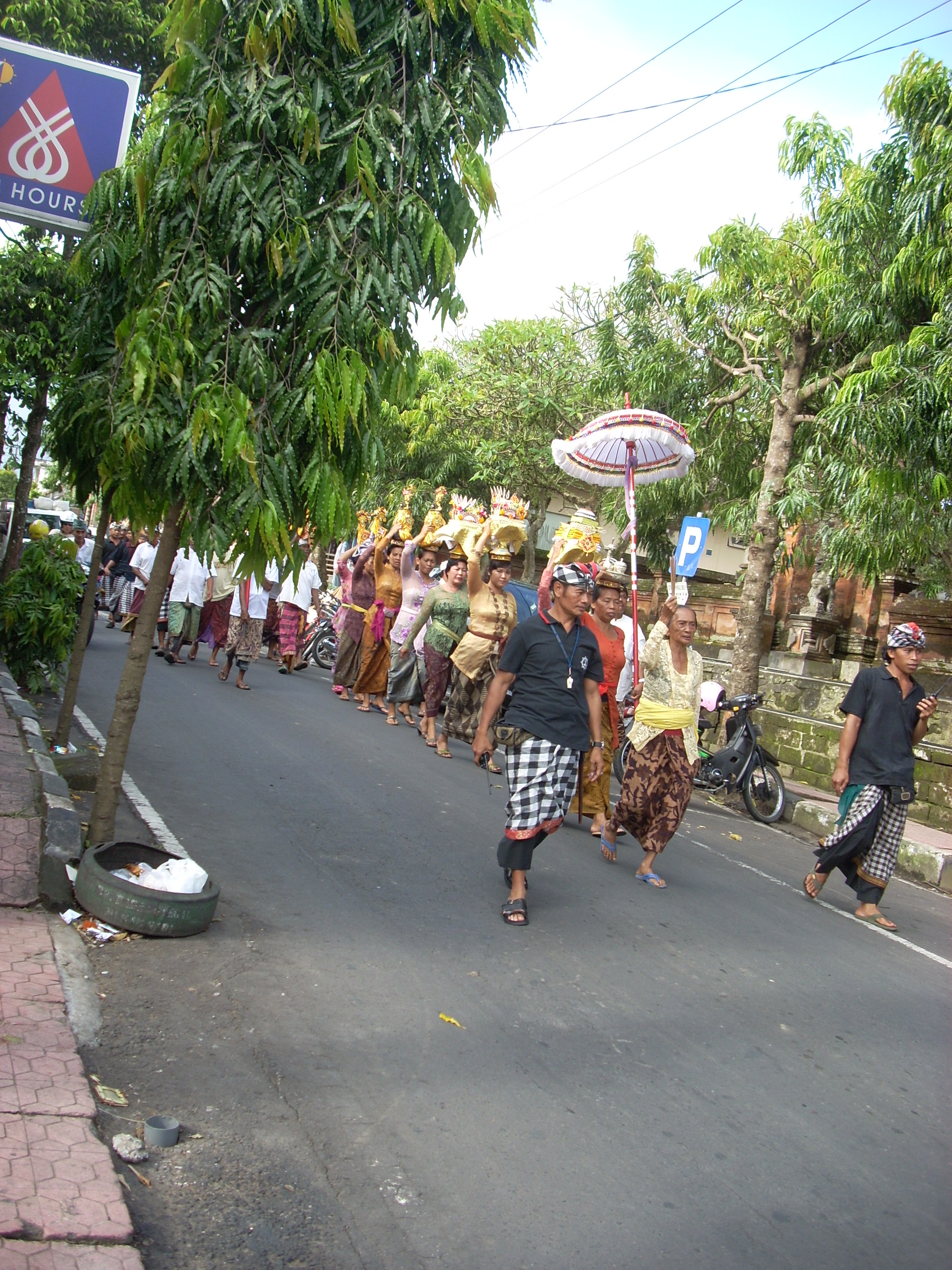
I am approaching my turn when Hanoman Street becomes suddenly quiet. No traffic. That can only mean one thing. Looking up the street I see them coming. A ceremonial procession is making its way toward me.

The black and white plaid fabric is seen everywhere in Bali. I was told that it represents balance.

They pass directly in front of me on their way to the temple to make the offerings that the women are carrying on their heads.  I don’t want to be the obnoxious tourist who intrudes upon their traditional rituals with camera flashing, so I try to be discreet and probably miss the best shots as a result.

The parade continues on and I head down the walled corridor that will take me home. As I turn the corner at the top of the steps, there beside my door is a canang sari, a small basket woven of palm fronds containing an offering to the gods. The Balinese present these offerings three times a day. Sometimes I wonder how the women get anything else done. They seem to sit for hours every day making literally dozens of these small gifts.

Finally back on my balcony I watch the threatening clouds approach.

There’s a stiff breeze and…ahhh yes! Here comes the rain!

For information, $1 per minute

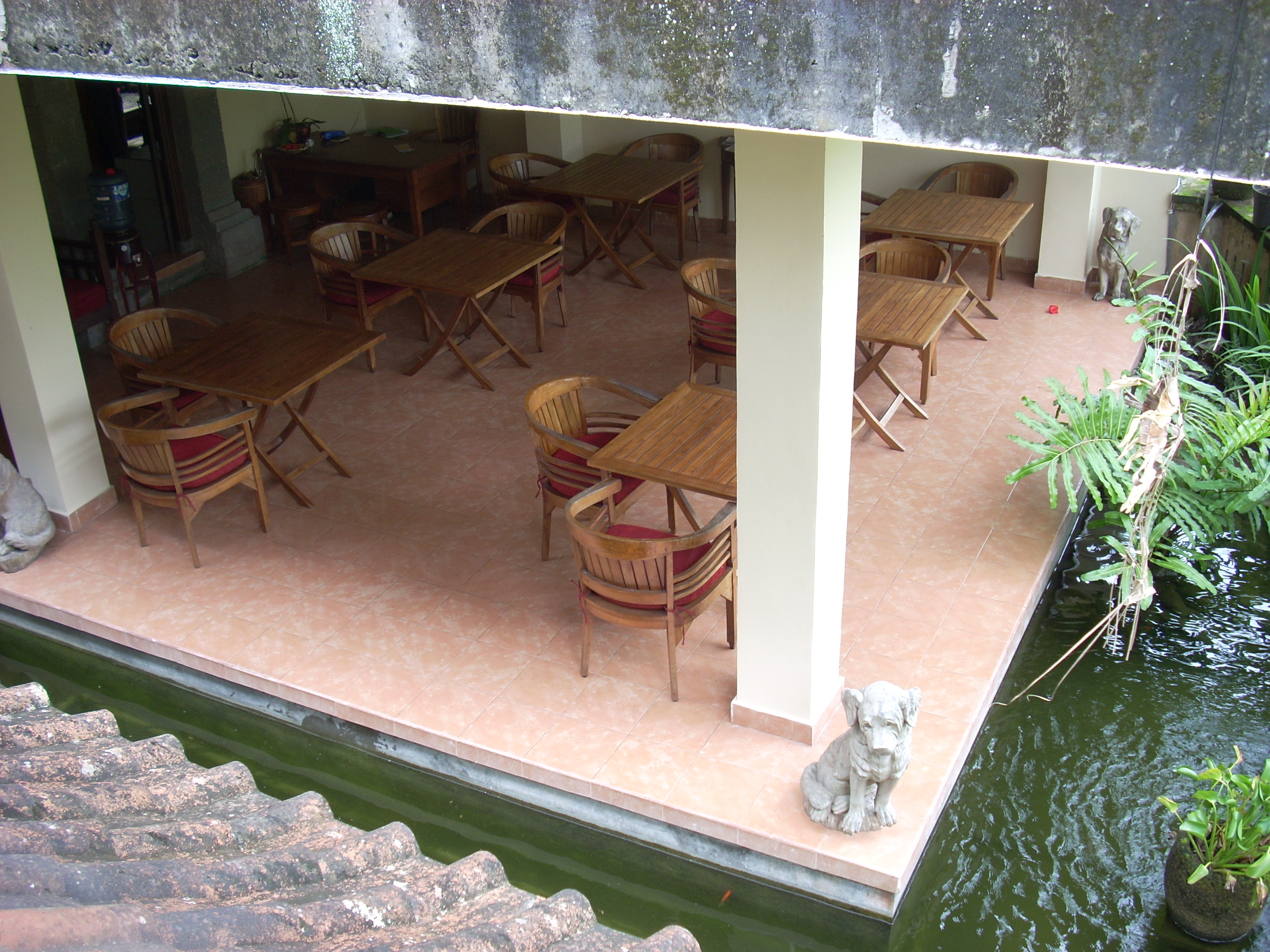
Breakfast happens here. I shot this photo from my balcony, and that chair by the post is where I sit every morning. The little canal is home to the playful coi that keep me entertained as they fight over the hibiscus blossoms that happen to land in the water. Each statue, and there are many, is adorned with a flower every morning as part of the gratitude offerings made daily here.

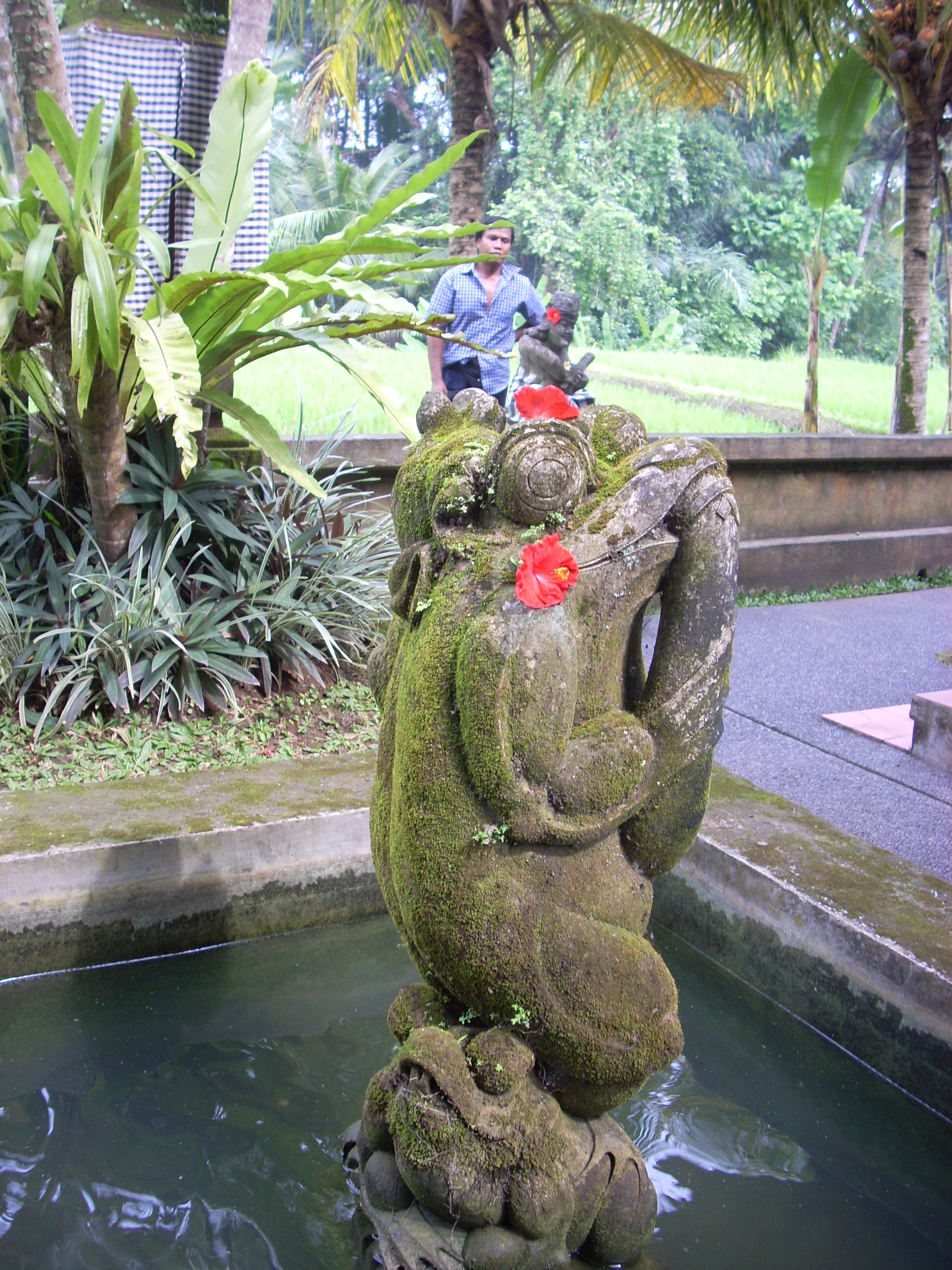
Fido appears to be dismayed that he has lost his flower! Others have been blown into the canal where the coi immediately dart toward them, imagining I suppose, that they are bright red treats.

Dewa appeared as I was polishing off the last of my egg and cheese on whole wheat toast and I asked him about the Hindu caste system. He laughed and said that it doesn’t apply anymore, then proceeded to tell me that there are four levels. Brahmins are the holy men and women who have tremendous responsibility but can make no money. They depend entirely upon the proceeds from the rice fields owned by the temples. There are other forms of revenue but that explanation was lost on me since Dewa’s English is very good but my understanding of it isn’t always spot on.  Kshatriyas are the next level. They are the military strata and Dewa informed me that he is one of these. Vaishyas, third in the heirarchy, are the administrators in the system, and Shudras are the workers. Men are born into their strata and cannot move from one level to another. “However,” Dewa says, eyes twinkling, “women can by marriage. Also, there are levels within these levels and men can move up or down in status depending upon their abilities.”

He goes on to explain to me that the Balinese also have a strict order for events in life. As a young man you find a girlfriend. Then you get your education. Then you marry. Then you make money…”Lots of money,” he grins and adds, “for information, $1.00 per minute!” I join his hearty laughter at this joke. “The the last stage of life is wisdom,” he says, “deep connection with the spirit.” He points then to a woman working in the rice paddy in front of us and explains that she is Shudras, a worker. He asks me if I would like to work in the paddy? I look at the woman, knee deep in mud, bent over to tend the young shoots, and I wonder what life must be like for her. I look back at Dewa, “I’m very lucky.” I tell him. And he agrees.

Next Newer Entries