You did what?!

The frogs kept me awake last night. When the sky brightened, hinting at morning, I got up, groggy, thinking maybe I would skip yoga. But force of habit had me dressed in racer bra and thigh-hugging bottoms before my logical mind kicked in. At that point it was easier to do the routine than to change clothes.

Afterwards, clear, focused, I made a list.

But first, a bit of historical data to bring you up to date…

I’m the one who sold everything and moved to Bali.
I’m the one who preaches ‘simplify’ as a way of life.
I’m the one who moves at least once every two to four months.

So, back to the list. It was short:

Olive oil
Chilies
Incense
Desk
*

Perhaps you’ve noted that the first three are consumable. All of my lists to date have been items I can eat, wear, or burn. So what, might you ask, and rightly so, is DESK doing on the list?

It’s complicated. Actually, it’s embarrassingly simple. I love furniture. I’m renting a house that is fully furnished but has no desk. I wanted a desk. I could picture it and the more space it took up in my head the more I wanted to own it.

I spoke to Ketut. He offered to have his brother make one. That’s my life here. It’s like having a magic lamp with a genie that grants my every wish. And that would have been fine, but the newer pieces of furniture in the house have a whitewashed finish. I’m fond of that finish. Ketut’s brother only does brown. I asked Ketut if he knew where this furniture came from. “Andong,” he said, and off we went.

The first three shops had nice stuff but no desks. The 4th place had two, one with a carved top that was oh-so-cute, but completely impractical. Then Ketut saw the second one; no carving, but two handy drawers in the front, perfect size, adorable!

P1050147

P1050149

P1050145

There was a sticker with the price on it. “Old price,” the shop owner said. “Now 150,000 rph.” I mentally did the math. That’s $14. The old price was $11. We negotiated and I got it for the old price. I know, I know…a solid wood, adorable desk with 2 drawers in a whitewashed finish for $11. Don’t hate me.

While I was gearing up my best Indonesian to negotiate a delivery, Ketut picked up the desk, carried it out to the motorbike, and said, “Take now.” I must have had that “You’ve got to be you-know-whating me” look on my face because he gave me his biggest, thoothiest grin, and said, “In middle possible.”

I just want you to know that I have now, officially, crossed over. I have transported a fairly large piece of furniture through central Ubud, riding across my lap, hanging out perilously on both sides, on the back of a motorbike. And the scariest of all…it seemed like the logical thing to do!

The Queen is Dead

In August, Ubud had a mass cremation. Sixty some Balinese people who may have already been buried for years, were fetched, cleaned up, and cremated. In October there was a mass tooth filing. The ceremony was performed on over 200 Balinese people. Holy men were carted in from the far reaches to have enough holiness to perform the rite for all those people in one day.

Cremations and tooth filings, weddings and the ground touching ceremony at a baby’s three month birthday, are very expensive events. A tooth filing costs approximately $1000 U.S. In Bali, where the average income weighs in at about $40/month, providing these all important rituals for the family would be impossible without a mass event. When the cost is spread out over enough folks, it becomes affordable.

But if you’re the queen, the game changes. This account of today’s cremation appeared in The Jakarta Post. The photos are mine.

The palebon agung, a term reserved for the cremation ceremonies of royal family members — as opposed to ngaben, the ceremony for normal Balinese — will be conducted for Tjokorda Istri Sri Tjandrawati, the late wife of the Ubud palace’s penglingsir (family leader) Tjokorda Gde Putra Sukawati. She passed away on Oct. 14 at the age of 59 at the Mount Elizabeth Hospital in Singapore after a year-long fight against stomach cancer.
*
Her embalmed body has been lying in state in a pavilion inside Ubud palace in preparation for the palebon agung since Oct. 15. Alongside her were her belongings, such as a comb, small mirror and toothbrush. Family members also brought offerings every day, such as coffee and tea, which were the deceased’s favorites during her life.
*
Two Hindu high priests will lead the cremation ceremony. They are Ida Pedanda Lingsir of Padang Tegal and Ida Padanda Aan.
*
The palebon agung will be held Friday. Various rituals will start around 12:30 p.m., when the body of the deceased will be transported on the bade (cremation tower) to the Dalem Puri royal cemetery east of the palace.
P1050090

The purple and gold bull waits in readiness outside the palace

The procession will involve two major props; a 7.5 meter-tall (24.6 feet) wooden sarcophagus in the form of a purple buffalo and a 25 meter-tall (82 feet) bade with nine tiers. In Bali, the eleven-tiered bade is reserved only for a ruling king.
P1050091

The body of the deceased will be moved from the palace to this tower via the scaffolding on the right, then carried through the streets to the cemetery.

Main roads in Ubud will be closed to vehicles during the procession, while electricity will be shut down starting from around 9 a.m. as cable poles will be dismounted to prevent them blocking the bade. Around 5,000 men from Ubud will take turns carrying the heavy tower along the 1 kilometer road from the palace to the cemetery. Upon reaching the cremation site, the body will be transported to the sarcophagus and then burned into ashes.
P1050102

The tower has been connected to the second scaffolding. Now the body of the deceased will be removed and placed into the hollow body of the bull.

The nuduk galih ceremony will follow after the procession completes. The remains will be cleaned with coconut water to be blessed again. After this ceremony, the remains will be rearranged to shape a human form on a piece of cloth.
P1050107

The fire raged and debris flew through the air as people scrambled away from the heat.

The whole process ends when the remains — including the ashes, bones, and all other parts — are covered with the cloth and floated out to sea. The deceased’s remains will be disbursed off Matahari Terbit beach in Sanur.
P1050113

The streets were jammed with vendors, tourists and three, shiny, red fire trucks.

P1050115

It was a little like a street fair. Thousands of people, Balinese and tourists alike, turned out to pay their last respects.

No matter how many cremations I witness, I am still struck by the lack of mourning. Not that sadness doesn’t exist when a loved one passes. But good-byes are said in private, surrounded by family and community.

And then it’s show time. The tower and bull are carried through the streets accompanied by the percussive pounding of gamelan. Water hoses are trained on the straining bodies of the pallbearers who glisten with sweat under the crushing weight.

Add to that scene, the colorful carts of food vendors, women selling sarongs piled high on their heads, bouquets of flashy mylar balloons, bright colored sunbrellas, and tourists looking like they’ve worn their bedspreads in an attempt to fit in, and you have a royal cremation. P1050110

How do you eat an elephant?

First, the universe. Then, a galaxy. Within that galaxy, a solar system. Balanced in orbit, three planets away from the sun of that system: Earth. The northern and southern hemispheres. The Atlantic and Pacific Oceans. Five degrees south of the Equator, the 17,000 islands of Indonesia. One of those: Bali. A dot a little off center on the map: Ubud.

You eat an elephant one bite at a time.

I wrote a mini Michener-esque intro to this post because it needed that perspective.

Jules Verne authored, Around the World in Eighty Days. There were very few books that captured my interest in the tiny library at Central School in northern Minnesota, where I attended grades K – 6.  By the time I was seven, I had blown through most of what those shelves had to offer, The Black Stallion, The Black Stallion Races, The Black Stallion and Flame, Sue Barton Student Nurse, and the like. I was hungry for some unnamed thing that was missing from my literary diet. So I browsed the stacks for thick bindings with frayed, cloth edges, hoping to find treasure. I discovered Jules Verne. My eyes were opened to LITERATURE. There was no going back.

Then I grew up and forgot what I loved.

Decades later, Bali lured me. The village of Ubud, bursting with life, felt right to my remembering self. Nobody told me I had found my way to the home of the largest annual literary event in Asia.

The Ubud Writers’ and Readers Festival has taken me around the world in five days. Two-hundred-thirty-five writers from thirty countries came, by invitation only, to present at this festival. Thirteen were from the U.S. Thousands of volunteers, worldwide, applied, were screened, and a few hundred were accepted. Can you imagine the cultural differences? The diverse belief systems? The political prejudices represented by so vast a gathering? But all came, peacefully, joyfully, for the love of words. They spoke their truths and were heard.

As one of the volunteers, the immense privilege I enjoyed simply by my birthright as a U.S., English speaking, citizen was drilled home at the closing ceremony last night. Three of my Indonesian teammates approached me, huge smiles, radiating sheer goodness. They thanked me repeatedly and wanted to have photos taken with me. It was a joyous moment. Then one of the group said something to his friend in Indonesian. The most authoritative of the three reprimanded him, “Speak English when we are with Sherry,” he said.

I choked on that bite of the elephant.

Privilege rose up and swallowed my heart. I am in Indonesia, but the entire festival was conducted in English. There were translators who turned every native tongue into my language. The volunteers must speak English. The local Balinese patrons and sponsors, who contribute generously to this event, are not all fluent in English. Much of the rich content of the festival was lost for them.

So I sit here with the elephant of entitlement facing me, and I bow in humility to that elephant. It is with me wherever I go, simply because I was born white, in America.

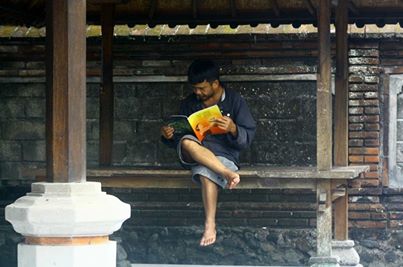
Balinese man reading the Festival Program

Man Reading the Festival Program Photo by Muda Sagala

A Writers’ Fire

It’s dark. Quiet. Still. I stand at the street looking down on a small circle of men in white. Where is everybody? I check the time…7:45…I’m early.

There are hundreds of people in Ubud for the 2013 Writers’ Festival. A large percentage of them are the volunteers from around the world. They make this event possible. All of us are invited here tonight. Is Minnesota, U.S.A. the only place on earth where people arrive a bit early to make sure they’re on time?

I make my way, with some trepidation, down the staircase toward the gathering. As I approach I notice a person sitting on the sidelines. His brown shirt, pants, shoes, and stocking-cap blend with his skin. He’s invisible. He notices me and says hello, then smiles a mouthful of white teeth. He’s no longer invisible. He assures me that this is the right place and invites me to take a seat on the platform with the holy men.

Holy men are scary. They shouldn’t be. I’ve been hugged by an ancient holy man who was about a foot shorter than I am. But in Balinese hierarchy, a holy man is at the very pinnacle of authority.

with holy man

One of the men in the circle has noticed me. He nods. I nod back and smile. The next thing I know he is beside me, asking my name and where I’m from. This is standard procedure anywhere in Bali. Siapa nama anda? Di mana?

Pak Ketut takes me under his wing and informs me that this ceremony honors the Hindu diety, Agni, the fire god. The priests are busy preparing the altar, which by now is covered with flowers and fruit. I’m surprised we aren’t here to ask the blessing of Saraswati, goddess of knowledge and the arts. I ask Pak Ketut about it and he explains that Agni burns away all that is unwanted. The intention of this ceremony is to clear out whatever stands in the way of a successful, 2013 Ubud Writers’ Festival.

While I’m engrossed in Hindu Ceremonies 101, a few others straggle in. They join Pak Ketut and me and get the same questions, Siapa nama anda? Di mana? There is a woman from Singapore, one from Borneo, an Australian chap, and me. This time when invited to join the holy men on the platform we do so.

It’s 9 p.m. when the 8 o’clock ceremony commences. I should know this by now. Bali operates on jam karet, rubber time. Nothing ever starts when it’s supposed to. When time is attached to an event it’s a mere suggestion.  The Balinese possess an innate knowing and always appear en masse at the precise moment things commence. Or maybe things commence when the Balinese appear en masse?

There isn’t a full gamelan orchestra, but one of the men has cymbals. Another has a rattle. I notice now that all the holy men have some type of instrument. The officiating priest rings a bell and it begins. There is a cup of water and a folded banana leaf in a dish in front of me. I watch as the others dip the leaf in the water and pour it on their hands, cleansing them. Suda, sitting beside me, tells me if I touch anything besides rice during the ceremony, I must wash my hands again. I am reminded of this every time I take a photo. Suda points to the water and I dutifully wash.

There is a bowl of dry rice and a banana between us.

P1040833

A low tinkling begins. The priest chants in Sanskrit. Those in the group who can, echo the response. As the volume builds the fire is fed and becomes a dancing apparition in the center. The sound ebbs and flows. The music stops. In a grand finale lasting at least fifteen minutes, the priests incant. The sound crescendos to an abrupt halt and we all grab a handful of rice and throw it on the fire.

P1040838

The chant resumes and this performance is repeated over and over and over again. The rice in our dish is replenished many times. Then it stops.

We stand and form a circle. Very slowly, clapping a rhythm, our intimate little group of about twenty people, circles the fire. Then one-by-one we approach the holy man. It’s my turn. I kneel and incline my head toward him. He dips his finger in a mixture of oil and ash from the bowl sitting in front of him and with one finger, puts a dot of black over my third eye. When all have received their mark, food is distributed and it’s party time.

We open our neat packages to explore the contents. My new friends poke tentatively at the food while I dive in with my fingers and gobble the delicacies. Yum. We say goodbyes then Pak Ketut is there. “What do you feel about this ceremony?” he asks me as he makes a circle in the air with his arm then pats his chest. “What do you feel in here?” I pause. What do I feel? How has the night impacted me? And how do I communicate that with someone whose English is minimal. I open my mouth, not sure what will come out, but the words are there. “I feel special,” I said. “I feel special and blessed.” Pak Ketut beams. “Yes.” he says.

Together we have fed the fire. Bushels of rice and bananas smolder in the embers. Agni’s tummy is full and so is mine. Let the 2013 Ubud Writers’ Festival begin!

What We Keep, or…Don’t Pack the Surge Protector!

The Bali Advertiser is a popular newspaper for the thousands of ex-pats living on the island. This month they pubished a feature article I wrote with the same title as this post. Click on Bali Advertiser and it will take you to their website. Then click on the issue that appears in the center of your screen and page through until you come to the article covering page 57.  Or, better yet, you can read it right here…

WHAT WE KEEP…OR,  DON’T PACK THE SURGE PROTECTOR!

When stakes are pulled up and a new life is launched, what comes along? There’s always baggage, tangible and intangible, but I’m talking prized possessions. What carries the emotional weight to be considered worthy of a spot in one’s new existence? Wedding china and crystal?  The mahogany dining table that seats twelve…comfortably?

Our stuff tells a story. But the belongings that are carried with us into a new start, a life transition, hold volumes of information. The energy contained in each accompanying treasure comes heavy with memories. Those that promote the path chosen over the one left behind, are valuable affirmations of who we are and what we want. But sometimes the things hauled along are symptoms of a lack of trust, an inability to let go.

I am reminded of the story of a man sitting by the side of the road. A traveler came by and asked him, “What are the people like in that village up ahead? I’m thinking of living there.” The man looked up at the traveler and said, “What were the people like in the place you left?”  “They were wonderful,” the traveler replied, “Helpful and friendly.” The man smiled, “You’ll find the people here are pretty much the same.” The traveler went on his way. Soon another traveler came by and asked the man, “What are the people like in that village up ahead? I’m thinking of living there.” Again the man said, “What were the people like in the place you left?” The traveler scowled, “They were back-stabbing, busy-bodies. I couldn’t wait to get out of there.” The man nodded, “You’ll find the people here are pretty much the same.”

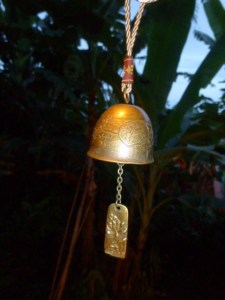
Wherever we go, there we are. There’s no escaping ourselves. P1030207But I’m fascinated by the things we keep, sometimes boxed up, collecting dust in a dark closet, sometimes in a climate controlled vault, untouched, seen only by the attendant during a routine check. Even I, minimalist that I’ve become, brought some things with me when I fled the sub-zero misery of the American Midwest. Some are supportive of my journey. The small, brass temple bell from Unmunsa, a Buddhist Monastery in the mountains of South Korea, speaks to me. Its clear voice is a call to meditation, the joyful reminder of a moment on the pathway toward awakening. The worn patina hints at something more permanent than my life.
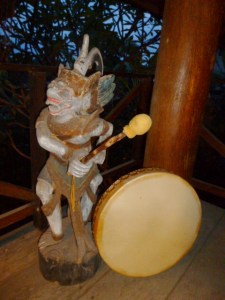
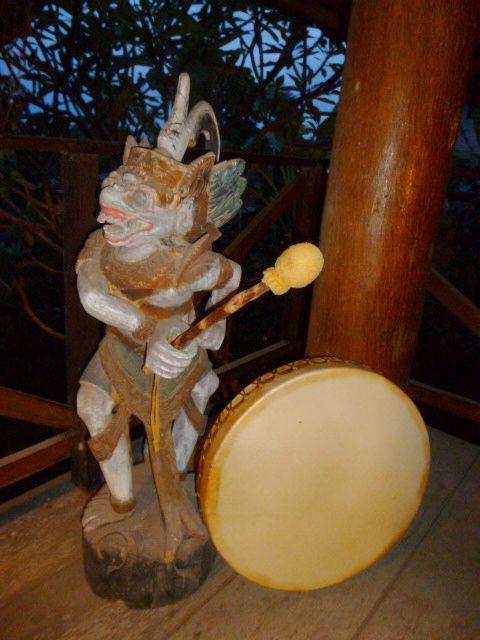
Frame DrumOn the other hand, the elk skin on the frame drum from a shop in Seattle turned immediately flaccid as it drank from the drenched Bali air. Its rich percussive vibrations are a distant dream. But all is not lost. I keep it for its decorative value. And it holds images of my youngest daughter, golden hair and shades, showing me the ‘gum wall’ and Fisherman’s Wharf, as we walked that city together one memorable day.
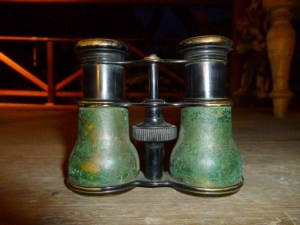
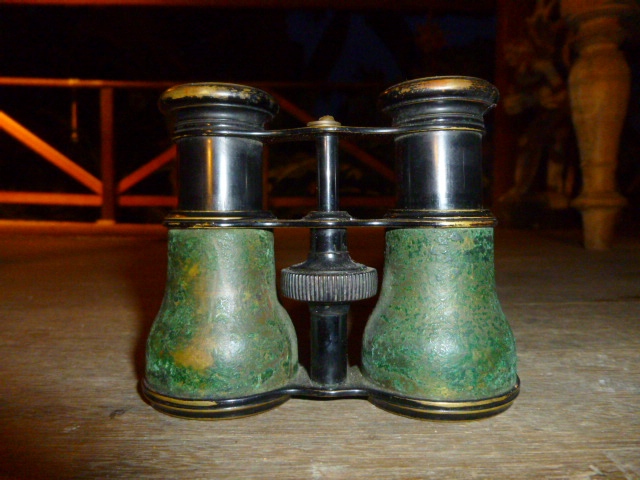
I found the antique French field binoculars in a consignment boutique and fell in love. They were of absolutely no use in my old life. But they called to me. It was as though I knew they would enhance my experience in an undreamed future. Here they zoom in on exotic birds, butterflies, or workers in distant rice fields. They bring closer the beauty and bounty of Bali that feeds my soul.
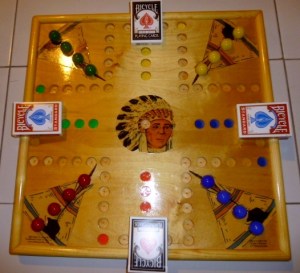
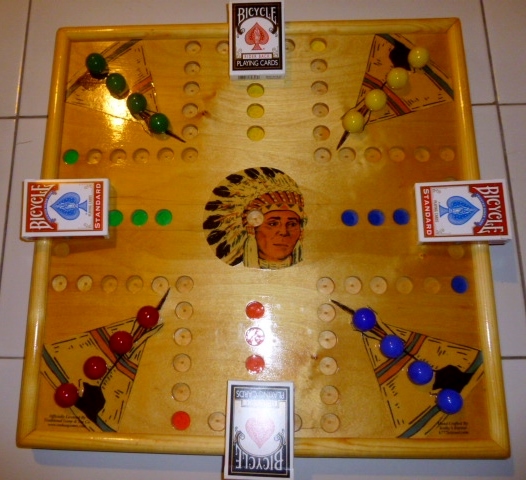
??????????But the most impressive come-along, taking up two-thirds of the space and weight allowance in my luggage, was the Texas Mean game. My parents were introduced to it in that state on a winter sojourn there. They returned with a pattern for the board. Over the years dad produced countless reproductions for friends and family in his workshop. Now, 90 years old, he still plays, and more often than not, wins this competitive game.

It posed a problem, however. The solid wood board was too large. No amount of angling it crosswise, or forcing it into the expansion area of the suitcase, would allow the zipper to close. I was bemoaning that fact to a friend. “Let me see it,” he said. A day later my board returned, sliced, hinged, and modified. It fit.

What is the energy carried with me in these possessions? It’s like Soren Kierkegaard, the Danish philosopher, said, Life can only be understood backwards; but it must be lived forwards. Reflection reveals much. The bell speaks of mystery, travel, adventure. It holds visions of cherry blossoms, clouds of them, drifting onto the path like snow, and monks in gray robes, single file, entering the temple. It calls me inside, to the spiritual part of myself that is ever evolving. It is the essence of who I am and what I love.

The drum is my heart, symbolized. It is soft now and pliable with the freedom, hard won, to be exactly what it wants to be. All those years it did its duty, pounding out the cadence on command, holding steady the rhythm of life. Here, in Bali, my heart beats reggae. It aligns with the hammering of gamelan. It releases me to dance.

The binoculars are 1800’s vintage in mint condition. What sights have they seen? What stories do they hold in the lenses of their glass eyes? When I put them to my face and watch butterflies circling, circling, in their intricate mating dance, they are warm in my hand. They bring me close-up to view the intimacies of another world. It is a deeper way of looking, a poetic way of watching.

And Texas Mean? There are memories of hundreds of games over the years. There is the warmth of family sharing laughter and friendly competition. There is the random act of kindness by the dear one who saw a solution to the size problem and fixed it. Gratitude is too small a word.

But best of all, my Balinese friends love the game! The fact that there is an image of a fierce Native American dead center, and teepees in each corner, doesn’t faze them. To them, it’s “The Fighting Game” and believe me, they know how to strategize and work the odds. We have spent many nights whooping and hollering, like natives on the warpath, as one or another of us gains the advantage. It dissolves differences in culture, language, and custom. It reduces life to play, and we’re all equal in the game.
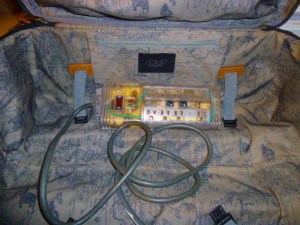
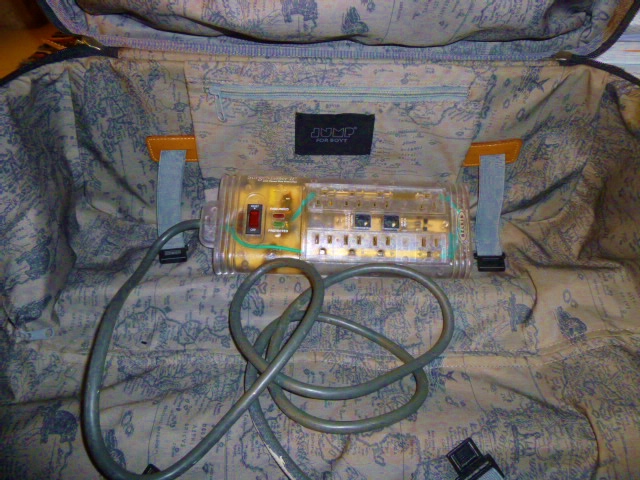
???????????????????????That’s about it, the laptop, the camera, those are essential to my work. But…oh yes, there is one other thing. It sits in the bottom of my otherwise empty suitcase in the dark, out of sight, out of mind, an embarrassment. It’s a giant surge protector with outlets for at least 8 electrical plugs. Paranoid about my new computer equipment, wanting to protect it, I stuffed the monster contraption with its thick, inflexible cord, into the luggage next to the Mean Game. It was the first thing I pulled out when I arrived in my new home. I found the correct adapter, plugged it in and attached the unit. There was an instant pop and a blinding flash that shut down the power in most of the banjar for several hours. Actually, that’s a bit of an exaggeration, but it scared the living daylights out of me!

It’s interesting as I ponder these things I brought from the old life. The ones that have love attached to them have grown even more precious. And I treasure them especially because they are few. But the unwieldy surge protector, packed out of fear and a mistrust of the unknown forces of power in my new place, backfired. I can’t even give it away. Nobody needs it here. It will just end up taking precious space and pounds out of my quota on some visa trip back to the States.

The unknown forces of power I should have feared are the ones that bring me face to face with myself. Bali is a playground for those energies and I am her playmate. Bewitched by the Siren call, I was lured from my complacent existence to her green embrace. The kindness she bestowed on me, with my strange white skin and pale eyes, left me with a fierce yearning to be with her, always.

So I divested myself of the accumulation of a lifetime, not bit by bit, but in one wild purge. It was a glorious release, mentally, physically, and emotionally. I let go of a life that no longer served me, if truth be told, had never served me. The few things I kept, the treasures that made it into my luggage, were gifts from me to me. They were promises made during difficult times that assured me of a different future. All, that is, except the surge protector. That was my stab at security, my insurance policy. In throwing caution to the winds and moving to the other side of the globe, that surge protector would ensure that my electronic connections to family and friends would be safe.

And Bali would have none of it. “You’re mine!” she thundered as sparks flew from the incompatible connection. “Yikes!” I shrieked back at her in shocked surprise. It was a lesson, harsh and immediate. She wasted no time allowing me to bask in any silly illusions I might have harbored. “Trust,” she said, her message as clear to me as if it were carved in stone.

My technological equipment thrives on Bali’s current, and so do I. She knew we would. And trust is no longer an issue. If I’m ever prone to doubt, a vision of a rogue surge protector, deep in the bowels of my luggage, comes to mind. I feel the sting of her reprimand afresh and doubt dissolves. We have an understanding, Bali and I, and as long as she has her way, all is well.

Sleepless in Singapore

There’s a 95 degree wind blowing through my sweat-matted hair. I lick the salt rivers that collect at the corners of my mouth. My tank top clings like I’ve entered a wet T-shirt competition.

The drive from Ubud to the airport usually takes a little over sixty minutes. We’ve been en route for two hours, bumper-to-bumper, breathing the noxious fumes of tour buses that clog the narrow roads. Motorbikes buzz like angry bees around us.

I arrive at the check-in counter looking like something chewed up and spit out. In the restroom I fish a clean shirt out of my backpack. A fresh layer of deodorant, a quick change, and I’m off. Immigration is a breeze and I find my gate with time to spare. The doors are locked. I’m told they won’t open for another half hour. The regular seating is occupied so I make myself comfortable on the floor.

It’s a great people watching opportunity. I notice a special couple. The woman has a curiously small head with a short-cropped cap of hair. She’s about seven feet tall. Her shapeless, mid-calf black dress covers most of the zebra leggings. These are tucked neatly into unlaced combat boots. The man’s height misses her shoulder by about two inches. His doughy complexion and blonde buzz-cut look sickly next to her dark presence. By comparison, he’s a non-event.

It’s hard to tear myself away from the unlikely pair, but the doors open and I move into the lounge area to await boarding. Time passes. More time passes. There is an announcement that our flight to Singapore has been delayed due to…well…that part isn’t clear.

Two hours later the intercom crackles. “Your attention please…” The gist is that the entertainment system isn’t working for seats 17 A, B, and C, and…. The announcer doesn’t have a chance to finish the sentence. There is an outraged roar from the waiting passengers who cannot believe the flight has been held up for such a minor detail. About 30 minutes later we’re in the air. The three people in row 17 have been assigned other seats. The group going to Frankfurt already knows they’ve missed their connecting flight. The delay reduces my layover time in Singapore to a mere 6 hours.

We land at the Changi airport at 11:30 p.m. It’s still 27 1/2 hours to Minnesota. I can feel fatigue settling between my shoulder blades. It’s too soon to be this tired, I moan, indulging in a moment of self-pity. A banner catches my eye. Rainforest Lounge. I take the escalator up to investigate. They have beds. For $10/hour I can stretch out and maybe even sleep. I explain that I don’t have a watch, don’t have a phone, don’t have an alarm clock, and could they please wake me in 3 hours to catch my connecting flight. I am told, very politely, that they don’t do wake-up calls. In the same breath they assure me that they will wake me in three hours.

I follow a guide down a quiet hall of curtained doorways to my room. They call the miniscule pods ‘slumberettes’ and the name fits.

Rainforest slumberette

Rainforest slumberette

Although small, it is impeccably clean, and that makes me happy. With as little noise as possible, I slip into my sleep shirt and settle into bed. The slatted walls allow for no soundproofing. They do, however, offer a fragmented view of the neighbor on each side. Unsettling. The curtain over the door does not enhance the feeling of privacy or security.

I have just achieved a semi-conscious state when a family arrives. There are four of them and they’re all talking at once. From the tone and the volume I know that something does not please them, but I don’t understand a word. They’re oblivious to those of us trying to sleep. One of my fellow pod mates utters a loud “SHUSH!” It accomplishes nothing.

Following that disturbance, I drift into uneasy sleep. At one point I think I hear a brown grizzly. I awaken in fright to realize that my neighbor on the left is rattling the walls with his snoring. A little later someone has a very happy dream. (I’ll spare the details.) But it was the panicked voice of the desk attendant saying, “Ms. Bronson! Ms. Bronson! So sorry! I forget about you!” that brought me bolt upright in bed. Whoops! My 3 hour nap lasted 4 1/2 hours. In a fuzzy grog I fumble out of my sleepwear and bolt for the gate. I still need to secure a boarding pass, clear security, and hopefully catch the plane. The sign says it’s a seven minute walk to Section D, my destination. I manage it in half that time.

This story has a happy ending. I arrive at the gate with 15 minutes to spare. My nap in Singapore makes the rest of the trip almost pleasurable. I watch six movies eat three meals, and time flies. My dear friend is waiting at curbside when I exit the airport in Minneapolis and the sun is shining. Now, a day later, I’m not utterly devastated by the effects of jet-lag. I’m sold. Future trips must include a pit-stop in the slumberette. But next time…note to self…bring earplugs…and an alarm clock!

Hard Headed Woman

Here is not so different from anywhere else. This is the first line of a poem I wrote once. The rest of it is long ago forgotten. But I wrote it before I knew Bali, and here IS DIFFERENT. The air is different. The opportunities are different. The language is different. And the people…ah, the people!

I met Wayan on my very first visit to Bali. Back then…way back then…she worked at Pertinen Spa and gave me the best massage I’d ever had in my life. When I came back two years later, I looked her up and treated myself to her ‘magic hands’ again and again. We became friends. Then I met her husband, Komang, and their son, Arya. First I was invited to their home, then to special ceremonies, then to Arya’s birthday party. They adopted me as one of their own, and when a Balinese family adopts you…it’s hard to explain. We don’t have anything quite like it in the U.S. It is assumed that they get to tell you what to do!

That’s why, when Wayan started her own business, Jiwa Raga Spa and Wellness, I became the poster child (I use the term loosely!) I tried loudly and long to convince her that she needed someone young, supple, unwrinkled at the very least. She would have none of it. One day she simply announced that she was coming to pick me up for the photo session. End of conversation. If you’re ever in Ubud, go to Jiwa Raga. I’m bigger than life on banners, posters, the spa brochure…it’s my one claim to fame. I told Wayan she was a hard headed woman. She agreed.

P1020790

Recently Wayan told me she would come and spend the night with me soon and she would make dinner. Because it’s difficult to plan exact dates in Bali (you never know when the banjar will need help with a cremation or special ceremony) I was pretty sure it would be spur-of-the-moment. So one evening, Wayan, Komang and Arya appeared at my door with groceries and Wayan set about making mie goring. It was delicious!

After the meal Komang announced that he had a special treat and disappeared into the kitchen. The next moment he came out carrying small bowls. “Lemon ice!” he said. He had watched a chef at one of the high-end restaurants in Ubud make it. “I copied him,” he admitted. It was delightful! Wayan told me she had brought treats for breakfast, too. I could get used to house guests like these!

In the morning we gathered around the table in our jammies and enjoyed coffee and  Wayan’s special rolls stuffed with strange ingredients. Some had meat in the middle, some were apple jelly I think…they were very tasty with our coffee. Then it was time for them to go to work.

P1030552P1030555

The handsome dude in the blue shades and matching jacket is Arya. Daddy Komang adusts his helmet and Wayan observes from behind. Then with hugs and goodbye’s they were on their way.

Family life in Bali is communal. In many cases, the sons remain in the family compound, bring their wives there, raise their children, and care for their aging parents. The family belongs to the banjar, a community of a few hundred people, and they have obligations to that group. Said obligations run the gamut and are based on Hindu ceremonies, rituals, and celebrations. The Balinese experience is completely opposite that of the isolated family unit in the West. So what I expected was based on my experience. What I got was based on theirs, and that’s the story of my life here as it becomes increasingly interwoven with the lives of my Balinese friends.

The vast differences always come as a surprise. I tell myself that by now I should know better, but the programming of my upbringing leaves a powerful imprint, as does my country of origin. I was born to privilege and entitlement just by virtue of being a citizen of the most powerful nation in the world. When I decided to live somewhere else, I came face-to-face with that truth and it has humbled me. I am grateful to Wayan, and Komang, and Arya. They are my teachers, as are my other wonderful Balinese friends. And I’m a slow learner, but ‘better late than never’ as the saying goes!

The Focused Intensity of Bali’s Young

Sometimes pictures are so much better than words!

Today was a big day at Dewi’s school. It was the end-of-the-year dance program. When you look at the photos below, keep in mind that Dewi is 5 and her classmates are pre-schoolers and Kindergarteners. None of them is over 6 years old. I didn’t know what to expect, but when I compared the accomplishments of these babies, with the things children in the West do at that age…hmmmm. And we are not talking a ritzy, private institution here. This is an example of a standard education in an average, Balinese school.

P1030722P1030718

Long before a single foot meets the stage, the kids are at the salon for hair and makeup.  That takes an hour or two. Then the young performers are dressed in the brilliant costumes typical of each dance.  If they are first in the program, it’s soon over. But some of these children had to wait an additional three hours while dance after dance was performed by other classmates. Dewi’s was the last, the Kecak…a grand finale. What I’m getting at is the dedication, patience, and serious attention five and six-year-olds are able to muster when it comes to these time honored traditions.

P1030783 P1030829 P1030745 P1030734 P1030860P1030776P1030761P1030784

While their faces show the depth of concentration required to remember the sequences of the dances, their hands and feet execute complex moves.

P1030785 P1030766 P1030773 P1030775

While some dance, others patiently wait. Here is lovely Tisna (on the right) with her friend.

P1030742Tisna’s mother is a professional Balinese dance artist and has travelled internationally with her group. She can be seen nightly at the Ubud Palace. Tisna is following in her mothers complicated footsteps.

No school program would be complete without awards. Dewi has modestly accepted her prize for being the most CONFIDENT. Funny, none of us were terribly surprised by that one!

P1030802

P1030796

This darling is fascinated…not by the dancing…but by me…a light-haired white woman who has invaded her world. When I ignored her, she reached a pudgy pointer finger out to touch my face. When I looked at her, she jumped into her mother’s lap.

P1030868

And no matter where you go, doting parents are all the same. They’re taking pictures. Notice there’s not an old-fashioned camera in the bunch! They’re all on their iphones!

But she looks so normal…!

P1010155

Amit pauses for a photo during a rice paddy walk

She calls herself, Healing Pilgrim. Amit’s story is not your typical biking accident. My friend was cycling in Cambodia, alone, when she found herself on a bridge that seemed fine at the start. She realized too late that it was rotten and she, and the bike, plunged through. A Cambodian farmer and his wife found her and saved her life.

The doctors didn’t give her much hope of walking again. Today, after countless surgeries, Amit walks. Sometimes she crouches or reclines. But she never sits, and she can only stand in one place for mere moments. Pain is a constant in her life, but to look at her, none of that is readily apparent. She is one of those people who suffers invisible injuries, and she has decided to do the thing she CAN do to spread the word about others like herself. She’s going to WALK.

Amit will be walking the Camino de Santiago in Spain to raise awareness about invisible injuries. Please click here to learn more about her story and The Camino Project. Then support her in whatever way you can.

Happiness Lesson #1

Photo credit to acolorfuljourney

Photo credit to acolorfuljourney

BE IN THE NOW AND ALLOW.

That’s my mantra. It helps that it rhymes. It also helps that it’s short and easy to remember. Even so, it’s one of the hardest instructions to follow.

When we want something, we generally want it now. If there are roadblocks to getting it now, we waste days trying to figure out how to get past them.  Often several options involving effort present themselves. Maybe we have to convince someone else to get out of our way. Maybe we have to borrow money. Maybe we try to form alliances. Whatever it is, the stomach knots, the mind spins and the result is STRESS!

LET GO.

Yes, that’s it, let it go. Whatever it is you must have, pushing, tugging, and creating angst for yourself is not the way to get it. If it’s yours, then it’s already yours and the timing will work itself out. If it isn’t yours, but you MAKE it yours, it comes with a warning. It probably won’t bring happiness and blessing to your life.

For too many years, by sheer power of will and a little creative juice, I went after what I wanted, timing be damned. In the process I left a trail of broken dreams in my wake. In my 40’s I began to ask why and seek answers. I started to wake up. Old habits die hard, but a true desire to change is a mighty force and I truly desired a different life.

Letting go of the need to control circumstances was probably the greatest challenge of all. But eventually I stopped having to plot the future down to the last toenail.

P1030715

When faced with uncertainty I just did ‘the next right thing’. If that wasn’t clear, I felt my feet. Right. I stopped where I was, planted my two feet flat on the earth, and focused. It’s the quickest way to be grounded in the present moment. Then I repeated my mantra…”Be in the now and allow.”

Peace comes with letting go. Then magic happens. When we move out of the way, we make space for energetic forces that defy our limited site-lines. We allow abundance. We invite blessing.

People ask, “What made you choose Bali?” Well, it wasn’t like that. The energy of Bali chose me, and I allowed it.

Previous Older Entries Next Newer Entries