
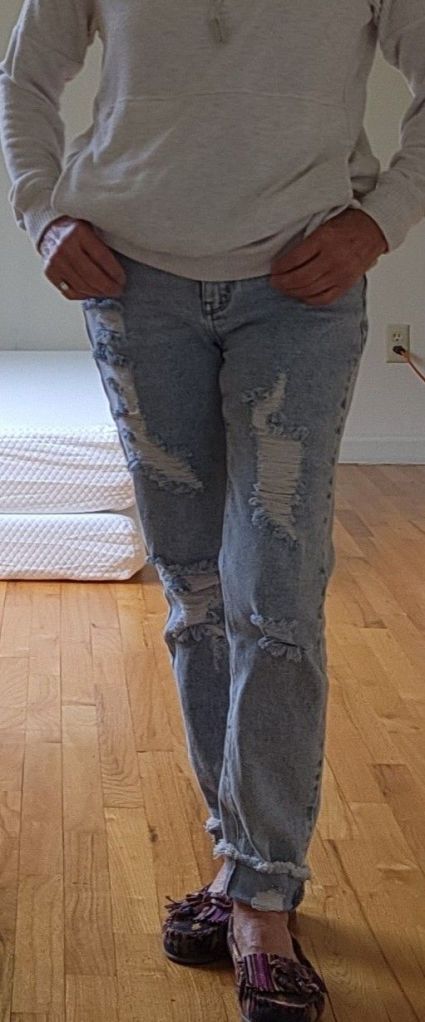
Don’t Hide Your Wild says Punk Granny in Holey Jeans

I’ve been wearing leggings for at least fifteen years. Nothing is more comfortable than the forgiving stretch paired with long tops that cover sagging buttocks and hide a thickening waistline. I had silky-thin ones for summer, bulky, fleece-lined ones for winter, and everything in between. I was set for life. 

On April 9th, I left Minnesota to spend several weeks with family. I wish I could say for certain what happened when my flight crossed into the Eastern Time Zone. All I know is that my perspective shifted. I saw myself differently. 

I like to consult the stars at pivotal points. 

The eclipse in early April seemed an appropriate time to do that. The results shocked me. Supposedly, I was about to experience a profound transformation that would make me question everything I believed about myself. 

I’m a person who journals for self-discovery, meditates, and digs deep into the workings of the subconscious. I value self-awareness, and mindfulness practices contribute to that knowledge. My initial reaction was, No way. I know who I am and I like who I am. Full stop. End of discussion

I landed at LaGuardia and booked a Lyft to Weston, CT. A few minutes into the trip, the driver missed an exit. We were in New York City rush hour. Traffic was at a standstill and all I could see in any direction were the roofs of vehicles reflecting sunlight like shards of brass. That added another hour to a trip that was already an hour and a half. I had ample time to reflect on the astrologer’s prediction and the spacey sensation that some part of me was slowly dissolving.

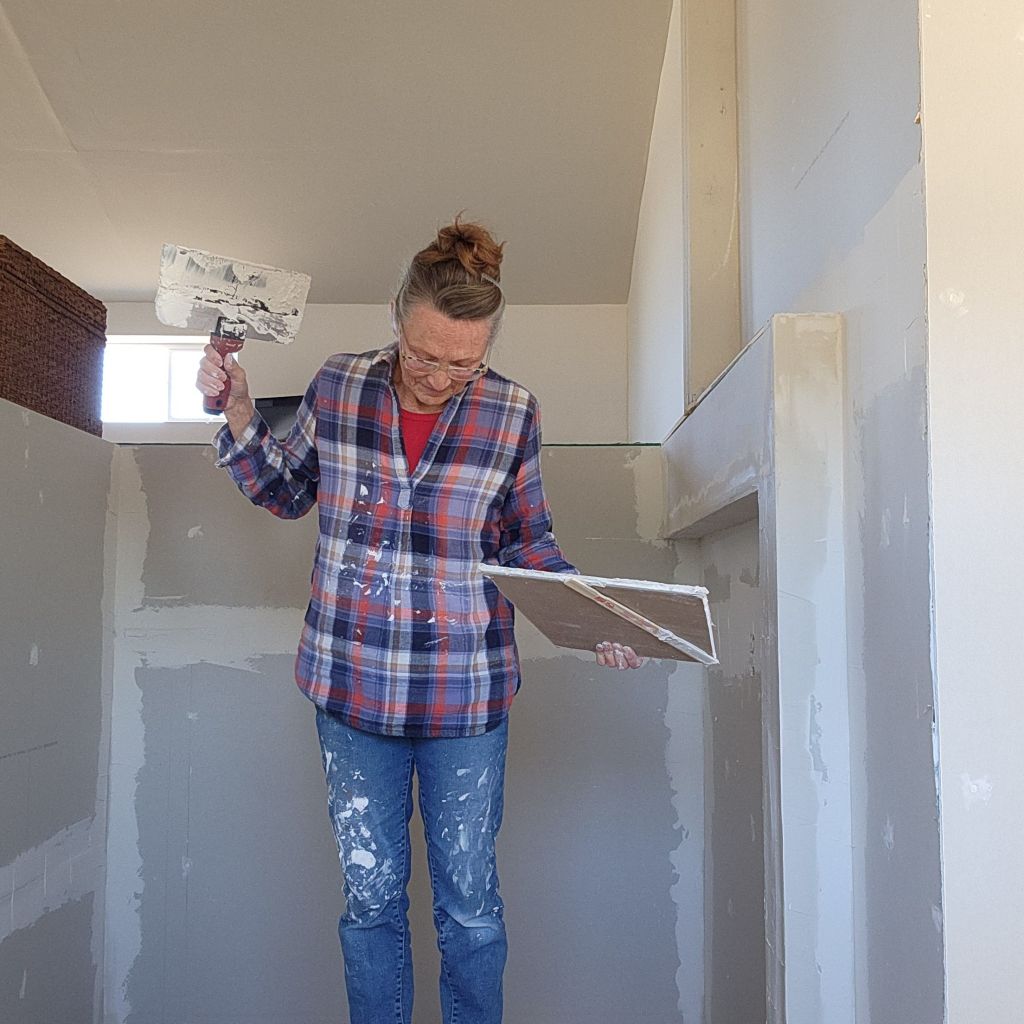
That night, I took off my leggings, stuffed them into the bowels of my carry-on, and sensed the end of an era. I donned work jeans and a flannel shirt, clothing I’ve become intimately familiar with over the past two years of house construction, and buried myself in the physicality of hard work. 

For the next six weeks, I shuttled back and forth between Connecticut and South Carolina, depending upon where I was most useful. CT meant doing whatever I could to assist my son-in-law with renovations to a newly purchased property. In SC I entertained my granddaughters while Mom traveled for business. 

The first time I left CT for Isle of Palms, SC, I pulled on a pair of dressy white jeans and a long-sleeved tee shirt, the only articles of clothing I brought that weren’t legging-related or work grunge. 

The following day I went shopping.
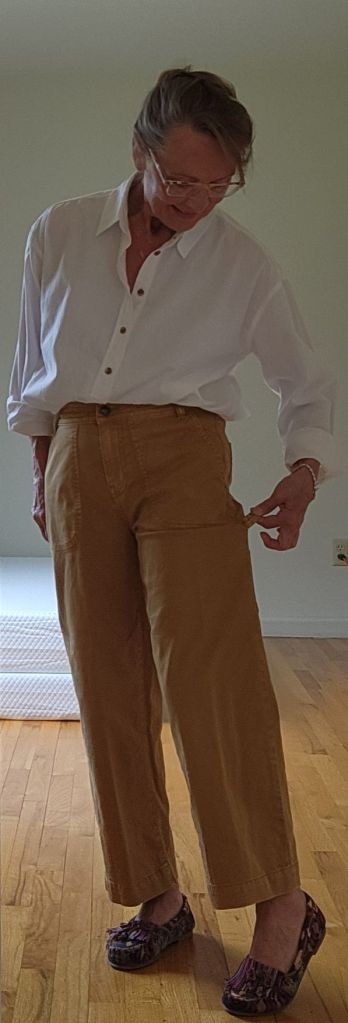
Whatever had clicked into place as I flew eastward, was actualized as I tried on fashionable, wide-leg carpenter’s pants, cargo capris, and holey jeans. I found bottoms first, then looked for shirts, the antithesis of flowy, to go with them. I was becoming the visual apparition of my revised inner essence. 

Wide-leg pants symbolized elegance and liberation in the 1930s. Cargo pants originated in Britain in 1938. Wearing jeans became a statement of youth rebellion in the 1950s after James Dean popularized them in the movie: Rebel Without a Cause. These fashions today are a remake of those vintage items. Torn clothing surfaced with angry youth during the British punk movement as the disenfranchised pounded hard rock music with lyrics rejecting mainstream corporate mass culture and its values. Their ripped jeans symbolized freedom of expression and individual non-conformity 

Since retirement, I’ve worn myself inside out. Whatever me wants expression, that persona is reflected in my apparel.

For the first few years in Bali, I gravitated toward lacey blouses and flouncy skirts, as far from business attire as possible. Then I moved on to capri leggings and flowy tops. When I landed in Mexico, after surviving COVID lockdown in Indonesia, the tables piled high with clothing at Tuesday Market drew me like a kid to a cookie jar. Bewitched by the sheer volume, the mass, the heaps of everything imaginable and unimaginable as far as the eye could see, I bought whatever caught my fancy, discarding most of it when I returned to the States a year later.

Mexico was a breath, a long inhale between COVID trauma and whatever might be next for me. 

Upon my return to the place I was born, the only thing that made sense was work. I threw myself into resurrecting a derelict cabin, turning it into a habitable dwelling next door to my sister’s home on the family farm. I felt most authentic in shabby work clothes that required no thought. 
However, this time coming home to Minnesota was much different. The skeptics who thought I wouldn’t stay in this remote place, no longer whispered their doubts. With a lot of help I’ve created a house I love that incorporates everything I’ve ever wanted in a dwelling. (Granted, free labor came with shaking heads and rolled eyes at my outside-the-box ideas.) But this community of family, old friends, and new acquaintances are rugged individualists. My renegade heart is accepted here and becomes more liberated with each passing year. 

Finding one’s true self isn’t a one-time thing. I’ve had many iterations, some authentic, a few not. Whenever I felt pressure to conform to accepted standards, I hid my wilder side. Looking back, I shouldn’t have. It came out anyway but in a dark, destructive manner. Had I allowed my soul free expression, I believe I could have avoided forty-five years in a half-life of shadows.

But that’s hindsight, always 20/20. Now, I’m the punk granny in holey jeans spouting wisdom for the Gen Xs, Millennials, and Gen Zers trailing behind me. It’s the age-old, Do what I say, not what I’ve done, advice. No matter your age, if you’re reading this it’s not too late! Do yourself a favor: don’t hide your wild!

Memoir is Subversive Literature

*

Memoir is subversive literature.

Just so we’re all on the same page with the definition of subversive, here goes:

Subversive: tending or intending to subvert or overthrow, destroy, or undermine an established or existing system, especially a legally constituted government or a set of beliefs.

I didn’t know that about memoir when I started writing mine. I had stories to tell, an unusual life to share with anyone who cared to read about it. I wasn’t in the business of overthrowing or undermining anything. Had you told me that’s what I’d be doing I’d have laughed you out of the room.

So I began and the stories rolled off my fingers like old friends. Sort of. At least the first one did, the story of my mother’s illness when I was five. I’ve rehearsed it many times over the years and it’s part of my belief system. It’s become a reason, an excuse, a foundational principal on which to hang dysfunction and irresponsible choices throughout my life. I didn’t know that until I wrote it down. When committed to paper it became blatantly obvious, and I cringed under that painful awareness.

It wasn’t an auspicious start, but I continued. I’d describe an event, render it alive again by the power of words, then sit there as it stared back at me in black and white. Is that what really happened? Is that how I felt? It’s the story I’ve always told myself so it must be true, mustn’t it?

Whether by virtue of the kindness of time, or a different perspective, or maturity, when I took a close look at my particular rendering of personal history I was dumbstruck. They were stories, some even compelling, but the act of writing them down demanded a certain adherence to fact, and memory tended to give me impressions, nuances of remembered emotion, but nothing concrete. When I dug them up, the aura around old enemies was softer, pastels instead of intense reds. The ones I’d blamed seemed less culpable than I was myself.

Disturbing. Yes, in a word it was disturbing to realize that my existing system of beliefs was nothing more than a network of interwoven stories, many of which were no longer true. Often during the writing of my life I’d stop and scratch my head, Really? and attempt to put myself back into the scene for a replay.

What happened as a result was the biggest surprise of all. Clarity. I gained clarity about who I was then and how that person is different from who I am now. I saw the forces that were driving me, some good, some not, and took note. Are those same forces still at work? And my belief system was shot full of holes. I couldn’t believe my own stories and that called into question…everything!

The other big word was opportunity. Memoir gave me the opportunity to rewrite the script, literally and figuratively. I have huge compassion for the woman who lived that life. There were reasons she remembered things as she did. And where it seems fitting, I’ve told the stories her way. But for me, now, the revelations gained through that process have reminded me of a basic truth: life is made up of the stories we tell ourselves. At any point we can decide to frame it differently and the power of that can transform our present reality.

Every life is a treasure trove of stories, and telling them can be a healthy exercise for anyone who’s lived a bit. The insights gained are valuable beyond measure.

But memoir is subversive literature. Don’t let anyone tell you otherwise.


Why Bali?

Why Bali? What is it that takes me thousands of miles from family and friends and holds me captive? What powerful force grips my mind and weaves it’s spell?

I’ve asked myself those questions. If I were running away from unbearable family matters, or painful memories, or anything at all, Bali would be a lovely place to run to. But I’m not. My family relationships are wonderfully close and loving. My memories are compartmentalized. I store the good ones in front for easy access and I have a convenient habit of forgetting the rest. I am not running from. I am running to.

The back of a motorbike is conducive to thinking. It was on the hour and a half ride back from Kintamani that I suddenly knew the answers to those questions. Perched behind Ketut, winding down the tight switch-backs as twilight and fog shrouded the mountains around us, my too-full heart began leaking from my eyes.

A brief stop on the way to Kintamani

I had spent the afternoon with Ketut’s family. Upon arrival I was welcomed, seated in a place of honor, fed and entertained. But they had work to do. So after an appropriate length of time, I was sitting like a distant queen watching her subjects. That wasn’t working for me. I abdicated my throne, walked over to the family, sat down on the ground beside them and began shelling beans. There was a flurry of activity, a stool was brought in consideration of my…age? Delicate white bum? Whatever. I politely declined in my best pidgin Indonesian. My effort was accompanied by uproarious laughter that left me wondering just what exactly I had said. The attempt to elevate me was abandoned and we settled into the business of work.

The beans have been shelled. I am sitting by Ketut’s ibu (mother) and Ketut is on my left.

All this was stewing in my mind with the hypnotic hum of the motorbike. Then the knowing dropped into my consciousness without effort. Here there is no pretense. These people are completely who they are and that allows me to be who I am. My roots are in the earth. I’ve shelled thousands of beans and peas, husked hundreds of ears of corn, picked berries, pulled weeds, baled hay. I spent my adult life in the city trying not to be a farm girl. But at my core I am that simple creature. Here, quiet respect is valued. Pushy aggression has no place. Humility is honored and the person who boasts or brags is secretly scorned.

One Balinese businessman I know was phoned and asked if he would host a large gathering at his place of business. He requested a meeting to discuss particulars. The date was set, then changed, then re-set, then cancelled. Another phone conversation ensued and the clients wanted to settle the matter over the phone. The Balinese businessman again requested a meeting. Later he told me, “I wanted to see their eyes.” Although it would have been an easy matter to arrange things via the telephone, the man held firm to his principles. The group went elsewhere.

And why is that important? It’s integrity. It’s knowing who you are and not compromising. It’s a set of values that doesn’t bow to the dollar. It feels like my childhood, the farm, the close-knit community of people who helped each other and didn’t feel the need for power suits or slick marketing gimmicks. And that’s why I was glad of the soft darkness as we rolled into Ubud at sunset. Nobody noticed my heart leaking.

Sundown in Ubud

Growth

I took a photo from my balcony that first morning in Bali. The tender young shoots of rice plants in the paddy below spoke of new beginnings, possibility, unlimited potential. They were like pre-schoolers marching in obedient rows, drinking deep of the nourishing mud at their roots.

Every morning since then I have eaten breakfast overlooking that same paddy, observing the subtle changes, drinking in the green of it, the succulence. I have seen it tended by barefoot women, bent all day over their task, mindfully pulling away what doesn’t nurture, what doesn’t belong.

And this morning when I sat down to breakfast and drank in the view it was like looking in a mirror I could so clearly see my reflection there. The seed of self planted here in the healing climate of Ubud has taken root. Things that do not belong to my truth, that do not nurture my growth, are being pulled away. I have met someone that I vaguely remember from a long, long time ago, a simple girl with poetry and passion in her soul. She got left behind when she didn’t fit the image I created for myself, the person I thought I ‘should’ be. We’re getting reacquainted. She’s a grown-up version with life-grit in her pores, not very pretty but very, very real. I am falling in love for the first time…with myself.

The rice paddy, too, has matured. She is a vibrant maiden now, full-grown but not quite ripe. I may not be here for the harvest of the rice. It’s not a plant whose growth I can predict with familiarity like tomatoes or corn. I’ve heard it has to turn golden before its time. I don’t need to know. It has fulfilled its purpose for me. Others will enjoy the fruits of its yield. My job is to show up for the reaping of my own late-sown crop.