A TYPICAL DAY


“You have a plan?” Ketut asks as he puts the produce from his morning trip to the market on my countertop.

“I’m writing.”

“The book?”

“Yes.”

“You want to see bale?” A simple question.

I’ve been talking about wanting a bamboo gazebo in the garden. It would be a lovely spot to read, sip fresh papaya juice, have a massage, and daydream among the topical flowers and lush greenery sheltered from the sweltering rays of the sun.

“Okay.”

I fill my water bottle, sling a lightweight backpack over my shoulder, switch my phone to data, and grab flip-flops and my helmet. I meet Ketut and his motorbike at the end of the narrow path that leads from my house to the street, and slide on behind him.

neka

In the fifty minutes from the house to Blahbatuh village where bamboo is fashioned into everything from swinging baby bassinets to complete houses, I learn that this isn’t the only thing Ketut has in mind. His list includes another stop, Depot Bangunan in Gianyar. It’s similar but less than one-quarter the size of Home Depot stores in the States. Still, for Bali, it’s huge.

“What do we need there?”

“Medicine to make bat gone.” He thinks for a minute then adds, “And door.”

I have a friendly bat that hangs out under the eaves at night. She’s harmless but the mess on my terrace every morning puts me off any thoughts of breakfast. I wonder what kind of medicine he has in mind.

After spending more time together over the past six years than most married people, Ketut and I have an abbreviated dialogue that works. I speak in Indonesian to him, he answers in English. “Door?” I ask.

“For toilet,” he says.

“Aduh! At last!” We laugh. He’s about as stubborn a human as they come and he’s fought me on getting a new door to his bathroom for months – maybe a year. I shudder to think what decay it’s fallen into that has caused him to finally entertain my wishes.

Then he reminds me I also need a Saraswati statue – doesn’t everyone?

The jolly owner of the bale shop speaks only Indonesian, fast. I try to keep up but have to ask him over and over to please repeat. He does, louder, but not slower. I catch enough to be able to crack a few jokes.

I like his product and the haggling begins.”Twelve million rupiah,” he says. I register the appropriate level of shock, tell him I’m not a bule kaya (rich foreigner) and what is his ‘morning price.’ That gets a laugh. “Okay, eleven,” he says. I change the subject. “Okay, ten million. Good price.” He’s having fun and I take the final plunge.

“I’ll give you nine million five hundred because you’re so handsome.”

Oh my. He doubles over laughing, and when he comes up for air with eyes dancing he says, “Okay. I give you for 9 million five hundred because you speak joke in bahasa Indonesia.” If for no other reason than that I continue to force my atrophying brain to study, and struggle to twist my tongue around this exotic  language.

The Depot stop is cut and dried. No haggling here. Ketut finds what he wants for the bat, chooses his door with only moderate complaints about the price, and we’re on our way.

There are miles of statues along the main road to Denpasar but I’ve had my eye on a particular shop in Peliatan, closer to home. We pull in and there she is: Saraswati, Hindu goddess of knowledge, music, arts, science and nature – with her swan.

dewi_saraswati

She’s gorgeous, but a little more elaborate, and a lot more expensive than what I’m looking for. I’m assured by the creator of this masterful piece that he can make anything and he will be happy to do so within my budget. “But you haven’t asked my budget,” I say, and give him a bit of a look.

“No problem, Madam,” he responds in perfect English, and right away I wish he’d said Ibu (mother), or Nenek (grandma), anything but Madam.

That word triggers me for some reason. It might be because it calls up images of an older woman who manages a brothel, escort service, or some other form of prostitution for profit. I’ve done many things for profit in my life but that isn’t one of them. However, it’s my problem, not his. How could he know? So I unruffle my feathers and we continue the process of establishing where my budget and his bottom line agree. The gap narrows, but doesn’t quite come together. I promise to think about it, and leave without ordering.

“You hungry?” Ketut asks as we straddle the bike and join the chaos in the street.

“Saya sangat lapar.” (Starving.) We head to a roadside food cart and pick up late lunch: a bunkus of rice, steamed vegetables, peanuts, a mixture of onions, garlic, tomato and chilies called bumbu, and other unidentifiable mysteries.

nasi-bungkus1

This isn’t westernized restaurant food. The flavors are pure Bali with lots of heat and we eat with our fingers sitting curbside. I carry a bottle of Thieves hand sanitizer in my purse at all times and use it before and after. Ketut likes the way it smells so he uses it too. We polish off the food like hungry wolves, then it’s back on the bike.

“Where?”

“Pulang, Ketut. Mau pulang.” The afternoon sun slips lower in the sky as he turns the bike toward home. Later I think about the day and where I’d have to go in the States with a shopping list like this:

Custom hand-made bamboo gazebo – Hmmm
Bat medicine and door – Home Depot, maybe?
Saraswati statue – Hmmm
Unregulated street food – Hmmm

And where could I haggle over the price and tell a man he was handsome so he’d give me a better deal without having to hire a lawyer the next day?

Ah Bali! She’s not for everyone, but I’m in love…still so in love.


When You’re Real

Most of my life I craved REAL while living the opposite. By the time I was in my late fifties I’d grown bone tired of keeping up appearances, looking happy when sad, successful when failing, confident when crushed, in love when…sigh….

Nobody said I had to fake it. The compulsion came from inside. The whole perfect facade of my life hid a mucked-up mess.

It was the story of The Velveteen Rabbit, by Margery Williams, that helped me change; helped me become REAL.

Isn't it ironic how this was one of my most favourite stories as a child and I really didn't know why ... but now I do.

It was the single most profound thing I’d ever read. It became my holy book, lines underscored, pages earmarked, and this paragraph especially, tear stained.

I look back on that time often, now that my joints are loose (more likely stiff) my hair’s been rubbed off (gotten thin) and my eyes have fallen out (lasik surgery). In spite of all evidence to the contrary, I don’t feel a bit ugly. I surround myself with REAL people, and they understand.

I no longer require pristine perfection in other things, either. Like, for instance my REAL groceries from the Ubud morning market. Far from the scrubbed and sanitized, shrink wrapped, color enhanced, chemical infused products proliferating the shelves in the local grocery stores, my food is brought in battered trucks fresh from the villages at 5:00 a.m.

20180605_190953

Ketut visits the market pre-dawn and does all the shopping. When I realized a year ago that I was protein deficient and needed to add a little meat to my vegetarian diet, I asked him if he could get chicken at the market. His answer was lengthy. Not only could he get it, he could get it fried, open fire roasted, grilled, steamed in banana leaves with Balinese bumbu, made into satays, and raw. I decided to try the fire roasted. He looked happy.

Next morning the grossest looking fowl I’d ever seen (exactly like the one above) arrived on my counter top. I’m ashamed to admit this now, but I squeaked when I saw it. I scream at snakes, most everything else that surprises me gets a squeak. I asked Ketut to take it to his kitchen, remove the head and feet, and return it looking less like it might get up and walk. He said I should use those parts to make soup. I told him he was welcome to have them for that or any other purpose just please take them away.

Of course it turned out that the scary bird was the most delicious meat I’d ever eaten. I’m sure it had been free-ranging, scratching and pecking in the family compound only minutes before it was captured, de-feathered, gutted, cleaned, and roasted over the smoking fire.

The brilliant green spinach offered up a few surprises of it’s own. It’s locally grown and organic. How do I know? It comes complete with bugs still residing in the leaves. The ones I miss during cleaning come floating to the top when I boil it for dinner.

And the eggs…?

20180605_190855

The eggs still have REAL poop on them!

I derive such pleasure from the simplicity. These products haven’t been cleaned up and made presentable. They come from farmers living a few miles away who load their trucks at o-dark-thirty and rumble into town. I love knowing that by avoiding the grocery stores and purchasing from the morning market I’m supporting independent family businesses, REAL people with REAL food.

Sometimes I wonder: What if I’d never read The Velveteen Rabbit? Would I still be living a soulless life? Words have incredible power to inform and transform. That little book happened to fall into my hands at precisely the time I was ripe for it’s message. And oh what bliss: the intoxicating magic of REAL!


Bali – Life in Technicolor!


When I practiced interior design, I told clients that their homes should reflect who they were (private persona) and how they wanted to be perceived by others (public persona). We spent significant time discussing this and often who they felt they were inside differed vastly from how they wished to be seen.

Personally, I wanted my home to tell the world how sophisticated I was. My mother modeled flawless manners: setting a proper table even for breakfast, insisting that I learn piano and listen to classical music when I much preferred playing guitar with my dad. Her need to look perfect to the world lodged in my psyche.

As an adult that ingrained training dictated appearances. The color palette in both the clothing I wore, and the furnishings I chose, blended a dazzling array of – you guessed it – neutrals. The absence of color was chic and classy. The only divergence from the black, white, beige theme was a red brocade jacket pulled out of mothballs at Christmastime.

I brought that aesthetic with me when I moved to Bali. The first thing I noticed after the two thousand shades of green, was the Balinese’ flagrant disregard for subtlety in their attire. Bali style was as far from neutral as Minnesota winter was from tropical paradise.

Layered patterns in bold, clashing colors challenged my tightly held conceptions of what worked and what most decidedly didn’t.

I searched the entire island to find quiet earth tones for accent pillows and cushion covers, but Bali would not be subdued. I settled for a dignified combo of black, rust, and avocado. Now, six years later, in response to a growing community of permanent Western customers, gray, taupe, and putty batiks and ikat fabrics abound, all those lifeless non-colors that no self-respecting Balinese person would ever want.

As the years passed I was unaware of my continental drift away from ‘safe.’ The change came so slowly I didn’t notice when the vanilla person hiding behind beige, went missing.

Upon reflection, blame settled on the Bali Blue Bed. When that precious antique handcrafted half a century ago by Ketut’s father for his growing family became my most cherished possession, my relationship with color began to expand.

Tentatively I added a little china to carry the emerging theme into the kitchen.Not long after the new dishes brightened up the far end of my quarters, I discovered skirts. Until that time, capris had covered my lower half, white ones, black ones, and of course non-threatening beige. I don’t remember when the first flowy, legless clothing crept into my closet but I remember the color: hot coral!

I loved flouncing around Ubud with naked legs! Breezes reached all those previously confined areas and I was so much cooler underneath! Soon the mid-length pants occupied a drawer that never got opened and the closet was full of skirts: blue, green, some with birds, others with flowers. Loose-fitting tops were the natural accompaniment and they came in various shades of bright. So the wardrobe morphed along with the house.

On the way back from the supermarket one afternoon, the bead shop lady greeted me on the sidewalk. Next thing I knew I was the proud and somewhat surprised owner of an enormous beaded basket!I’d ordered one that was half the size but when I had gone to the shop a month later to pick it up, the dear lady apologized. “So sorry, Ibu, but no small now, only this kind.” Evidently the current shipment of imported rattan baskets from Java that the woman used as a base for her beadwork, had only come in large.

As so often happened to me here, the Universe conspired to give me my heart’s desire. I’d lusted after the monster baskets so why had I ordered a small one? I knew the answer to that as well as I knew the reflection in the mirror. It was a lie as old as I was, instilled in the subconscious where it reared it’s ugly head from time to time when I wasn’t vigilant.

Thankfully, the ‘you don’t deserve such abundance’ story was overridden. I hugged the prize to my heart as the happy woman gave me a lift home on the back of her motorbike.

Then the heron came home to roost on top of the bookshelf.
It was a similar story with an interesting twist. I’d passed the bird in a shop window, stopped to look, decided it was unrefined, folksy even, and continued on. I did that several times over the next few days. Curiosity finally forced me inside to ask the price. Expensive. I left. Several weeks went by. Upon rearranging a few things in my house, a space opened up where none had existed before. The memory of that colorful creature popped into mind. I can’t explain why or how, but by the time I arrived at the shop, desire burned in me with all the passion of first love! Now every time I look at the stately bird, I smile and wonder how I could possibly have thought him provincial.

When the pillows and mattress cover on the the Bali Blue Bed recently grew too faded to tolerate, I went shopping. It was a shocking pink batik boasting mythical birds with glorious chartreuse tails that captivated me first. There followed a shimmering array of metallics for accents and a purple, orange, red geometric weave for back pillows. Handwoven eggplant colored fabric became the grounded base for all that whimsy.

The burst of color thrilled me. I loved to nestle deep in those delicious hues and absorb their intensity, to be cradled in the very essence of myself. Then it struck me: in my non-stop, stressed-out, U.S. workaholic life, I had to surround myself with boring neutrals. It was survival.

But in my laid-back, joyful Bali life, my nervous system has re-calibrated. I thrive in an atmosphere of visual stimulation, no longer living a schizophrenic existence. Who I am is on display for all to see in bold designs and brilliant hues. My house validates me the way insipid neutrals never could.

I’ve even ratcheted up the intensity in my clothing. The new temple outfit for the ultra important Hindu ceremonies I’m frequently invited to, is a hunting-jacket-orange kebaya with a fuschia sash over a hot pink-yellow-blue-etc. etc. sarong! And it just feels right.

Why did it take so long to come to this, to embrace the complex, colorful person hidden  somewhere inside? The answers have to do with fear, with the need to fit in, with concern about the perceptions of others, with self-denial, with…nevermind. Needless to say, the list of reasons is long. But the realization that all are now in past tense is sheer delight! I’ve burst the confines of conformity and traded suffocating sophistication for my technicolor Bali life.

Do I have the right to IMAGINE you?

I wish I could speak with ironclad certainty about the right of fiction writers to portray anyone, from any culture, in any way we wish. In her opening address at the Brisbane Writers Festival, Lionel Shriver, a celebrated U.S. author, adamantly took that stance. Her argument appeared sound: the genre is fiction, therefore it’s made up, imaginary, and nobody should take offense.

I’ve pored over her speech and studied the uproar of commentary it incited. Do you remember the movie, Fargo, now a television series by the same name? The Coen Brothers created the film and billed it as a true story. Here was a movie about my state, my peeps, getting rave reviews. I couldn’t wait.

I’d heard it called scathing social satire, but that didn’t prepare me for the film’s insulting portrayal of people, dare I say it, like me. I couldn’t separate myself from the exaggerated Scandinavian backwoods brogue littered with you betcha, golly,and gee whiz. But the problem went beyond a personal affront. People all over the world watched it and formed an opinion of Minnesota, a state of hicks who talk funny and are a little stupid, but really, really, nice. Nobody sat beside them saying, “This is a farce, a parody, people there aren’t like that, seriously they’re not!” It was cultural appropriation at its box-office best.

We can’t help ourselves. We believe what we read, see, and hear in the media. If we don’t swallow it whole, there’s an impression left in our mental data banks that sticks.

So I had a problem when Ms. Shriver, from a position of white American privilege, told the rest of the world in so many words: Shame on you for feeling marginalized. This is fiction. It isn’t about you, it’s about the author’s freedom to IMAGINE you.

Is she right?

Don’t we all love story? What if the freedom to imagine and create is censored, given walls, boundaries, taboos?

I didn’t like my group being portrayed in an unflattering way. Who does? And yet I’m a creative writer and imagining is what I do. I invent unsavory characters as well as quirky, funny, bumbling, brilliant, and dull ones. I visualize them in skin: tanned, pale, olive, sallow, wrinkled, white, brown. I identify them ethnically, socially, culturally, and by their own, unique voice. I give them place and purpose and bring them to life. It’s never my intent to ridicule or malign others. But have I unwittingly done that by creating people who are nothing like me?

How I love getting lost in a book that someone else has imagined, living with those characters in their reality while momentarily escaping my own. And how I love to create story, allowing my normally serious mind to come out and play, to run with abandon waving my magic wand as my dreamed-up people populate the pages and live and breathe before my eyes.

It’s scary when I extrapolate the issues of cultural appropriation in fiction to various possible outcomes. What if we were banned from writing anything but what we have personally experienced? Memoir would be off limits unless the only character was me. As soon as I introduced another person, an ex-husband, mother-in-law, one of my children, and shined my prejudices upon them, whether in a positive or negative light, zap! Guilty!

The fact that literary festivals are springing up all over the world, and writers are being introduced cross-culturally to a degree never before possible, brings issues of sensitivity to the forefront. Years ago, when authors wrote for a small segment of the population: those who could afford to buy books and also knew how to read, this was a moot point. But now that events bring writers and readers together world-wide, and literacy rates are increasing, those who have been portrayed in ways that don’t ring true to what they believe about themselves, are speaking out.

I get an uneasy feeling in my gut when the word censorship is bandied about. As a writer I come down solidly on the uncensored side of the debate. As a human being who identifies with a specific place and a distinct heritage, I’m torn. Cultural appropriation is a valid issue and one that won’t resolve anytime soon. Pandora’s Box has been flung open and as we say in Minnesota, who knows where the chickens will come home to roost.

How does this strike you?
Have we gone over-the-top with cultural appropriation, politically correct, sensitivity issues? Or have we barely scratched the surface of a necessary heightened awareness of The Other. Please share your thoughts.


The Constant Gardener

In some places, it’s a choice. In Bali, it’s necessity. In order to have a yard, or a path, or any space that’s clear of serpentine vines that weave bushes and trees together in an impenetrable wall, one needs a constant gardener.

That’s Ketut.

When he’s not hacking back the foliage, or mowing with his machete, he’s involved in the finer art of botanical husbandry.

“What’s that for?” I ask as he rounds the corner with a bucket of dirt and some black plastic.

“Make new tree,” he answers.

“Really?”

“You like this one?” He points to a gardenia bush. He knows I love the sweet-scented flowers.

“Yes, of course!” I say.

“Okay, make new.”

“What’s wrong with it?” I ask, a little confused. He’s on his haunches and has set about cutting into the bark of a strong, healthy plant.

“Ya this already good. Make new.”

If Ketut were a spouse I’m sure he would have lost patience with me long ago. But he’s not so I badger him with no fear of rebuff. As he works he explains what he’s doing and I duck into the house for the camera.

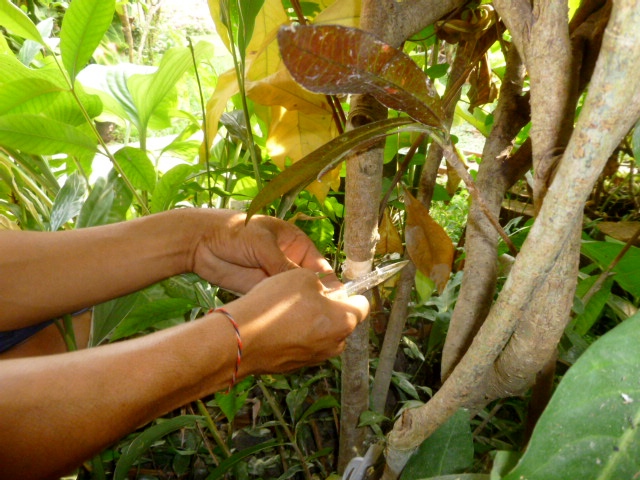
About an inch of bark is scraped off all around the trunk

Ketut scrapes off about an inch of bark all around the trunk

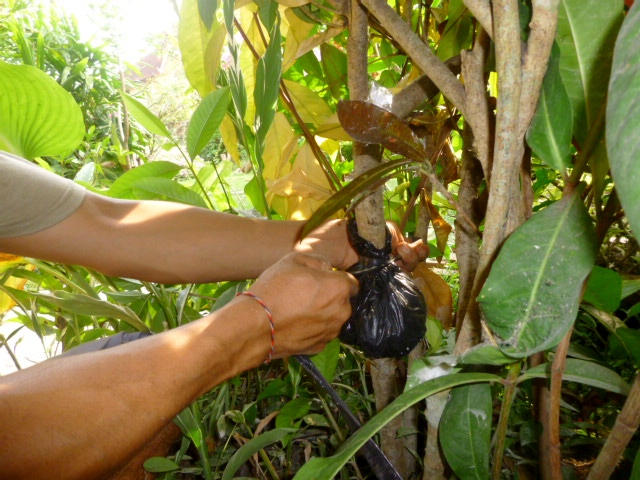
A piece of plastic is secured below the cut area and secured with string

He secures a piece of plastic below the cut area and ties it with string

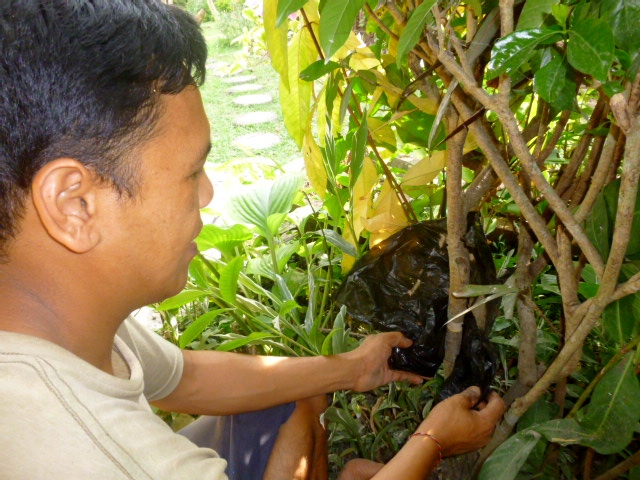
Forming a cupped shape, he scoops dirt into the opening

Forming a cupped shape, he scoops dirt into the opening

When dirt encircles the scarred trunk the plastic is drawn together and secured at the top. Another string is tied around the center.

When dirt encircles the scarred area of the trunk the plastic is drawn together and tied at the top and around the center.

Finally, Ketut punctures the pouch in several places to allow water to enter

Finally, using a sharp knife, Ketut punctures the pouch in several places to allow water to enter

In about three weeks, he tells me, a new root system will have formed inside the dirt ball. He’ll cut the bush off just below the plastic, leave the stump, and plant the tree. In days the stump will sprout new growth.

Plants are cheap here. A gardenia bush that size might cost 50,000 rupiah ($4.50). But Ketut comes from a farming family in the mountains. They grow oranges. He was taught early how to ‘make new trees’ and brings that knowledge with him to my garden. And I must say, it’s infinitely more delightful to watch Ketut make a new tree than to go to the nursery and buy one!

A High Holy No-No

I’m writing my story, a memoir of sorts, and I’m at a difficult part. In one sense there’s a feeling of release when I make my way through something that I’ve stuffed so far down it’s hard to even bring it back.
*
That happened today.
*
Then a Balinese friend stopped by. He blew my mind with kindness and I dissolved into tears. There was a mixed group around us and they absolutely did not know what to do. His random act was so complete and so unexpected it overwhelmed me. Then, just to make matters even more unacceptable (crying is frowned upon here) I hugged him. That is, of course, a high holy no-no in Bali!
*
His friends laughed, whether in nervous embarrassment for him, or for me, or for some unrelated reason I don’t know, but it accomplished what was needed. I disappeared until I could muster up a little decorum.

unnamed


When I tried to sit down and write again after all that, it was impossible. Enough emotion for today. I made a cup of coffee, found a quiet spot and allowed myself a few more grateful tears.

One thing is certain, and writing makes that clearer every day. I wouldn’t trade this crazy life for anything. Not for anything!

The ‘I’m Getting Old’ Myth

I’m getting old. It feels weird to look at my arms and see skin hanging off the muscle like wrinkled fabric. I still have really good muscles but the skin, OMG! The thighs are just as bad but I make it a point not to look at them.

Others my age cover their arms. I refuse. That’s part of the adjustment. How vain do I need to be? It’s a valid question. How vain do I need to be to continue to support the image of who I am, or an image of what I want others to believe I am?

We need to assimilate age, to accept it and become it. Otherwise we succumb to the impossible quest for eternal youth like Dolly Parton (71) or her counterpart old whatshisname Kenny Rogers (79)! They’ve been under the knife so many times that there probably isn’t an inch of flesh anywhere that hasn’t been sliced, pulled up, and tacked in place.

Dolly PartonKenny Rogers

And what are those glove thingy’s that Dolly’s wearing! Probably a distraction to camouflage really old hands!
*
I’m on a rant, but I’m finished now. Don’t, however, tell me that getting old beats the alternative even though it does, so far. The 50’s ease us into the idea. Oh yeah, I have a laugh line here or an eye-wrinkle there, and oh yeah, I need bifocals. Then we’re 60. Things still aren’t too bad if the lights are low.
*
But hold on to your perky tits, darlings, it’s a slippery slope from there!
*
So here’s what I’m saying. If there’s too much identity linked to the packaging, getting old is going to be a very difficult, or a very expensive proposition. But if life gets richer, raunchier, and more succulent with each passing year, a subtle exchange occurs. We turn inside-out. I kid you not. The inner workings of the mind, our passions and dreams, become paramount and the carcass is just a vehicle to get us from point A to point B.
*
Which behooves me to say, take good care of that carcass!

15 Steps Can Change Anything

I like structure, or maybe not really. But I know that I get the most accomplished when I have a list or an outline guiding me through the steps of ‘what’s next?’ So after I’d made some sweeping changes in my life, I sat down and figured out exactly what it took to get from point A (undesirable place) to point B (Utopia…or at least close). This is my formula in 15 steps. And for the sake of all things saintly, don’t skip number 15! In fact, it’s a good idea to celebrate all the little successes along the way. It’s called positive reinforcement!

A STRUCTURED APPROACH TO CHANGE 

Begin with a desire for something different

MOTIVATION 

Decide what you want

DREAM/GOAL 

Devise a plan of action

STRATEGY 

Develop a timeline for your plan

SCHEDULE

Determine what you will need to achieve your goal

RESOURCES 

Identify things that stand in your way

OBSTACLES

Decide how to overcome those barriers

SOLUTIONS

Create conditions that support the desired changes

ENVIRONMENT

Identify the friends who believe in you

SUPPORT 

Make a promise to follow through until you succeed

COMMITMENT

Make a start

ACTION 

Monitor your progress

EVALUATION

Modify when necessary

ADJUSTMENT

Don’t quit when things get difficult

PERSEVERENCE 

Acknowledge your successes

CELEBRATION!


Remember the old saying:
“How do you eat an elephant?”
Answer: “One bite at a time.”


Image Credit: goodreads.com

Facelift

Korean Woman

fashdloops.com

“Have you had a face lift?” the beautiful Korean woman sitting across from me, asked. I had just met her. More than a little surprised at the personal nature of the question, I stuttered a quick, “No.” Then peering at her perfect skin and guessing her to be about thirty, I asked, “have you?”

“Oh yes,” her nod added emphasis to her words, “and I would strongly suggest you should too.” It was all I could do to keep from spewing my mouthful of tea in her flawless face.

My website, however, was in need of a little nip and tucking. After all, it has matured and now knows who it is and what it’s about. But my face? Not a chance. I like what Victor Hugo said: Laughter is the sun that drives winter from the human face. And isn’t that the truth? No matter how wizened, toothless, and gnarly, a smiling face is always beautiful.

Are You a Dream Catcher?

*
If you lose your dream, you lose the force that propels the universe forward
on your behalf. Don’t doubt it for a minute. It’s 100% true.
Dreamcatcher by xxluulixx.deviantart.com

Dreamcatcher by xxluulixx.deviantart.com

*Some people have forgotten how to dream.

*
Some have a dream but cannot imagine achieving it.
*
Dream Catchers have both imagined and achieved what they want in this life.
*
They have one quality that others lack.
*
My daughter, Joy, says they’re fearless, but that’s not true. They’re just as terrified as the rest. The difference is the fact that they don’t allow fear to stop them from doing that thing that calls them. They know that not pursuing their dream is a compromise, a decision to live someone else’s life instead of their own.
That was in my heart today as I thought of you.
*
*

Previous Older Entries Next Newer Entries