Travel Guide Barbie

Few things are more terrifying than a trip to the hair salon. I can say with absolute honesty that I’ve never walked out of an appointment satisfied. I’m always convinced I could have done it better myself. (Overly confident? Narcissist? Confirmed do-it-yourselfer! Yes!) So for the past several years I’ve applied Nice-n-Easy #108 Natural Reddish Blond every couple of months with deeply satisfying results.

Fast forward…Bali.

I’ve been here for two years. When friends or family ask, “Can I bring you anything from the States?” I’ve begged them to load up on as much #108 as they can comfortably stow in their already overcommitted luggage. In exchange I play tour guide, help them find drivers and navigate the unwieldy currency exchanges. To date, my sassy hair has gotten by on the good graces of visitors. Then that thoughtless company discontinued #108. Trying creatively to meet my needs the last shipment via Jan’s suitcase held various alternatives. Bless her for trying.

Those events propelled me into panic. I’m not about to give up my vivacious strawberry blond-ness without a fight.

I began my search locally and realized in short order that a natural red-blond hair color could not be found in this village. Ubud is a thriving tourist center that caters to Asian women who all have dark hair. The products I found were in shades of mahogany, burgundy, pinky-purple, and brass.

I was three months into my last color job. Desperate, I got a lift with a friend to the upscale Mal Galeria in Denpasar, an hour’s drive from Ubud, and began the inquiry. Matahari had hair dye but nothing permissible. The apologetic clerk suggested Hypermart. The name, at least, sounded promising. Reality was a bit something else. Picture Walmart times ten and you’re close. The battalion of check-out counters with lines stretching to oblivion made me re-think going natural. As I did a No way! about-face my eyes caught sight of a small pharmacy tucked into a niche on the left. It’s worth a try, my ever optimistic self said.

I asked in pidgin Indonesian if they had hair color while pointing to my head. After a quick stop at shampoo and a few more meager attempts to communicate, I was led to the back of the shop. There, in a cluster of the usual sultry mahoganies and sables, I saw an incongruous label sporting a cartoonish red-head with enormous eyes. Her hair, Sweet Apricot, was the right color.

schwarzkopf-fresh-light-hair-color-sweet-apricot-L_p0018326099I blinked several times and she was still there. May I look? I said. The name on the box was in English but everything else was undecipherable. Is it for children? I asked. The question seemed reasonable enough to me. The imp on the box was a cartoon after all! What guru of marketing would put a video game type character on a box targeting…Asian teens and young adults? Didn’t they invent the gaming phenomenon? Of course! Brilliant!

The clerks were discussing me, looking at the box, then pointing to my head. This good for you, the older one said.

Now there was no way out. The 95,000 rph price tag translated to about $9 U.S. Shelling out a fist full of 10,000 rph notes I thanked the smiling clerks, tucked my tail, and left.

The box lay hidden in a drawer until last night. A glance in the mirror at my two-tone hairline, dishwater meets redhead, sent me digging under a bag of cotton balls, bandaids, and miscellaneous other supplies. I pulled out Sweet Apricot and was appalled anew by the image. It’ll be okay, I said, Relax! You can do this!

I opened the package and organized the contents in an array before me. The design of the applicator bottle seemed to have significantly superior engineering to the single aperture squeeze thing I was accustomed to. The hermetically sealed packet of plastic gloves weren’t the whisper thin, wrist length throw-aways that Miss Clairol sees fit to supply. They stretched all the way to my elbow and were textured for a non-slip-grip. Sweet Apricot was dead serious about protecting the delicate hands of it’s users.

A quick Google Translate provided instructions that sounded familiar. It’s just hair. As I thought it, I wondered how many times I had breathed out those same three words prior to a disaster of epic proportions.

I’d stalled long enough. With the picture directions spread out on the countertop, I noticed a punch-out circle in the box just the size of the applicator bottle. I was instructed to remove the circle, secure the bottle in the opening for stability, then pour in the color cream, cover securely, and scramble. (Google translate isn’t perfect.) I did as I was told.

You don’t need a blow-by-blow, but the experience was shocking. Once again my sub-grade expectations put me to shame. The solution didn’t singe the nostrils like the Nice-n-Easy brand. It smelled good. The comb-like applicator was 100 times better than the Clairol product and delivered the color cream in an even, perfect flow through its teeth. The goo stayed in my hair and didn’t dribble down the back of my neck or under my chin. Of course all that would be moot depending upon the final outcome.

When I finished, Ubud was experiencing one of its humid, evening rain showers so I knew my hair wouldn’t dry until morning. Final judgment would have to wait.

As the sound of roosters and a chorus of frogs heralded sunrise I stumbled to the bathroom mirror. Spikes of shiny plastic Barbie-doll-ish hair sprouted in all directions. But the color wasn’t a normal Barbie color. It was more like Roller Blade Barbie or Mud Wrestler Barbie. I found myself once again squinting and rubbing my eyes. Maybe after a cup of coffee…?

P1070235After coffee I loved it! No more imports of inferior products from America. No more impositions on the good will and big hearts of Bali bound travelers. I’ve found my color at last, Sweet Apricot!

When I skyped with daughter, Joy, this morning she thought for a minute then christened me, Travel Guide Barbie and I’m okay with that. I’ll still do the tours, arrange drivers, and help with currency exchanges. And I’ll do it with gratitude for my friends who are planning future trips to Bali, because I’ve yet to find a workable alternative to CoverGirl #210 Perfect Point Plus Espresso eyeliner pencil!


When you just keep falling in love

For someone who’s sworn off men, I’m not doing too well. I’m alone, that isn’t the issue. But my defenses have been shot to shreds in the loveliest possible ways and I find myself falling in love a little bit every day.

First there’s Ketut. I’ve written thousands of words about Ketut, glowing, gushing words. When I first came to Bali he was my room staff. I remember when he met me at 3 a.m. as I disembarked from a taxi after a trip of thirty-six hours from the States. “You Zely?” he asked, then hoisted my brick-heavy suitcase on his shoulders and told me to follow him. The next morning, there he was again. “Breakfast?” he said. “Kopi? What you want?”

P1030558

Ketut with baby daughter Nengah

I remember my thoughts. A man? Why? Couldn’t I have a sweet girl cleaning my room and bringing my breakfast? Drat! I don’t want to put up with man-energy. But I didn’t understand then that the Balinese man isn’t like the men I’d known in the West. Ketut filled my room with flowers, daily. He anticipated me, knew when I would be hungry and showed up with treats. Knew when I wanted company and hung around to chat. Knew, even more importantly, when I wanted to be alone, and left me alone. His intuition was far more highly developed than mine, and I’ve come to realize that’s true of Balinese people in general. (But I won’t go into details here! Another time.) In short, Ketut healed my heart.

Enter, Gede! He’s another member of the staff in the neighborhood where I live. Gede is a clown, a twenty-one-year-old little boy who loves to laugh and make others laugh too. One day he gave me a lift on his motorbike and told me he wanted to bring me a kebaya. That’s the beautiful, traditional blouse that women wear to ceremonies here. It seemed far too generous a gift for someone who doesn’t even employ him, but the next time he went to his home in Kintamani, he came back with not one, but three stunning kebayas for me. They all fit like they had been custom tailored for my body. I fell in love with Gede long before the kebayas, but I fell a little bit deeper that day.

P1030524

Gede…always the trickster!

The Tukangs working on my house, we’ll call them Dewa One, Dewa Two, and Pak Mandi, all have a slice of my heart. Dewa One scared the bejeezus out of me when I first met him. He had an angry man look, his hair was wild and his body was as tight as a coiled spring. He snapped orders at his crew and I steered clear. But his work was immaculate and one day I drilled up the nerve to tell him how happy I was with his skillful precision. He smiled. No, you don’t understand. He SMILED! There isn’t a more beautiful face on earth than the smiling face of Dewa One. My heart became gooey. Now I find every possible opportunity to praise him and he graces me with that gorgeous grin every time. I love Dewa One.

workers that took down the yoga deck

Dewa One…you’ll have to trust me about the smile!

The most outrageous of my loves is Pasek. He’s blatant, calls me his second wife, makes highly suggestive comments and enjoys watching me bristle. I’ve met his first wife and I adore her but I wouldn’t want to be her. Her hubby’s a handful. But do I love him? Oh yeah. Pasek is the one I call when my electricity goes out, when my faucet leaks, when I need food from the market, or when I want to know about Balinese culture. His harmless joking has become just another part of life here. And he, too, anticipates me and shows up just when I am about to dial his number.

Bali - Pasek's Family (26)

Pasek and his wife, Nyoman

But it doesn’t end there. I’m in love with my tailor, with the taxi drivers, with the man who sells tickets on the street, and the shop keeper at the corner convenience store. I’m in love with my neighbor’s husband, and pretty much every Balinese man I know. Do I use the word too loosely? I don’t think so. The men in Bali are kind to me. I’m susceptible to that. In the West kindness has become a lost art. We have bumper-stickers to remind us to be kind. But here it’s a fact of life, so I just keep falling in love.

P1060558

The neighbor’s husband! (Don’t worry, Nina…you have zero competition here!)


My Village, My Tribe


P1010125

I woke up the other morning to emailed photos of the annual Family Picnic. It’s an institution, an every year reunion of all living members of my father’s large family of origin. There were twelve children who had children who in turn had children, and those children are currently having more children.  So they gather, those who aren’t feuding or living far away, at the home place, to eat, reminisce, play softball, and marvel at how they all look the same, never change, don’t age, and isn’t cousin Charley’s little girl a handful!

I puzzled over the photo for a long time and then took a walk. My injured foot felt ready at last.

The past six weeks I’ve been immobilized due to an injury. During that time I became aware of a different world. On the best days it was vacant, void of feeling, a long tunnel of boredom. On the worst days a sodden blanket descended over everything and the atmosphere darkened with anxiety, foreboding, and fear. It was a place empty of gratitude. In my small room, day after day, foot propped on pillows, construction noise hammering around me, there were times when I sank into that other world.

But today marked the end of solitary confinement. I set out under paintbrush blue skies washed with sunlight and expectation. The taxi drivers in the street welcomed me back. Where had I gone? Had I been in America? I met an Australian friend for lunch and mailed a letter at the post office. Out of nowhere gratitude spilled over me. In gratitude anything is possible. The air sizzles with potential. People smile and instant bonds form. It’s a world of generosity and heart wholeness.

At the end of my outing, giddy and joyful I approached home. The shaggy grass in the yard had been trimmed by my neighbor. I drew closer and saw Ketut’s head in the kitchen window. I could hear Lake Batur fish sizzling in the pan. “How did you know I’d come home now and be starving?” His uncanny intuition is unnerving. “Did you read my mind?” I’ve accused him of that before.

“You long walk, maybe hungry,” he said as he piled mounds of stir-fried vegetables, steamed rice with chunks of sweet potato, and the crisp body of a whole fish on a plate and handed it to me.

“Yes,” I thought, “A very long walk, right out of one world into another.” I had created them both by what I allowed my mind to dwell upon. Ketut is always kind and thoughtful. The sun in Bali is always shining. I have no more or no less money today that I did yesterday. But for six weeks my stony little heart lacked gratitude.

Bali - Ketut's Family (4)

And then it hit me. What seemed odd about that picture was that all those people have white skin. Of course they do. They’re Norwegian with a smattering of other European genes. My family here is Indonesian, mostly brown, and sometimes I forget that I’m not.

But it isn’t skin color that makes a village, or shared history that creates a tribe. It’s the condition of the heart, the bonds of love and service, the willingness to be vulnerable and accessible to one another. That can happen anywhere.

And gratitude is the gate between worlds.

Which is more difficult for you, too many choices or too few?

Do you love having a multitude of options and revel in the process of narrowing them down to a single, perfect choice? Or are you happiest when provided with only two so you can flip a coin? You may say, “Well, that depends…” But you know what? Not really.

How do you handle abundance?

How do you handle scarcity?

Do you believe there is always more than enough or is there a slow leak in the bottom or your glass?

For me, the more options the better. My brain is hardwired to sift through layers of information and hone in on the nugget, the unexpected thing that’s exactly what I want even if my notion of it is foggy when I set out on the hunt.

So here I am today, looking for a particular item. I have to decide between two options because in the whole of Bali there are only two options, neither of which is what I’ve envisioned. What happens? I freeze up. I simply can’t decide.

The problem is two-fold.

A) I have a preconceived idea of what I want, and

B) I know what would be available to me in America.

So I leave that shop and go to the next. Same two options. And the next. Same. I get myself to a bigger town believing that just around the corner will be Home Depot, or Target, and they’ll have CHOICES!

Why am I so pig-headed stubborn? One reason is because I will exhaust all possibilities before I resign myself to settle for something I don’t really like. (This has not always been so!) Or, once convinced that my desire cannot be met, I’ll rearrange my entire plan so I don’t need what Bali doesn’t have. This approach works better for me.

Here’s the irony: there are exquisite products here that I could only dream about in the U.S.

But to find simple things like a clear shower curtain liner, crepe paper streamers, or hair dye that isn’t purple mahogany or fire engine red, is a different story. Not having access to what I want spurs creativity. I cruise the markets and shops mentally cataloging the proliferation of unusual,unique, and really strange items for sale. What will work instead of__________ (fill in the blank) is my new mantra.

If I were rushed for time or stress-crazed over a deadline, this would drive me nuts. But I’m retired! What a glorious state of being! And if I need a clear shower curtain liner I can go to the plastic shop and buy a hunk of the size and weight I want, take it to the tailor who will hem it and add grommets, go to the aluminum shop and have a pole cut to the right size, then call my handyman to come and figure out how to make it all work. And he will because the Balinese are the most creative, inventive, where-there’s-a-will-there’s-a-way people on the planet.

It’s a different way of life. Magical, frustrating, and every day something new.

Now back to my question: which one is more difficult for you, too many choices or too few?

Can I be happy when I’m not?

It’s easy to be brave when nothing frightens me.

It’s easy to be strong when nothing stronger attacks.

It’s easy to have compassion from a distance.

It’s easy to let go when I don’t really want it anyway.

It’s easy to be happy when life gives me what I want.

But I don’t get spiritual growth points for that! There’s no gain without loss, no enlightenment without accepting and overcoming difficult challenges.

Three weeks ago everything changed. A door fell on my foot. It wasn’t just any door. This door was a very old, very dense Bali door of teakwood that came crashing down in the dark. A goose-egg the size of a softball ballooned, splitting the skin across the delicate arch and it throbbed like a drum being beaten from the inside. Neighbors heard the crash and rushed to my aid but other than an ice pack there was little to be done.

I took two ibuprofen and, since it was night anyway, hobbled to bed.

Backstory:

I’ve always been healthy. I’ve had the kind of body that cooperates no matter what I throw it’s way. It’s a balanced body, strong, hardy, and willing. It likes physicality and too much sedentary downtime is not okay. So as I was saying…

P1070050Day One.

I wake up and try to walk on the bulbous left foot, but it’s more of a limp-hop that deteriorates fast when all the blood in my body rushes to the wound with it’s fiendish pounding. I decide that this will be a writing day with my foot elevated on a stack of cushy pillows.

Day Two.

I tentatively swing my feet out of bed and plant them on the floor. The left one seems to rest on a squishy bubble. I try to walk and the throbbing hop-dance commences. But today is writers’ group and I am determined to go. There’s a length of fabric from a sarong tie that is about the right size so I wrap my foot and try a normal walk. Yes. With the support of the makeshift bandage it’s do-able.

The foot is still happier elevated so I take a seat at the end of the table and make it through the meeting in fine form. Afterwards, a friend invites me to see his new villa, “It’s only 500 meters,” he says.  I struggle with the metric system. Is a meter like a foot? A yard? And if it’s 500 yards, how far is that? We start out and after 10 steps I’m in trouble. But my strong, hardy, willing body won’t say no.

When I get home I go straight to bed with ice packs and my foot propped up far enough so the hammering blood drains away from the wound. “I probably overdid it a little.” It’s my last thought before going comatose.

Day Three.

Okay, let’s just say I do a stupid repeat of day two. I take my foot shopping, walking on concrete floors for hours. What was I thinking? The throbbing that night is intense and I notice a hot redness forming around the split flesh. I take two ibuprofen, slather the open slit with triple antibiotic cream and go to bed with the ice pack hoping I’ll fall asleep before it melts.

Day Four.

My Balinese friends begin to hover, frown, and offer various oils, ointments, and the juice of roasted frangipani stems to apply to my compromised foot. They notice the melted ice pack. “No ice,” they tell me. “Only heat.” They want to know if I’ve seen a doctor. “No, it’s not broken,” I say, after all, I can walk, can’t I? But the inflamed area bothers me. I’ve brought a prescription of antibiotic tablets from the U.S. and decide to take them.

Day Five.

I experience a change in my nervous system. The realization that I am going to have to slow down to a near dead stop and allow this foot to rest if I want it to heal drops into my consciousness. NOOOO! screams my strong, hardy, and willing body. In that instant I know that it’s going to be a battle. My usual practice of denying pain and pushing through isn’t going to work this time. A surge of panic starts at the base of my spine and ripples upward, fluttering around my heart and lodging in my throat. I scramble to the internet and enlist Google. After reading dozens of descriptions I self-diagnose. I’m quite certain that I have sustained a stable Lisfranc injury.

Naming the thing brings a certain peace. But as I read down to the treatment and recovery time a fresh wave of resistance rattles me. It can take up to six weeks of elevation and minimal use of the foot to fully recover.

A touch of insanity seeps around the edges and creeps into my flailing mind. Six weeks! The still functioning logical part of my brain takes a step back. “Oh, you don’t like that at all, do you?” she taunts. “You love to tell everyone else to listen to their body, and look at you! Here’s your chance and you’re behaving like a spoiled brat.” Self-talk can be brutal. But I have to admit that she, I, am right. I grab my notebook. I need to process and writing is the quickest way for me to get to my truth. The first word that appears is OPPORTUNITY.

With that word my perspective shifts. This time of enforced quietude, inactivity, and introspection is an opportunity rich with possibility, I write.

The power of suggestion, when written down, is readily internalized and becomes as solid as fact. When I put those words on paper I know that the time will not be wasted or lost, that it will just be different. Giving honor to my foot, working with it’s healing instead of against it, brings me back into harmony with myself. Accepting the constraints as a gift, an opportunity to explore my own mental and emotional discomfort which are far greater than the actual, physical pain of the injury, provides a rich environment to expand my awareness.

Day Twenty-one.

Today marks the half-way point, three of the six weeks are behind me. The foot is still swollen, the gash is still oozing, but the knob has receded and there’s no infection. It’s healing. But the real progress is in my mind. I’m not fighting it any more. In fact, I’ve grown to quite love the endless hours of confinement. When all of that Type A, produce-or-die energy is stripped away, I become a docile, contented, lazy-ass, slug…pretty much.


Seismic Shifts

For those of us devoted to inner work we are aware when we’re in the middle of something big.

Transitions manifest in various ways. A squirrely uneasiness, a plunge into deep depression, an expectant nervous sizzle, these and other unsettling phenomena like them can signal significant change.

Volcanic Eruption

Volcanic Eruption

When the earth’s crust moves, volcanoes, earthquakes and tsunamis result. A movement of mere inches can throw the existing order of things into chaos. When the violence settles, whole land masses have disappeared and new ones have formed from the molten contents spewed forth. Craters and mountains rearrange themselves. Earth-wounds lay open, fragile and unstable.

The energy of our transitions works the same. Just as the earth shudders and trembles, spouts steam, or rumbles sometimes for months, maybe years before a major trauma, so we do likewise before the breakthrough.

A human experiencing change is a microcosm of that magnificent earth force. We are transforming on a cellular level, altering the synapse sequences of nerves, re-routing paths in the brain, overriding destructive programmed responses. It can leave us feeling raw and exposed but at the same time, new, like a landscape stripped of old growth awaiting the gardener.

It behooves us to become conscious of the way we experience these seismic shifts. Whether we’ve sought change or had it forced upon us the opportunity is the same. If we approach the challenges in a spirit of friendliness and cooperation, gratitude will manifest and accompany us on the journey. And as we know, life is only and always all about the journey!


Writing Memoir – The Vulnerability Factor

“You should write a book!”

Shouldn’t we all? Isn’t every life worthy? Hasn’t each soul passing through existence experienced the joys and sorrows of living in a unique and personal way?

I’ve tried many times, sat down with the crisp blank Word Document staring me in the face. Where to start? Birth? I don’t remember much. Looking at the whole of my life rolled out through the decades is instant overwhelm. But worst of all, boring. I know this story. It isn’t like writing a fiction novel where the twists and turns are as much a surprise to me as they will be to my future reader.

Looking back at failed attempts I understand why it couldn’t happen until now.

1) Too painful.

To write memoir you have to go back into the stories and re-live them, write the experience of what you saw, the smells, tastes, and textures, the feelings. My heart hadn’t healed enough to go there.

2) Too revealing.

To write memoir you have to accept who you are and write from that place. I wasn’t ready to give up the façade of perfection, take responsibility for my own bad decisions and be honest with myself.

3) Too real.

To write memoir you have to be willing to be vulnerable. Your shadow has to appear in all it’s shameful, embarrassing glory. Because after all, isn’t it the shadow side that makes us interesting…and whole? I wasn’t willing to embrace the darkness of my own truth.

4) Too scary.

To write memoir you have to risk everything. We thrive on connection with others. Shame is the fear of disconnection. To reveal ones self, warts and all, is the ultimate risk. We go to great lengths to keep our sunny side up and numb ourselves to the shameful parts. I was numb.

5) Too soon.

To write memoir you have to have a clear perspective of your purpose. “Because someone told me I should,” isn’t a clear perspective. “Because I love myself and I have an amazing story to tell,” is better. But when you come to the place of knowing that your story isn’t yours, that it belongs to others who are still mired in the swampy numbness of their own failings and insecurities and it may show them a way through, that’s when it’s time.

My time is now. As I muck around in the past, digging up old stuff, the events that light up for me aren’t the ones I expected. And as I write them, the way they present themselves on the page isn’t always the way I’ve rehearsed them through the years.  It’s the most amazing phenomenon. What I’m writing is my life told from a place of wholeness and it doesn’t look anything like the dismal sink-hole I imagined it was.

When I hit a particularly bumpy stretch and make myself go back into it, on many occasions laughter bubbles up. The first time it happened I was dumbstruck. “Why am I laughing? This was a nightmare!” In a flash I realize that I’m laughing at myself, at my naiveté, at my relentless stupidity in not wanting to see what was right in front of my face.

img_3184

Walking the labyrinth

I’m loving this memoir writing process. The words tumble out and bounce back at me like the rerun of a movie I watched a long time ago. But I’m seeing it with older, wiser eyes, and a healed heart. And even though I think I know the ending, I’ve let go of the need to control it. I’m willing to be surprised.


We’re not in Kansas anymore!

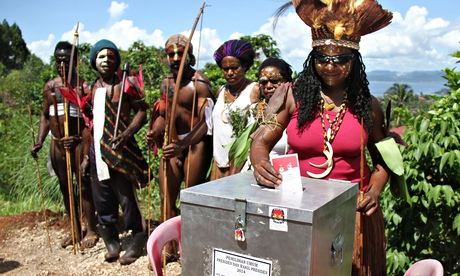
We’re not in Kansas anymore! This photo of voters in New Guinea portrays more eloquently than words the collision of worlds as all of democratic Indonesia turns out to elect its new president. The information in this article, reposted from The Guardian, compares this election with the extraordinary grassroots success of Obama in the United States.

Jokowi and Prabowo both claim victory in early Indonesian election results

Papuans vote in Jayapura in the remote eastern Indonesian province.

Voters in Jayapura, in the remote eastern Papuan province. Analysts fear the dual claims of victory could lead to a constitutional standoff. Photo: Liva Lazore/AFP/Getty

The Guardian, Wednesday 9 July 2014 16.13 BST

by: Kate Lamb, Jakarta

A historic presidential election in Indonesia was precariously balanced on Wednesday after both candidates declared themselves winners, raising the prospect of a tense standoff in the Islamic world’s biggest democracy.

Just hours after the polls closed, Joko Widodo, the governor of Jakarta who has made the fight against corruption and social injustice key policies, gave a live television address claiming victory, setting off scenes of jubilation among his supporters.

“We are grateful that based on the counting of the quick counts, Jokowi-JK has won,” he said, referring to his own nickname and the initials of his running mate, Jusuf Kalla. He cited one of the early post-election counts, which samples votes from around the country and which gave him about 52% of vote compared with about 48% for his rival, Prabowo Subianto, an ex-general and son-in-law of the former dictator Suharto.

“This is the victory of all people of Indonesia,” Jokowi later told supporters. Another credible quick count by the pollster Saiful Mujani with similar figures gave Jokowi 52.95% and Prabowo 47.05%.

But his opponent was in no mood to concede, appearing on television later to say: “We are grateful from the incoming data that we received the mandate of the people.”

Numerous quick counts cited on television channels showed significant variations in result, depending on the political affiliation of the TV channel. The quick counts conducted by the Centre for Policy Studies and the Indonesia Voice Network, put Prabowo in front by 1% to 4%.

Political analyst Yohanes Sulaiman said: “I think basically we are going to be in limbo. Are you actually willing to tell Prabowo to his face: ‘Hey, you are wrong’?”

Prabowo, who was dismissed from the Indonesian army special forces for ordering the kidnapping of pro-democracy activists in 1998, is known to have a short temper.

His supporters admire him for his firmness, arguing that Indonesia, a nation strung across 17,000 islands and home to hundreds of ethnic groups and cultures, needs a strong, unifying leader.

Other analysts believe the dual claim could end up in a long drawn-out constitutional battle that is unlikely to be resolved for months.

The elections are seen as a crucial test of democracy in the world’s fourth most populous country, as they should result in Indonesia’s first democratic transfer of power from one elected leader to another. Indonesia has offered a respectable example, in recent years, of a Muslim-majority country that threw off dictatorship and blossomed economically under a democratic system.

On his official Twitter account, the outgoing president, Susilo Bambang Yudhoyono, who has publicly endorsed Prabowo, urged for peace to be preserved.

He asked both camps to “restrain themselves and not to mass on the streets to celebrate, until an official KPU [election commission] announcement”.

Yudhoyono repeated his comments several hours later, adding that the conflicting counts did not qualify as the “official results”.

Authorities said up to 250,000 police officers were on standby across the country and while there are fears that the conflicting declarations could cause unrest, as of Wednesday evening there were no reported incidents.

Before the election several credible pollsters had placed Jokowi ahead of Prabowo, but maintained that the race was too close to call.

At the polls, voters appeared to be equally divided over their choice of the next president.

Voting preferences were more pronounced across demographic lines. First-time voters, who account for a third of the 187 million electorate, tended to favour Jokowi.

Anis Komariah, 28, commenting on Jokowi’s reputation for clean governance as she voted in south Jakarta, said: “He is the type of person that is sincere, and the parties that support him, he didn’t offer them ministerial positions.”

Young voters, who have taken to social media in huge numbers during the election – at one point on Wednesday six out of 10 top trending hashtags worldwide referred to Indonesia’s election – believe that Jokowi represents a clean break with the past.

Older voters who are likely to have vivid memories of the mass riots that led to the fall of Suharto in 1998, say they favour Prabowo, seeing him as a strong, commanding leader who they believed would better unify the country.

Rofiq Mohammad, a 48-year-old voter, said: “I think a strong leader is important because we don’t want a situation like the Middle East.

“If things get unstable, everything will go bad and maybe so bad that it will be difficult to come back again. Indonesian stability is the most important.”

However, there appeared to be a consensus among voters in the world’s third-largest democracy that the election should go ahead peacefully amid fears that riots could break out in the event of a tight or contested result. Official results are not expected for two weeks.

Edward Gunawan, a film producer who flew home to Indonesia from Bangkok in the middle of a shoot so he could vote for the first time, said that in recent weeks selfies and pictures of food had vanished from his social media feeds.

“It’s interesting that your news feed is suddenly filled with very serious stuff, but I see it as a very encouraging sign,” said Gunawan, who likened the mood to the election of US president Barack Obama in 2008. “My generation and even the younger generation are getting involved and getting excited about the political process.”

How To Outwit Atrophying Brain Cells

As a native English speaker I have assumptions about language. But the one that troubles me the most as I study Indonesian is the idea that everything I say should translate the way I think it. In other words, I want every word of English to have a corresponding word with an identical meaning in Indonesian. Am I naïve or just stupid?

If you’ve learned another language you know that at first you listen to what’s said, translate it into English so you know what’s being said, think of the answer in English, then translate it back into the foreign language. That’s a bulky, inefficient method and that’s where I’m at.

So the other day when I wanted to say, ‘next time,’ I fished around my brain for the Indonesian word meaning next. Whoops! Sorry. No enchilada. I asked the nearest English speaking Balinese person, “How do you say ‘next time’?” He rattled off a string of words. “Repeat that slowly, please,” I said.  When I wrapped my head around the jumble, it translated as, following the other time only. That doesn’t work for next month though. Next month is, following the month in front. Try happy birthday. It’s no fun at all: congratulations repeat year. I don’t need to be repeating any years, thank you very much!

My favorite is selfish. That one word of English takes no less than four words of Indonesian and it translates literally as, like to make important one’s self alone. Nails it to the wall, doesn’t it?

I was told that Indonesian was an easy language to learn so I plunged in all starry-eyed and eager. Easy compared to what? Arabic? Chinese? But for those of a certain age who want to exercise the brain cells to keep them from atrophying, by all means study Indonesian. It’s 90% memorization and 10% remembering what you’ve memorized. That’s a lot to ask of defunct grey matter. After that the challenge is knowing how to put all those amazing words together in a sentence. It’s tricky. Throw everything you know about English sentence structure out the window and you’re off to a good start.

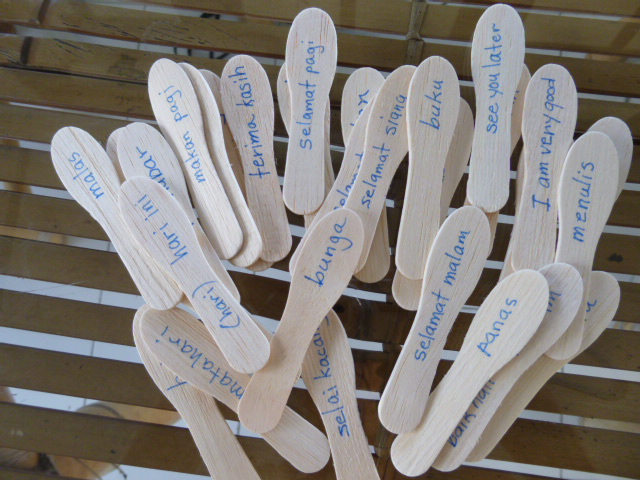
P1000267This was my humble beginning about a year ago. I found the wooden ice cream sticks, 25 to a package for 40 cents, and bought two packages. I wrote an Indonesian word on one side and its English counterpart on the other and I was on my way. Ah the bliss of ignorance! It really did seem easy until one day I realized I didn’t know how to say anything in past or future tense. That’s when the prefixes and suffixes and all the delicious little extras appeared.


P1070038

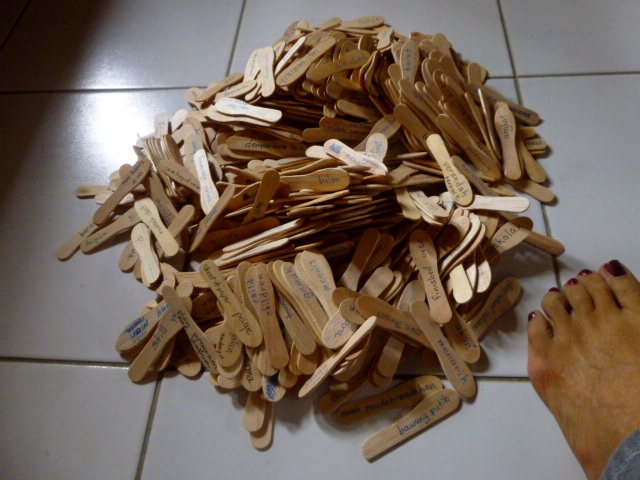
 Now, hundreds of words later, I am nowhere near fluent in this ‘easy’ language. These five hundred plus sticks hold the words that I’ve successfully lodged in the memory banks.

P1070039

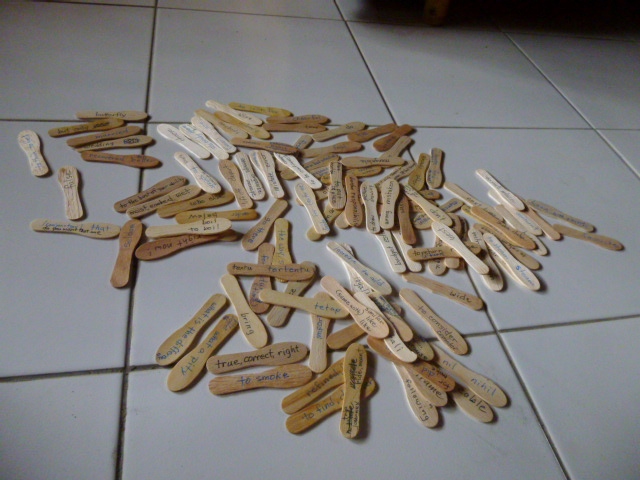
 And here are 107 more that rattle around like loose marbles, but I’m getting closer.

It’s an undertaking that is humbling and gratifying at the same time. Just knowing I CAN still memorize and retain information is a kick! But being able to communicate in the national language of my host country feels important. It’s my way of saying thank you. Thank you for your kindness, your beauty, your warmth. Thank you for your patience with my assumptions and my ignorance. But most of all, thank you for this amazing life. 


Today I Lost a Friend

It began like a normal morning with roosters crowing in advance of the sun. I awoke with them around 5 a.m. As the sky brightened I checked the clouds, puffy white in a sea of blue, perfect. Ketut appeared with groceries from the market. “I’d like to go to Denpasar today. Are you busy?” He wasn’t.

A half hour later we were tooling through rice paddies and small villages in high humor. I’ve mulled on the fact that Ketut tends to speak little when I can hear him but becomes a regular chatterbox when the thick helmet, rushing wind, and surrounding traffic noise make it almost impossible to decipher his words.

The shop I wanted to see was in Kerobokan, but as we entered the Denpasar area I spotted an ACE Hardware Store. These are not like the Ace Hardware’s at home. Here you can find fake plants, ‘a plastic garden’ as Ketut puts it, bathtubs, and children’s toys as well as auto parts, tools, hinges and toaster ovens. Neither of us had been there before so we took time to check out all three floors of the massive building.

We were looking at the display of safes cleverly disguised as canned vegetables, when he got a phone call from his wife. Workers were repairing the floor in that vicinity of the store so Ketut moved to a quieter area to take the call.  When he came back he had a strange look in his eyes. I told him I was finished and asked if he was ready to go. Holding me in that deeply intense gaze he said, “I’m sorry.” My gut did a flip. Something was terribly wrong.

“What is it Ketut? What happened?”

“My father die,” he said. The bottom dropped out of my heart.

Ketut’s father was special. Whenever I was a guest at the family compound he sought me out to talk. He asked questions about my country and my family. He wanted to know about the seasons in Minnesota and how it could be so cold for part of the year and so hot at other times. His mind was sharp and quick to grasp the nuances of things he had never seen. Knowing him I understood where Ketut got his facile intellect and ready wit.

Not only did he possess a natural curiosity and a fine intelligence, but he was kind. deeply kind. That’s another attribute that Ketut inherited from his papa.

The ride back to Ubud was a teary one for me. I know that outward expressions of grief are not appreciated here. A ‘clear face’ is highly prized. Sadness is thought to attract negative energies and upset the balance.  I was glad of the dark glasses and the hour on the back of the motorbike to process my emotions.

Every so often Ketut asked, “You okay?” The dear man had just lost his father and he was still tending to me.

“Yes, I’m okay. You okay?”

“Ya.”

The motorbike bumped it’s way back to Ubud while Ketut told me the story of his father’s illness. He had been to the Balinese healer and a Western doctor. The doc told him his arteries were closing and surgery wouldn’t help. The Balian gave him a medicinal concoction to drink every day. Some days he felt strong. He drove his motorbike and cut grass for the cows. Other days were not so good.

“My father say he want big photo,” Ketut said as we reached the outskirts of Ubud. “For cremation.”

Bapak is survived by four older siblings. One sister had requested a photo for her cremation several months ago. I snapped a picture, had it enlarged and printed, and delivered it to her on a subsequent visit. It was a very big deal.

“Is it too late?” I asked.

“Oh no! Not until cremation.”

I have the picture. It captures this man, his elegant bearing, wise face and kind eyes. He looks far younger than his seventy years and for the hard working mountain farmers, that isn’t often the case.  I’m glad there is one last thing I can do for Bapak as his soul speeds on its journey. Goodbye, my friend. I’ll miss you.

P1060632


Previous Older Entries Next Newer Entries